
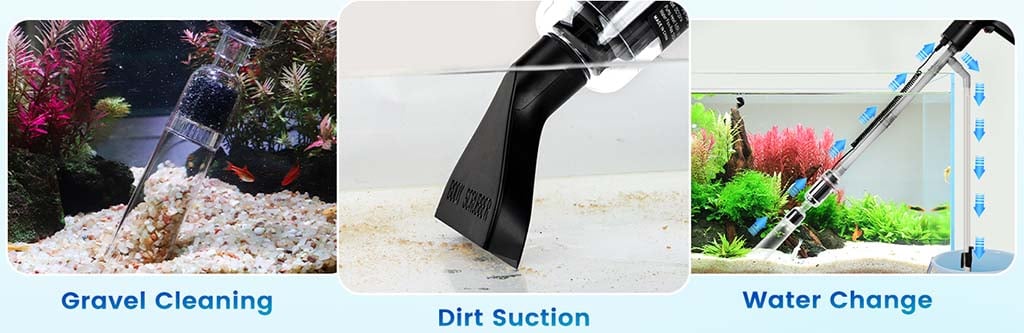
An electric gravel cleaner is a blessing for many aquarists due to its speed and efficiency. If you are in confusion about whether to buy or not an electric gravel cleaner, this article will help to resolve your query. In this article, you will learn about what this is, how it works, and its usage. A comparison between a manual and an electric gravel cleaner will help you understand the clear difference.
Content Table
What features to have the best electric aquarium cleaner for your home aquarium? Moreover, how to use an electric gravel cleaner is a worthwhile part of this article. At the end, you will find out one of the best electric gravel cleaner reviews, i.e., HG292. In short, till the end, you will be ready to kick-start your electric gravel cleaner journey.
best electric aquarium gravel cleaner
What is an Electric Gravel Cleaner in an Aquarium?
An electric gravel cleaner is a battery-powered vacuum or electric vacuum tool. It cleans the tank bottom, leftover, fish waste, and dirty water from the gravel bottom of the tank. You can consider it a real vacuum cleaner, but for your tank.
Working Principle and How it Works?
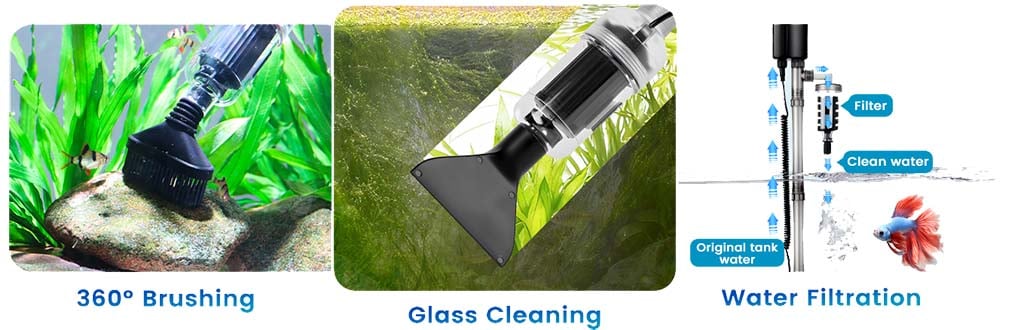
It has a motor that creates suction to pull the dirty water or other wastes from the bottom. Debris is stuck in a filter chamber, and clean water returns or moves to a bucket in the tank.
Uses of Electric Gravel Cleaner
- Remove fish waste and leftover food from the bottom.
- Remove the harmful bacterial colony from the tank.
- Helps to keep ammonia and nitrite levels at zero in the tank.
- It is time-saving as compared to manual syphoning.
- Fast water changes
- Sand washing
- Help to clean algae from the tank’s walls.
Electric Gravel Cleaner Vs Manual Gravel Siphon
Manual gravel siphoning is usually fine for beginners, as they have small tanks. However, a manual gravel siphon is not suitable for a large tank. Moreover, a manual siphon needs to initiate the process through mouth suction or shaking.
Many aquarists find it annoying and uncomfortable. While the electric gravel cleaner initiates the process by itself, no manual suction is required. Here are some other differences between manual and electric gravel cleaners.
| Feature | Electric Gravel Cleaner | Manual Gravel Siphon |
| Power source | Battery / USB | None (gravity-fed) |
| Ease of use | Very easy | Moderate learning curve |
| Suction control | Adjustable | Hard to control |
| Setup time | Quick | Takes longer |
| Best for | Large or deep tanks | Small tanks |
| Fish safety | High (with flow control) | Moderate |
| Beginner-friendly | Yes | Less so |
Does My Fish Tank Need an Electric Vacuum Cleaner?
An electric vacuum cleaner is not inevitable. If you have plenty of time and a small tank, a manual gravel vacuum is fine. However, here are some scenarios where an electric gravel cleaner is a better option.
Large Tank (40+ Gallons)
Manual cleaning takes too much time in large tanks. If you have a 40+ gallon tank, it is better to use an electric gravel cleaner.
Deep Sand Or Gravel Substrate
If your tank has a deep sand or gravel substrate, a manual gravel siphon will not help. It will be inconsistent and messy. In this case, an electric gravel cleaner will help as it can clean the deep substrate in every way.
Busy Fish Keeper
If you have too many tanks or have a busy schedule, an electric gravel cleaner will ease your fishkeeping journey. Usually, it takes 10 to 15 minutes to keep a tank bottom clean.
Replantation Tank
If you are doing replantation in your tank, debris will be everywhere. Therefore, it is necessary to clean the bottom thoroughly.
Tank With Heavy Feeders
If your tank has heavy feeders, i.e., goldfish in your tank, they produce huge amounts of waste. In this case, it is better to have an electric gravel cleaner.
how to use electric gravel cleaner
Key Features to Look For Before Choosing
Before selecting the best electric aquarium gravel cleaner, you need to check the following characteristics in your targeted cleaner.
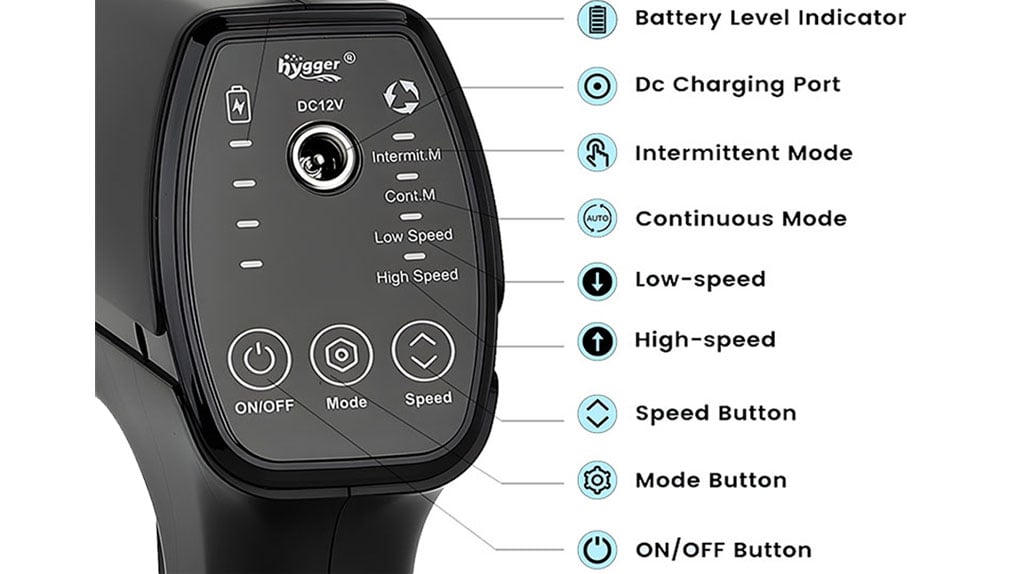
- Check the suction power. Whether you can adjust the suction and flow. Heavy suction can lead to sucking small fish into the tank.
- Check the tube length. Usually, a large tube is better as it can reach some awkward places in the tank without any problem.
- Check the quality of the filter bag or chamber. Fine mesh helps to catch even small particles and avoids clogging.
- Look at the auto shut-off option. It will help to shut down the motor in case it is running dry and avoid burning.
- The 2-tube water return system is always better as water returns in the tank by itself after filtration.
- Check the nozzle size options. Different nozzles do different jobs at the bottom of the tank.
Use an Electric Gravel Cleaner
Use an Electric Gravel Cleaner Safely and Effectively
The electric gravel cleaner is easy to use. You only need a few things.
- Electric gravel cleaner
- Bucket (for drained water)
- Dechlorinated water (for water top-off)
Steps to Use Electric Gravel Cleaner Safely and Effectively
- Ensure that the device is fully charged or has a reliable electrical supply.
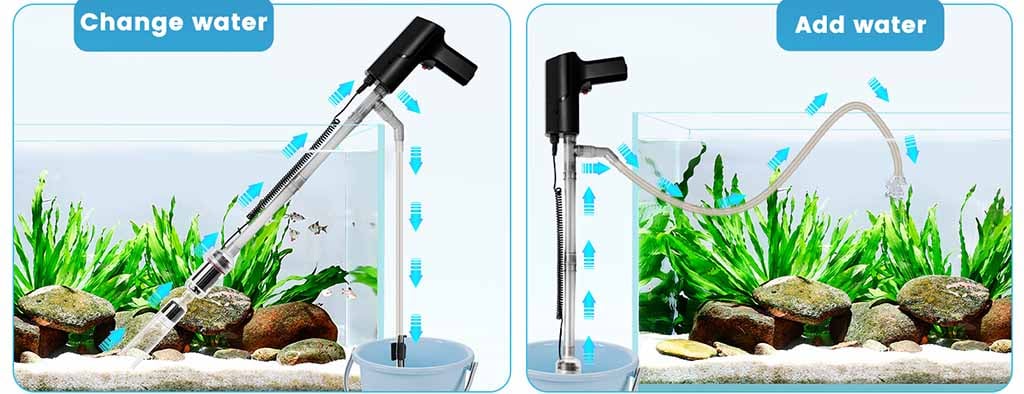
- Place the intake tube in the tank and the outlet tube into a bucket or back in the tank according to the design.
- Secure the mesh bag properly to catch the debris.
- Turn off the tank filters. It will reduce the flow, and cleaning will become easy. Moreover, it will also protect small fish or snails in the tank.
- Push the intake nozzle gently one inch into the substrate.
- Turn on the cleaner and slowly move it across the gravel. It is optimal to move in a grid pattern.
- Periodically stop the process and check how much water has been removed. Never remove more than 25 – 30% in one go.
- Divide the tank bottom into various sections. Clean 1 section weekly.
- After cleaning, when water is not returning to the tank, refill the tank with dechlorinated water. Restart the filter.
- Rinse the filter bag with tank water. It will help to preserve the beneficial bacteria.
HG292 review
HG292 Electric Aquarium Gravel Cleaner Review
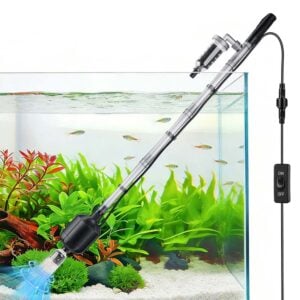
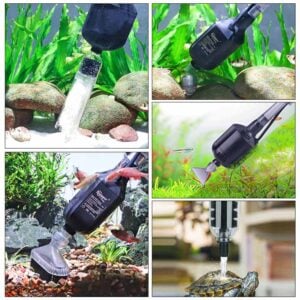
HG292 is one of the best electric aquarium gravel cleaners. It is practical and time-saving for clean-conscious aquarists. It has a multifunctional design. It single-handedly covers the following operations.
- Water changes
- Gravel cleaning
- Debris removal
- Sand washing
- Scrubbing
- Light filtration
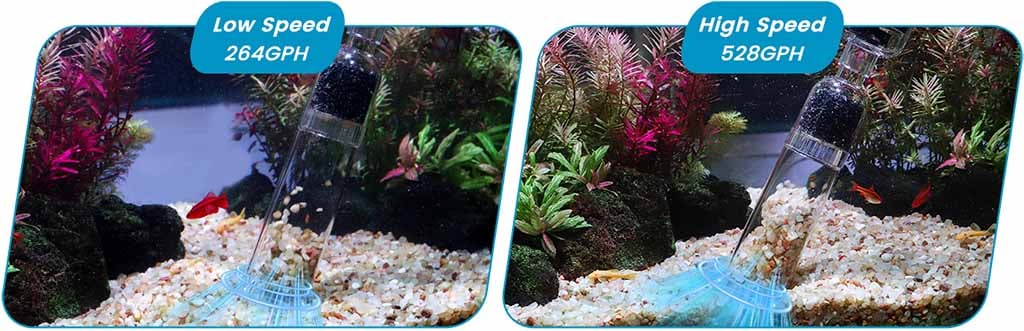
360 Gph Flow and Suitable for Shallow Water
It offers a strong 360 GPH flow rate. It results in water change with ease and speed. It is suitable for large turtle tanks that have frequent dirty water. It is effective even in low water levels, from 2 inches to 0.5 inches of shallow water.
Attachments to Make It Versatile
- The brush head helps to clean the glass surface
- A sand vacuum is helpful in substrate cleaning
- Corner suction head reaches tricky areas
- Transparent tubes provide a suction view of whether water or fish is being sucked.
Accessories That Make It the Best
- An upgraded filter cup and a reusable sponge are suitable for trapping debris during internal circulation.
- Adjustable tube length, i.e., 11.4 to 40.6 inches, enhances its suitability for small and large tanks.
In short, the HG292 electric gravel cleaner is the optimal option for cleaning and tank maintenance. It helps to save time and reduce labor with flexibility. However, make sure that the motor is completely submerged in low-water conditions.
electric gravel cleaner review
FAQs
Q: Is HG 292 suitable for large and small tanks?
A: Yes, it is suitable for small and large tanks as it offers an adjustable tube length that varies between 11.4 and 40.6 inches.
Q: Will gravel dust harm fish?
A: Yes, for the first time cleaning, you need to be cautious. It can harm and even kill the fish in the tank.
Q: Is it worth it to invest in an electric gravel cleaner?
A: Largely yes, as it saves time, reduces labor, and optimizes tank life.
Q: What do I need to use an electric gravel cleaner?
A: You need the following 3 things to use an electric gravel cleaner.
- Electric gravel cleaner
- Bucket (for drained water)
- Dechlorinated water (for water top-off)
Related Products


Do you have water pumps for 265 gallon tank. I am using my HG-105-3500..I am using 2 for my 40 gallon sump. I would like something larger.
You can choose the HGY0004 75model for your 265 gal tank, it’s large enough for the big tank