
Aquarium maintenance has moved well past buckets and manual siphons. For fish keepers managing planted tanks, deep aquariums, or multiple setups, a DC aquarium water changer removes the friction from what used to be the most tedious part of the hobby. The difference between AC and DC technology is not just a matter of technical terminology. It directly affects how your equipment performs, how long it lasts, and how much control you have during each maintenance session.
Content Table
Does my tank need a DC water changer? This post explains the technology, the working principle, the real use cases, and a full HG296 review to help you decide.
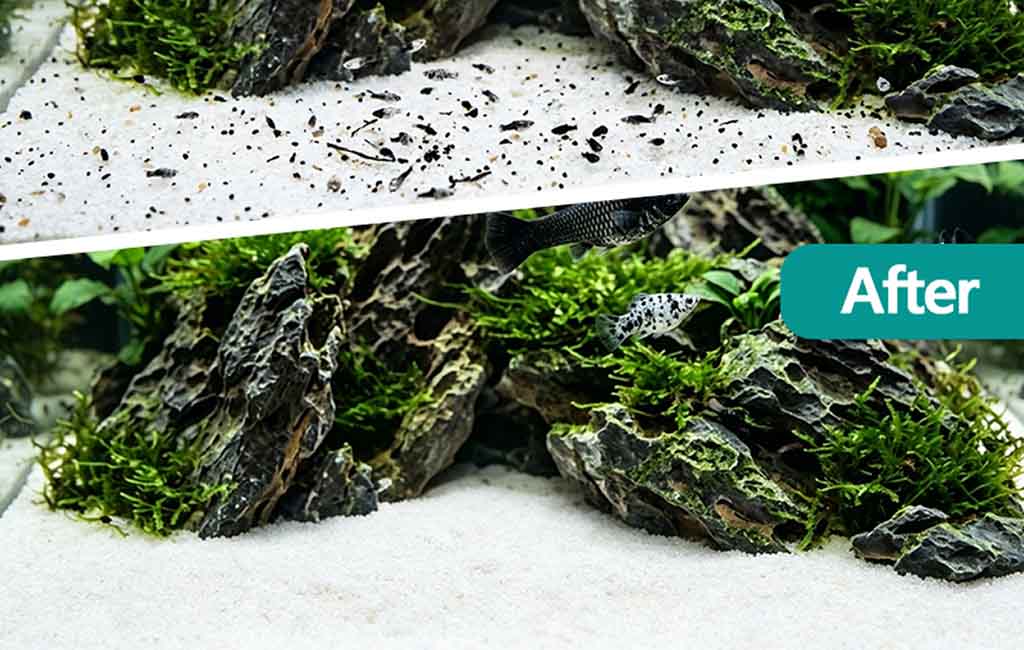
The difference between AC and DC
The Difference Between AC and DC in Aquarium Equipment
Before choosing any motorized aquarium tool, understanding the difference between AC and DC saves a lot of guesswork later.
AC (Alternating Current)
AC motors receive power directly from a wall outlet, where voltage alternates direction at 50 or 60 Hz, depending on the region. Most traditional aquarium powerheads and canister filter motors use AC power because it is simple to manufacture and inexpensive.
Pros:
- Lower upfront cost per unit
- No charging required; always ready when plugged in
- Suitable for continuous, uninterrupted operation
Cons:
- Fixed speed with limited flow control
- Generates more heat during operation
- Higher energy consumption compared to DC equivalents
- Cannot run untethered from a wall outlet
DC (Direct Current)
DC motors convert AC power into direct current internally, or they run on battery-stored DC power. The difference between AC and DC becomes most visible in precision. A DC motor can vary its speed electronically, which means flow rate, suction power, and run time are all adjustable.
Pros:
- Precise speed and flow control via electronic regulation
- Significantly lower energy consumption (DC motors can be 30 to 50% more efficient than AC equivalents at comparable flow rates)
- Quieter operation due to reduced magnetic interference
- Battery-powered DC units operate fully cord-free
Cons:
- Higher initial cost
- Battery-powered units require recharging between sessions.
- More complex internal electronics
For aquarium water changers specifically, the difference between AC and DC is most apparent when vacuuming gravel near plants and delicate substrate. AC units run at a fixed suction level. DC units let you dial down the power so you pull waste without uprooting aquatic plants or disturbing fine sand.
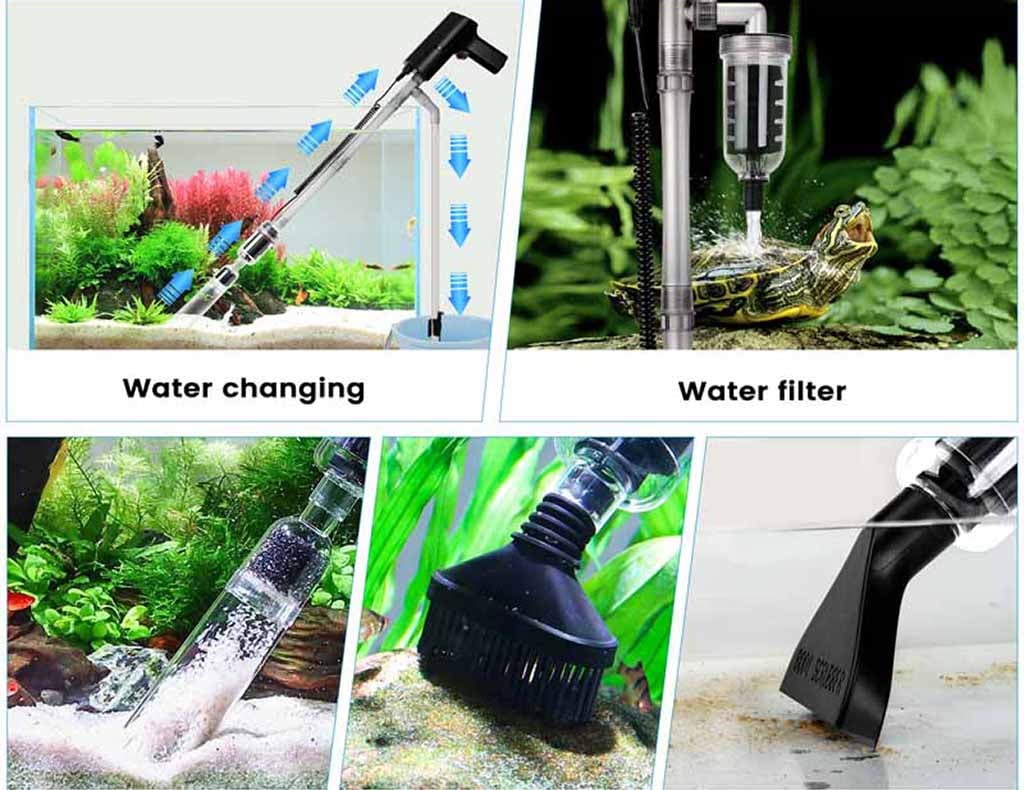
working principle of the DC aquarium water changer
Basic Working Principle of the DC Aquarium Water Changer
The working principle of DC aquarium water changers centers on a brushless DC motor driving a sealed impeller inside a water pump. When power is supplied, whether from a lithium battery pack or a DC adapter, the motor generates a rotating magnetic field. That field spins the impeller, which creates negative pressure at the inlet and pushes water toward the outlet at a controlled rate.
The working principle of DC aquarium water changers differs from that of AC units at the control layer. A DC water changer uses pulse-width modulation (PWM) circuitry to vary the voltage sent to the motor. Increasing the duty cycle raises the impeller speed and flow rate. Reducing it slows down the motor proportionally. This is why the flow rate on a DC unit can be set to precise increments rather than just on or off.
For battery-operated models like the HG296, the lithium cells discharge at a stable voltage maintained by a battery management system. That system protects the cells from over-discharge while ensuring the motor receives consistent power throughout the session, so suction does not weaken noticeably as the battery depletes.
The tube assembly extends the vacuum action from the motor down to the gravel bed. Debris is drawn into the tube, passed through the pump chamber, and expelled through the outlet hose into a waste bucket or drain.
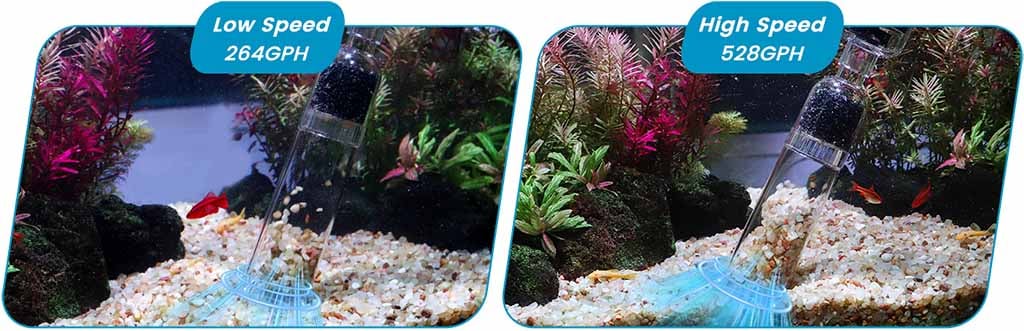
Roles of the DC Aquarium Water Changer
Roles of the DC Aquarium Water Changer in Daily Maintenance
A DC water changer is not a single-task tool. Its involvement in a proper weekly maintenance routine covers several distinct jobs.
Partial Water Changes
Removing 20 to 30 percent of tank volume weekly is standard practice for maintaining stable water chemistry. A DC water changer pulls water out through the outlet hose at a controlled rate, so you are not rushing or accidentally over-draining.
Substrate Vacuuming
Organic waste, uneaten food, and fish waste settle into gravel or sand within 24 to 48 hours of a feeding. Without regular removal, that material becomes a source of ammonia. The vacuum head of a DC water changer disturbs the top layer of substrate and pulls detritus out before it fully breaks down.
Algae Removal
Brush attachments on multi-function DC changers scrub algae from glass, decorations, and hard surfaces while simultaneously vacuuming the dislodged material so it does not cloud the water.
Water Addition
After draining, a DC unit with a bidirectional pump can draw conditioned water from a separate container and refill the tank at a slow, controlled rate. This avoids temperature shock and prevents substrate disturbance during refilling.
Mechanical Pre-Filtration
Some DC changers include a filter cup attachment that captures suspended particles as water passes through the pump. This acts as a temporary mechanical filter during cleaning.
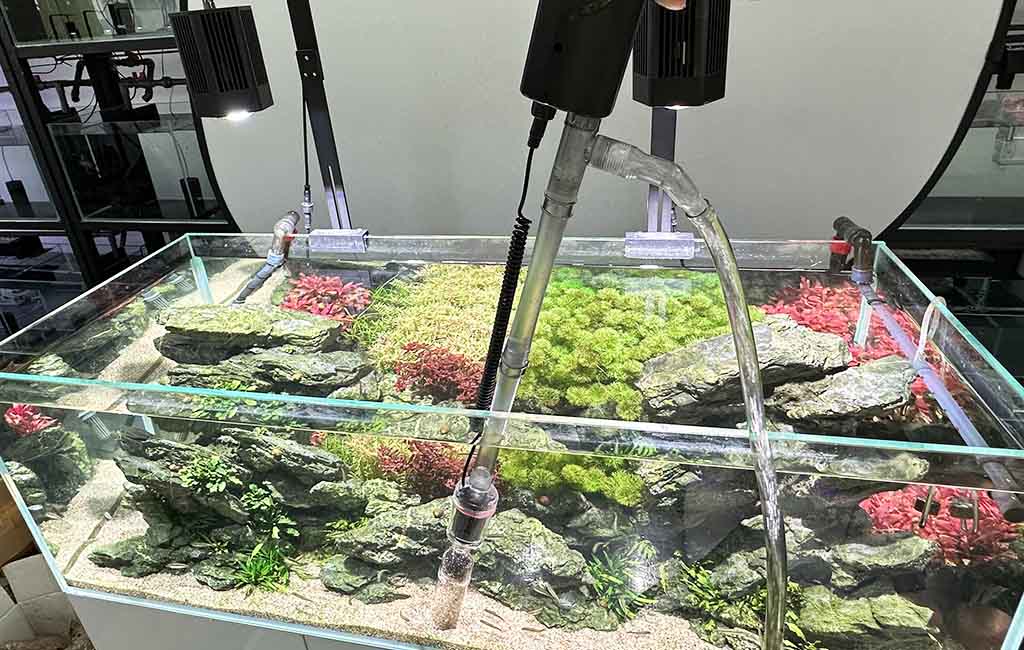
do my tank need a DC water changer
Why Choose a DC Water Changer Over a Manual Siphon
Manual siphons do one thing. They drain water through gravity after you start the flow with mouth suction or a squeeze bulb. There is no pump, no flow control, and no attachment system for gravel washing or algae scrubbing. Every separate task, vacuuming, draining, refilling, and scrubbing, requires a different tool.
A DC aquarium water changer consolidates those tasks into one unit with adjustable power. For a 40-gallon planted tank, the difference is significant. A manual siphon on that setup means separate tools, multiple trips to carry water, and no flow control around sensitive root systems. A DC water changer handles the entire session in a single setup.
The working principle of DC aquarium water changers also means the pump can reverse flow for refilling without repositioning any hoses, depending on the model. That alone eliminates the back-and-forth between the drain bucket and tap that makes manual changes time-consuming.
Energy use is another factor. DC motors at this scale typically draw 10 to 20 watts compared to AC equivalents pulling 25 to 40 watts for similar flow rates, though the larger saving is time rather than electricity cost.
hygger HG296 AquaGrip DC Aquarium Water Changer Review
The HG296 is hygger’s battery-powered entry in the DC water changer category. It carries the AquaGrip name and positions itself as a cord-free, multi-function vacuum for home aquariums.
Power and Battery
The hygger HG296 DC Water Changer runs on a built-in 2600mAh lithium battery with a rated runtime of up to 16 hours on a full charge. In practice, heavier workloads at maximum flow will shorten that figure, but for a typical 30-minute maintenance session, runtime is a non-issue. The battery charges via a USB power cord included in the package.
Flow Rate and Pump Performance
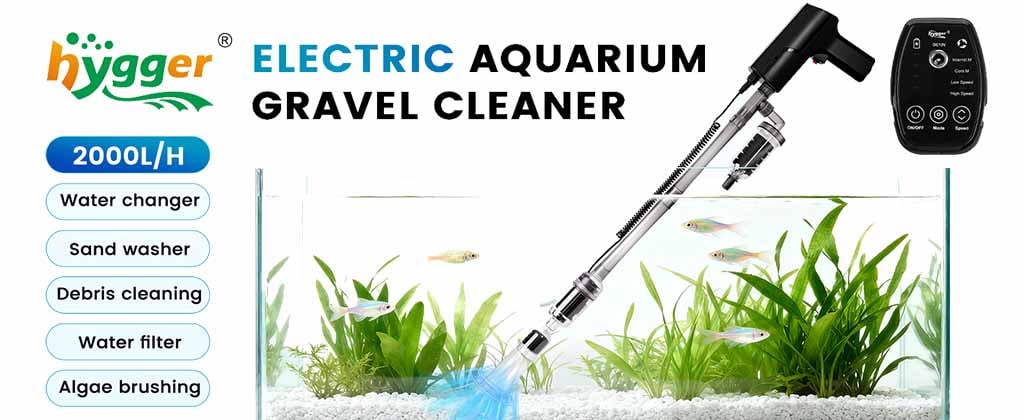
The pump delivers a maximum flow rate of 528 GPH (2000 L/H) with a lifting height of 9.85 ft (3 m). That lifting capacity matters for tanks placed on low stands where the drain bucket sits at or below the tank level.
HG296 review
Handle Controller
The handle controller is the standout feature in this HG296 review. It displays remaining battery level, allows switching between automatic and manual operating modes, and adjusts flow rate on the fly. Automatic mode cycles the pump at a steady preset rate. Manual mode lets you hold the button to run the pump only while actively vacuuming, which conserves battery during pauses.
Six Functions
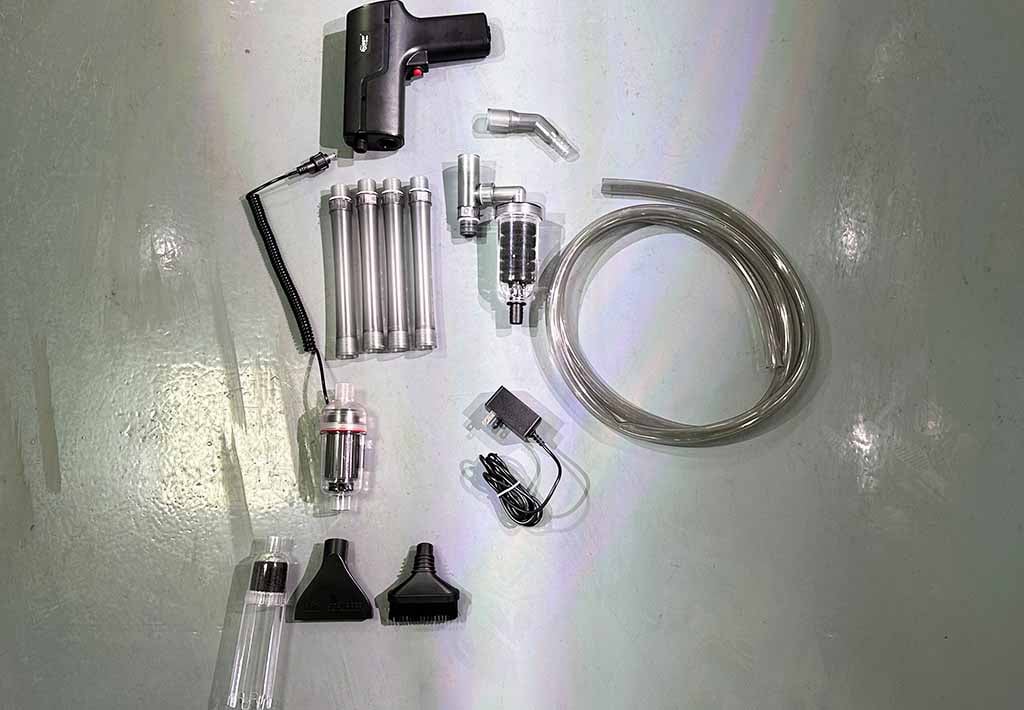
The HG296 includes the following attachments and functions:
- Sand washing head with filter cotton for substrate vacuuming
- Duckbill suction port for debris and surface waste removal
- Brush head for algae scrubbing on glass and decorations
- Filter cup for mechanical pre-filtration during use
- Water changing mode for draining and refilling
- Water circulation mode for temporary aeration
Extendable Tube System
Four rigid extension tubes splice together without tools and extend the reach from 21.2 inches to 42.7 inches. That range covers shallow tanks as small as 8 to 10 gallons and deep tanks up to approximately 36 inches in depth. The tube system supports both freshwater and saltwater environments.
Overall Assessment
The HG296 review from early users reflects consistent satisfaction. One verified buyer described it as a combination vacuum and water pump that removes the need for any power cord during use, noting the disassembly is straightforward, and the battery hold is reliable. At its price point, the combination of cord-free operation, 6-in-1 functionality, and the precision of the handle controller makes it a strong option for mid-size home aquariums.
hygger HG296 DC Aquarium Water Changer
Whose Fish Tanks Need a DC Water Changer
Does my tank need a DC water changer? That depends on the setup. Some tanks benefit significantly more than others.
Planted Aquariums
Fine substrate and root systems make manual siphoning risky. Reduced suction control on a DC unit protects plants during gravel vacuuming.
Deep Tanks (24 Inches or More)
Manual siphons lose flow rate as depth increases. A DC pump with a 9.85 ft lifting height maintains consistent suction regardless of tank depth.
Multi-Tank Fishrooms
Battery-powered DC chargers eliminate outlet dependency. Moving between tanks without repositioning extension cords saves considerable setup time across a session involving five or more tanks.
Shrimp Tanks
Does my tank need a DC water changer if it houses shrimp? Yes. Neocaridina and Caridina species are extremely sensitive to flow disturbance. The low-power manual mode on a DC unit reduces the risk of sucking shrimp into the vacuum during gravel cleaning.
Saltwater and Reef Tanks
Saltwater tanks require precise partial changes to avoid sudden salinity shifts. A DC water changer with flow rate control allows slow, measured draining and refilling.
Beginners With Smaller Tanks
Even a 10 or 15-gallon tank benefits from a DC water changer if the owner finds the manual siphon process messy or difficult to start consistently.
Making Aquarium Maintenance Easier
The working principle of DC aquarium water changers, and specifically how PWM control translates into adjustable suction, is what separates this category from every manual tool. For the fish keeper who maintains multiple tanks or manages a planted setup where substrate disturbance is a real concern, the HG296 review covers a product that delivers on that principle practically.
Does my tank need a DC water changer? It is a question most aquarists answer after one proper maintenance session with a unit like the HG296. The cord-free design, 16-hour battery, and six attachments mean the tool stays useful across every part of the water change process rather than just the draining step. The difference between AC and DC ultimately comes down to control and flexibility, and for regular tank maintenance, both matter more than most hobbyists initially expect.
Related Products

Leave a comment