
Pro LED lights for aquariums are among the best investments you can make for your aquarium. These LEDs help meet the lighting needs of aquatic plants by offering various brightness levels for different plants.
Content Table
In the following, you will learn about how pro LEDs are different from regular LEDs and their benefits. How do these lights help to fulfil the diverse lighting requirements for different plants? Moreover, how to schedule your LEDs and brightness requirements for different plants. In the end, you’ll find a detailed review of the HG280 pro LED light.
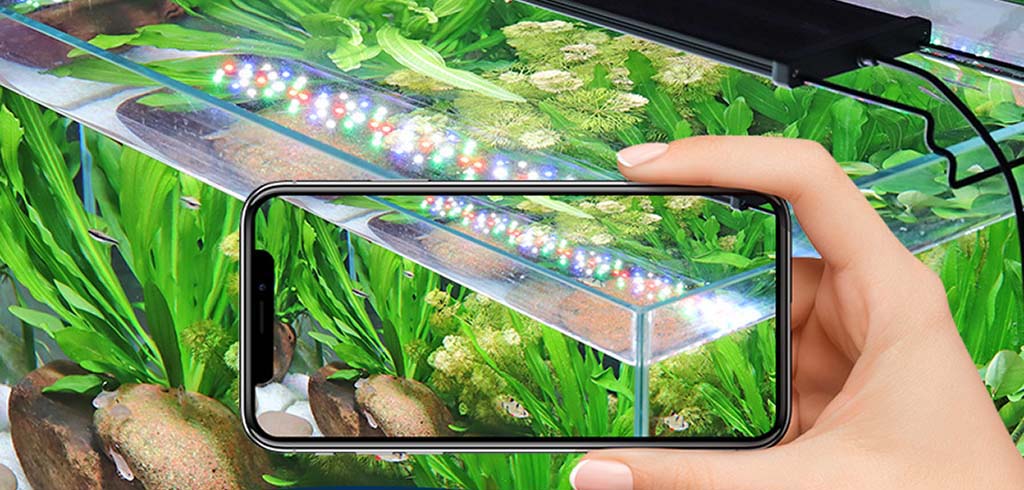
Pro LED light for aquariums
Pro LED Light for Aquariums
A pro LED light for aquariums is a specialized type of LED light with characteristics that are often missing in regular LED lights. Regular LED lights often have one or two brightness settings and provide white or blue light. On the other hand, these pro LED lights have several brightness settings and a full light spectrum.
Pro LED lights use multiple channels that produce different wavelength lights. This diversification allows you to set any light combination according to your tank. For better understanding, look at the following comparison between regular and pro LED lights.
A Comparison Between Command and Pro LED Lights For Aquarium
| Feature | Common LED Light | Pro LED Light |
| Light Spectrum | Limited (white/blue) | Full spectrum (RGB, white, UV) |
| Brightness Control | On/Off or basic dimmer | Precise % control per channel |
| Timer Options | Basic on/off timer | 24/7 gradient scheduling |
| PAR Output | Low to moderate | High PAR optimized for plants |
| Price Range | $10 – $100 | $150 – $700+ |
| App/Remote Control | Rarely | Common |
The Benefits of Pro LED Lights in Planted Aquarium
Why does someone put a big budget on professional-grade LED lights when you have regular LED lights? The answer is that these pro LED lights for aquariums have several benefits over regular LEDs. Here is a list of such benefits.
High PAR
Plants and corals usually require blue and red light wavelengths for optimal photosynthetic activity. Regular lights have less diversity in PAR. These pro lights offer an optimal wavelength ratio. Moreover, they boost the plant and coral growth.
Mimicking With Nature
Fish and plants show their original colors and true potential when they are in their natural habitat. Pro LED lights simulate sunlight and sunset in the tank. This natural environment produces a healthy biological rhythm, controls algae growth, and reduces stress in the tank.
Avoid Algae Bloom
These aquarium lights help to deliver the exact light wavelength. This precise light helps to avoid algae blooms in the tank.
Healthy Plant Growth
With pinpoint accuracy of PAR, these lights help to promote healthy plant growth in the tank.
Enhance Fish Coloration
Full-spectrum light helps to show the true colors of fish. If you have red and blue fish, these lights bring out their color.
The Benefits of Pro LED Lights
Reduced Plant Melt
As mentioned in the previous section, regular lights have limited control over light wavelength due to fewer modes than pro LED lights. While these pro LEDs offer more control, you can ramp on and ramp off the light for a smooth light transition, instead of a sudden variation. This smooth transition helps to avoid plant melting in a tank.
Ideal For Reef Tanks
These pro lights have deep blue and UV channels. These lights help in promoting coral fluorescence and the health of symbiotic algae in the tank.
Shimmer Effect
These lights filter through water and enhance the visual appeal of any tank.
Weather Effects
Although it is not common, some remote control LED lights offer a weather effect mode. In this mode, you can see the simulation of a lightning storm and cloud cover.
Minimal Heat Production
Regular LEDs produce more heat and increase water temperature. These lights produce less heat and avoid the heat spike in the tank.
Energy Optimization
Pro LEDs for aquariums are energy-efficient and help to avoid big electricity bills. Although the initial cost is higher, you can enjoy the fruit later on.
Long Lifespan
Pro LEDs have a prolonged lifespan. Usually, a pro LED lasts for at least 50,000 hours. These lighting hours are significantly higher than those of the metal halides and T5 lights.
Aquatic Plants Diverse Lighting Needs
You can’t grow all aquatic plants with a similar type of LED lights. Plants require varying lighting conditions. If you provide them with undesired light wavelengths, it’ll be a disaster for the plants. Here are different light-based categories.
Low Light
The plants that grow in the shade of the river banks and in deep waters usually require low lighting. These plants show a slow growth rate and are forgiving in nature. For such plants, you need to set 15 to 30 μmol/m²/s PAR for 8 to 10 hours. Java fern and Java moss are examples of such plants.
Medium Light
These lights require moderate light for optimal growth. A 30–50 μmol/m²/s PAR is the optimal range for these lights. You need to turn on the light for 8 to 10 hours daily. Amazon sword, Vallisneria, Hygrophila, and Bacopa are examples of such plants.
High Light
This plant category needs bright light and often grows in fast-moving water. They require high care. However, with proper care, you can see the stunning results. These plants require 50–100+ μmol/m²/s PAR. Moreover, turn on the lights for 8+ hours daily, and these plants require a CO2 supply. HC Cuba, Rotala, Glossostigma, and Red plants are examples of such plants.
aquatic plants lighting needs
Learning 24/7 Light Gradient Process and Time Periods
Setting the optimal light gradient helps the fish and plants in various ways. Here is a suggested 24/7 lighting gradient that you can achieve in your aquarium with pro LEDs.
| Time | Phase | Brightness | Purpose |
| 12:00 AM to 6:00 AM | Night | 0–2% (moonlight) | Fish rest
Minimal disturbance |
| 6:00 AM to 8:00 AM | Sunrise | 2% → 40% | Gradual warm-up
Triggers fish activity |
| 8:00 AM to 12:00 PM | Morning | 40% → 80% | Active photosynthesis begins |
| 12:00 PM to 4:00 PM | Peak Midday | 80–100% | Maximum plant growth period |
| 4:00 PM to 6:00 PM | Afternoon | 80% → 50% | Light starts tapering |
| 6:00 PM to 8:00 PM | Sunset | 50% → 10% | Wind-down
Feeding time colors |
| 8:00 PM to 12:00 AM | Evening | 10% → 0% | Fish settle
Plants rest |
However, keep in mind that you need slight variations for different types of tanks. For example, here are some such scenarios.
Low Tech Tanks
Maintain the peak brightness at 50 – 60% of maximum. Such plants require about 8 to 9 hours of photoperiod, including sunrise and sunset.
Medium Tech Tanks
These tanks require 70 to 80% at the peak hours. Such tanks need a total of 9 hours of photoperiod.
High-Tech Tanks
Usually, these tanks require CO2 injection. At peak, they require 90 to 100% light and a total 8-hour photoperiod. Ensure that you turn on the lights 1 hour before the peak time.
brightness levels for plants
Aquarium Pro LED Light Brightness Levels for Plant Growth
In an aquarium, you need to work with accuracy as it is a matter of fish and plant life. If you go with the guesswork, it can cause harm to fish. PAR is far more important than the lumens, which are usually advertised. A quick rule of thumb for setting PAR is that you need to have higher PAR for deeper tanks. The light should penetrate to the bottom of the tank. Here is a recommendation table regarding the aquarium depth.
| Tank Depth | Recommended Surface PAR | Notes |
| Under 12 inches | 40–60 μmol/m²/s | Even low-light plants may struggle if too bright |
| 12–18 inches | 50–80 μmol/m²/s | Sweet spot for most planted tanks |
| 18–24 inches | 80–120 μmol/m²/s | Highlight plants at the substrate level |
| 24+ inches | 100–150+ μmol/m²/s | Deep tanks need serious light power |
Tips For Optimal Brightness Setting
- Start with a light brightness with 50% and check the algae growth in the tank. If it shows no algae growth, increase 10%, i.e., from 50 to 60. Repeat the procedure till you see the algal activity.
- Use red in the morning and evening simulation. Moreover, this wavelength encourages plant growth without algae blooming in the tank.
- Use the blue channel for the night. This channel helps to optimize the nocturnal fish growth and health.
- Adjust the CO2 supply according to the brightness level. Low brightness without CO2 helps to avoid algae bloom. In brightness, you need to increase the CO2 supply. Without a CO2 supply at high brightness, it triggers the algae growth in the tank instead of plant growth.
HG280 Pro LED light review
HG280 Pro Simple Aquarium LED Light Review
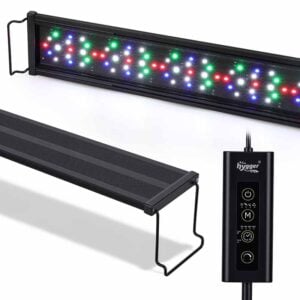
HG280 is a fine example of pro LED lights for an aquarium. It offers full-spectrum light and is suitable for 24 to 36-inch tanks. hygger has specifically designed this light for the serious hobbyist at an affordable price.
Specifications and Features
Here are some specifications and features of the HG280 LED aquarium light.
| Specifications | Detail |
| Wattage | 28W |
| Coverage | 24–36 inch tanks |
| Spectrum | RGB + White + UV |
| Control | App-controlled + remote |
| Timer | 24/7 programmable gradient |
| Dimming | 0–100% per channel |
| PAR at 12″ | ~85 μmol/m²/s |
| PAR at 18″ | ~55 μmol/m²/s |
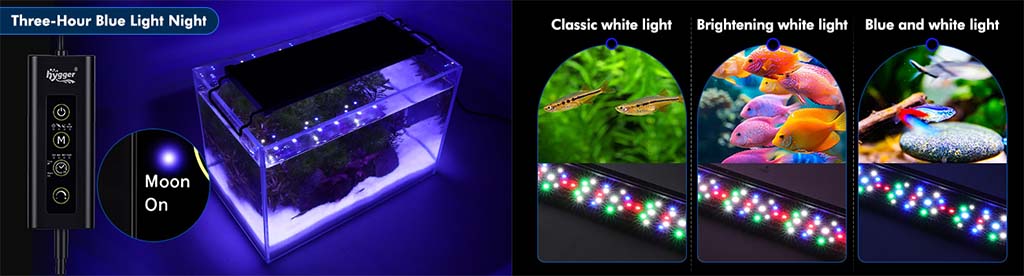
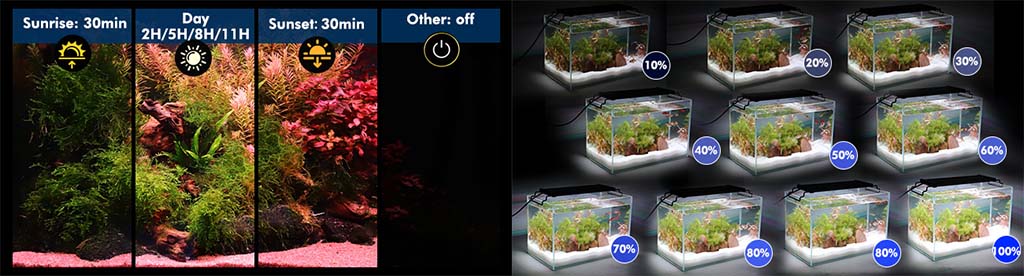
| Number of time periods | 4 (3H/6H/9H/12H), and each time period comes with a complete gradient process. |
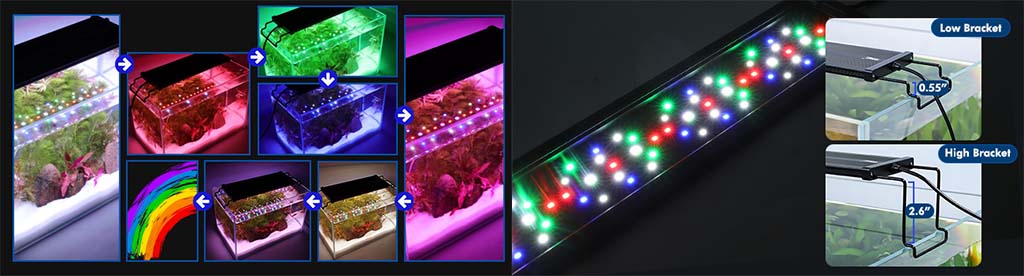
| Number of day modes | 4 (Sun, fishlight, nightlight, and WRGB cycle) for more details |
| Memory option | It restores the previous setting in case you face a power outage. |
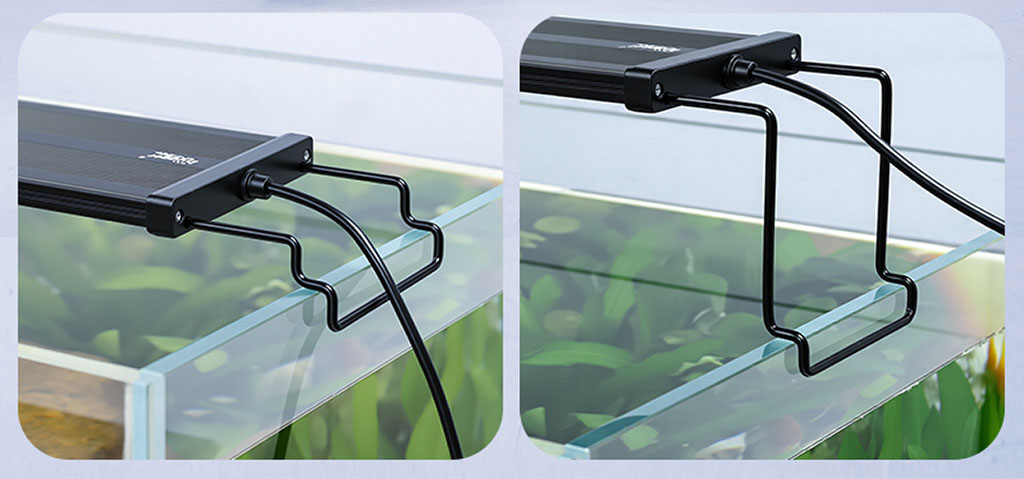
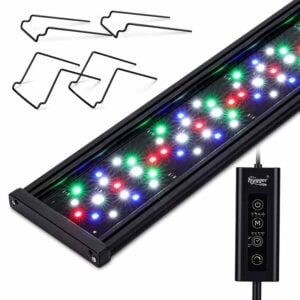
| Size of Brackets | 2, i.e., 2.6 inches tall and 0.55 inches short. |
| Moonlight | It has an additional 3 hours of moonlight mode, in addition to the 4 modes. However, this is up to you to select or not. |
| Brightness modes | 10 modes, i.e., 10%-20%-30%-40% -50%-60%-70%-80%-90%-100% |
| Long-lasting service life | It is due to the concave-convex and aluminum shell that increases the service life of the HG280 pro aquarium LED. |
Pros
- Fully programmable for 24/7
- Strong PAR output for a 28W light
- Slim and low profile
- Low-heat-producing
- Quiet working
- Multi-channel RGB+white independent control
Cons
- First-time setting takes some extra time.
Keep Moving Forward
If you are serious about your tank journey, add pro LED lights to your aquarium. Initially, they might bleed your budget a bit due to higher cost, but you’ll enjoy the fruit of your investment later on. No algae bloom, optimal plant growth, and striking colors of fish are some benefits you can see in your tank. HG280 pro LED light is one of the optimal options among various pro LEDs and offers several benefits.
Related Products

Leave a comment