
Murky fish tank water looks bad and proves hazardous for fish and the entire tank environment. It happens for various reasons, such as an uncleaned substrate or a bacterial bloom. You can avoid it by adopting multiple treatment methods. In the following, you’ll learn about how to purify water for fish tanks. To know this and many other tips after testing the fish tank water, scroll down.
Content Table
Murky Fish Tank Water
Murky or cloudy fish tank water means that the aquarium’s water is unclear. Usually, it appears milky or green. It happens for various reasons. Here are some of them.
Bacterial Overgrowth
Usually, this phenomenon is more visible in a new tank. When you are building a new tank, bacteria begin to establish their colonies. They live there to decompose fish waste and leftover food. If there is any imbalance during the colonies’ development, you can observe cloudiness in the water.
Inefficient Mechanical Filtration
If mechanical filtration is not done efficiently, the unwanted waste particles begin to build up in the tank. This buildup leads to cloudiness or murky water in the fish tank.
Excessive Feeding
When some beginners start building a tank and feed fish with excessive food, and forget to remove the leftover food. The leftover decomposes and releases waste. Bacteria have excessive food, and that results in murky fish water.
purify water for fish tank
Overpopulation/High Stocking
When you stock a high fish volume in your tank, they produce excessive waste. On decomposition, it produces excessive food for bacteria. The higher bacterial population causes murkiness in the tank.
Uncleaned Substrate
It is recommended to completely rinse the substrate before adding it to the tank. If the substrate is inadequately rinsed, it also causes cloudiness in the tank.
Algae Bloom
If there is excessive light or higher nutrient levels in the tank, it causes an algae bloom. An algae bloom causes green, murky water in a fish tank.
Lack of Cleanliness
Sometimes, fish and plants die in the tank. If they are not removed from the facility, they cause murky fish tank water upon decomposition.
Is the Fish Tank Water Suitable for Your Fish?
The answer to this question depends on various aspects. Here are some key features.
Know About Your Fish Requirement
Each fish species has different water parameter requirements, i.e., pH, temperature, and salinity. Therefore, do proper research about the water parameters requirements.
Water Parameter Testing
Once you are assured about the requirements, set the water parameters according to the species. During the process, regularly check the water parameters. Even after fish introduction, perform proper checks at least once a week or twice a week.
Test the Parameter Before Introduction
Water parameters take time for stabilization. Therefore, check the water parameters before fish introduction. Only introduce fish when they are completely mature and stable.
Usage of Safer Tank Water Parameter Stabilizer
In fluctuating water conditions, always use suitable and fish-friendly materials to stabilize the water parameters. Here are some natural options for stabilizing water parameters.
| Parameters | Stabilizer |
| Water softening or purifying | RO water |
| Hardness and pH increase | Lime stone
Crushed corals |
| Lowering pH | Peat moss
Driftwood |
| Water temperature | Heaters or chillers. According to the requirements. |
Test Your Fish Tank Water
Crystal water does not mean that it is safe for fish or has no murkiness. Many invisible parameters can make your tank an unlivable place for fish. Here are some other such invisible parameters. Next time, when you are trying to avoid murkiness, test these parameters as well and ensure that they are within the ideal range.
| Parameters | Ideal value |
| Ammonia | 0 ppm |
| Nitrite | 0 ppm |
| Nitrate | Generally, less than 40 ppm. However, set the baseline according to your species. |
| pH | Usually, 6.0 to 8.5. However, depends on the stocked species. |
| KH | 3 to 8 dKH |
| GH | 4 to 12 dGH |
| Chlorine | 0 ppm |
| Chloramine | 0 ppm |
| Heavy metals (Zinc, Copper, etc.) | 0 ppm |
How to check?
Use a liquid test kit to check these parameters. The best time to check these invisible water parameters is as follows.
- After weekly water changes.
- Before introducing the new fish to the tank.
How to Adjust These Parameters?
Use the following methods to bring the water parameters into the ideal range.
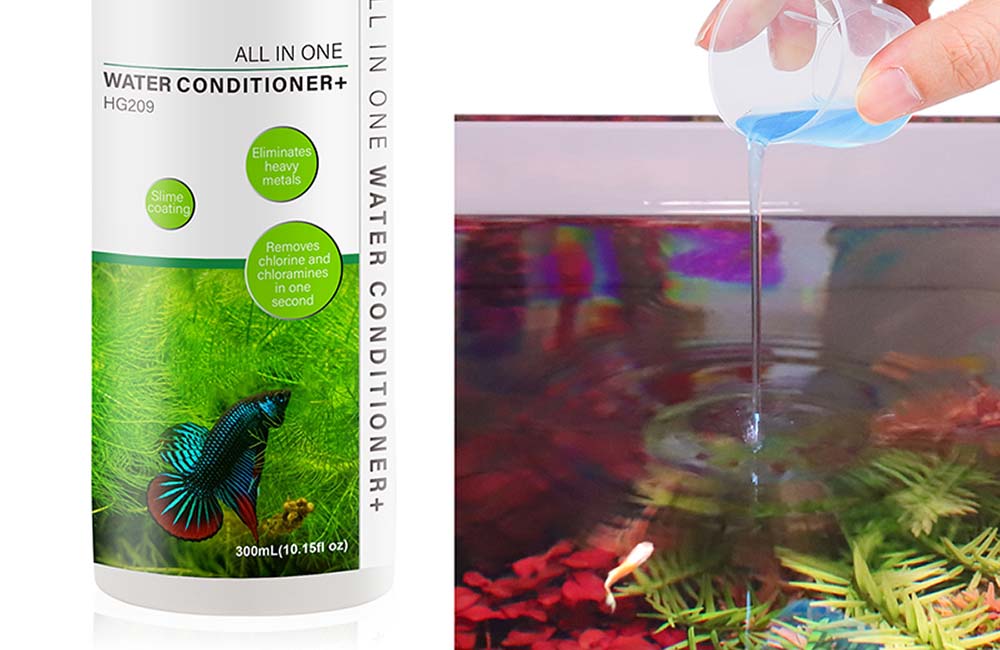
HG209 All-In-One Water Conditioner
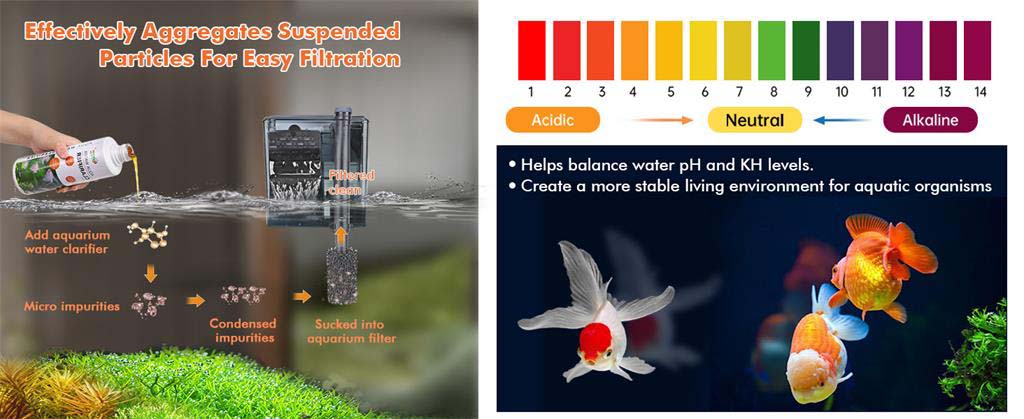
It helps to clear the murky or cloudy water and make it crystal clear. It clumps different microparticles. The rest is easy to remove this big chunk with adequate filtration. It is equally suitable for freshwater and saltwater setups.
Best Use Case Scenarios
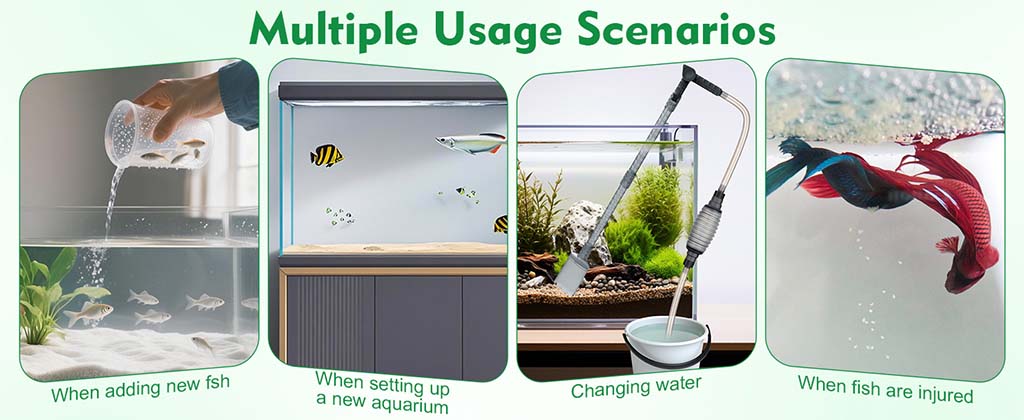
- Parameters are within the optimal range, but cloudiness is there.
- After substrate cleaning or rearrangement.
- New tank setups.
Usage
- Shake the bottle.
- Add a 10 mL dosage for every 100 liters or 26.5 gallons of volume to the tank. Double the dosage if there is extra cloudiness.
- Ensure that the filters are continuously working.
- To boost the result, turn on the air pump. It’ll raise the oxygen level in the tank.
- The result becomes visible within 30 seconds. However, for crystal-clear water, wait 2 to 6 hours. The clarification time depends on the water cloudiness.
murky fish tank water
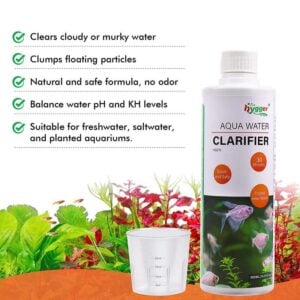
HG210 hygger Aqua Water Clarifier
If you have done the test and found variations in chlorine, chloramine, and the presence of heavy metals, it is very alarming. HG210 will help to clear the tank water of these harmful materials.
Usage
- Shake well before use.
- Add 10 mL per 100 L(26.42 Gal) of aquarium water during water changes.
- Add 20 mL per 100 L(26.42 Gal) of water for sudden chlorine spikes or urgent water quality issues.
- Add weekly to help maintain stable water conditions.
Benefits
- Condition the tap water and make it suitable for fish.
- It helps to improve the fish’s stress resistance.
- It buffers pH.
Purified Murky Water for Fish Tank
Several reasons contribute to murky water in fish tanks. Therefore, it is not suitable to just remove the cloudy particles. Before deep diving into practical tips, understand the types of murkiness.
| Effect | Cause |
| White or cloudy water | Bacterial bloom |
| Unwashed substrate | |
| Green tint | High light |
| High nutrient level | |
| Both of these reasons cause the algae bloom in the tank. | |
| Brown tinted water | Unclean substrate |
| Driftwood tannins | |
| Floating debris | Leftover food |
| Fish or other pet or plant waste | |
| Filter problems |
Tips to remove murkiness
Water Change
- Replace 20 to 30% tank water with treated water.
- Use a water conditioner, i.e., HG209, before adding the tap water to the tank.
Bottom Cleaning
Use a substrate cleaner, i.e., gravel vacuum, to clean the bottom of the tank.
Address the Filter Issues
- Wash the filter media with the tank’s water.
- Use effective mechanical, chemical, and biological filtration in combination for optimal filtration.
- Add a clarifier sponge to enhance the filtration process.
Water Clarifier
- Use water clarifiers to remove the murkiness of the water. HG210 is one of the best clarifiers, removing cloudiness.
- Add desired dosage, i.e., 10 ml per 100 liters. In the event of higher cloudiness, add 10 ml to the same 100-liter volume.
- Keep running the air filters to increase the aeration. It’ll help to improve the efficiency.
Green Tint Murky Water Control
- Use only the desired lighting level in the tank. Otherwise, it’ll cause an algae bloom in the tank.
- Algae bloom causes murkiness in the tank water.
- Turn the lights on for 8 hours a day.
- Avoid exposing the tank to direct sunlight.
- Add algae eaters to the tank to control the algae bloom.
Waste Reduction
- Feed only fish that finish in 2 to 3 minutes.
- Avoid overstocking.
- Remove leftover food.
How to Avoid Murkiness
- Always cycle the tank before introducing the fish.
- Regularly test the water parameters.
- Regularly clean the water.
- Grow live plants as they absorb excessive nutrients.
test the fish tank water
Keeping Your Fish Tank Water Crystal Clear
- Avoid overfeeding.
- Maintain proper mechanical, chemical, and biological filtration.
- Turn the lights on for only 8 hours daily.
- Remove food leftovers after feeding within 2 to 3 minutes.
- Regularly test the water parameters.
- Check the filter conditions.
The Final Word
Algae bloom, bacterial bloom, overpopulation, etc., are many reasons for murky fish tank water. Ensure that your tank is a livable place for the fish. You can verify this by testing water parameters, understanding the fish species, and other relevant factors. HG209 and HG210 will help to make your tank water crystal clear. Other than these methods, removing food leftovers, changing water, controlling light, and other similar measures will help keep your tank crystal clear.
Related Products



Leave a comment