
Jawfish are easy to keep, beautiful, and small fish. In the following, you’ll learn about what a jawfish is and whether jawfish are aggressive or not. Moreover, an introduction to yellowhead and blue-spotted jawfish will help you clarify your choice. At the end, you are good to go with the precautions that you need to adapt for this beautiful jawfish journey in your tank.
Content Table
Jawfish
Meet Jawfish
Jawfish are small and colorful fish that always do something to keep them busy. This activity makes them favorable for many hobbyists. These fish belong to the Opistognathidae family. This family has about 80 different species. Most of them live in warm but shallow water. Their presence is discovered in the tropical Atlantic and Pacific Oceans.
Reason Behind the Name
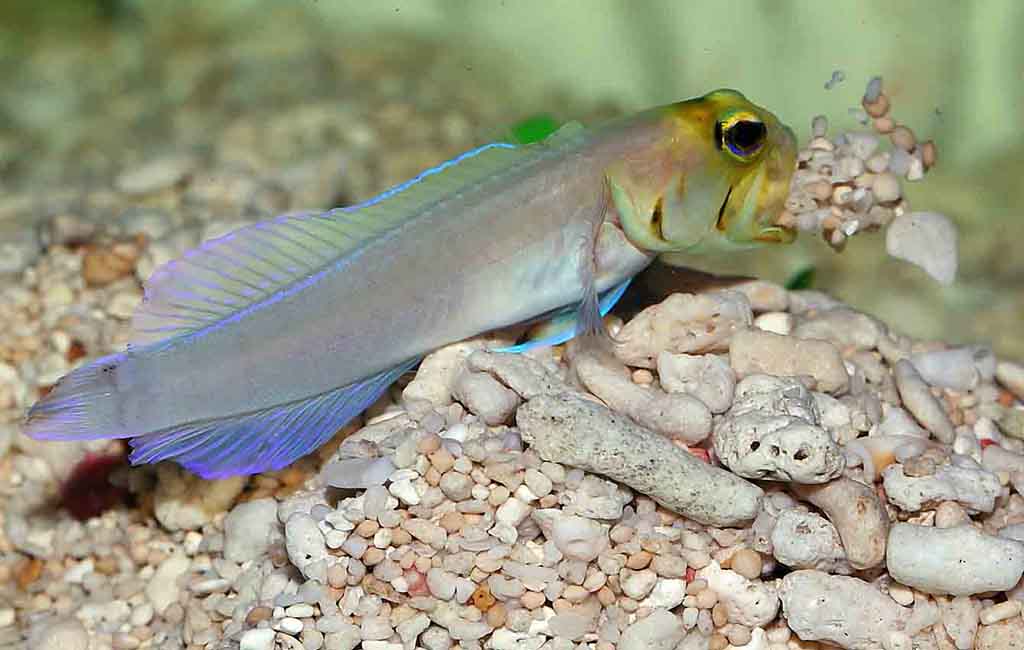
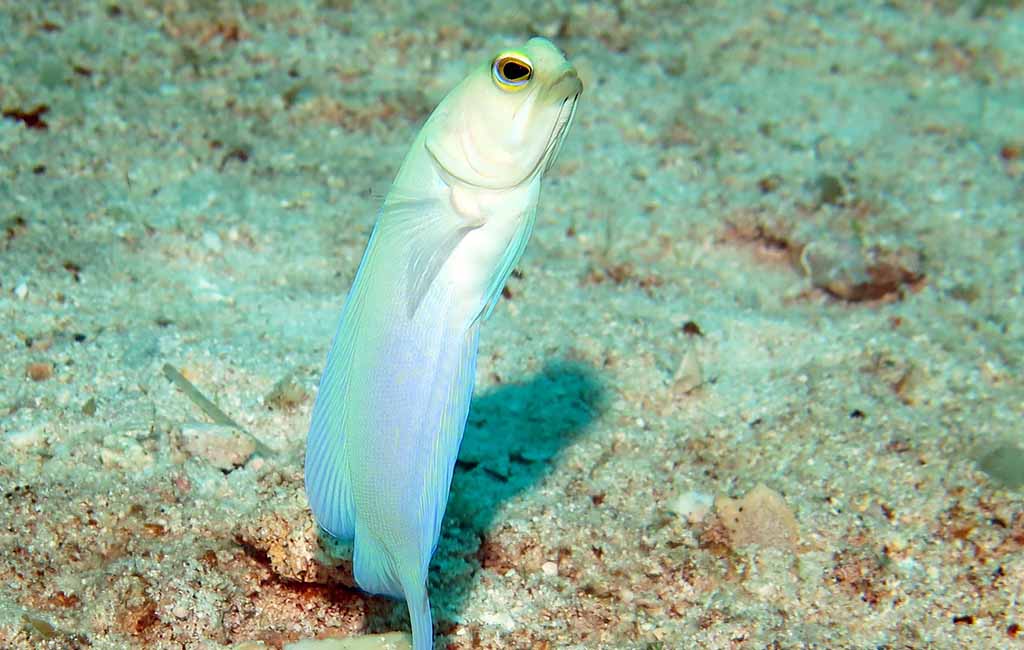
Jawfish love to build deep burrows in rubble or sand. They use their mouths to build these burrows. For this reason, they are called jawfish. After building the burrows, they just stay in front of their built burrow and look at the passing creatures. As soon as they find something suspicious or threatening, they suddenly go back to their burrow.
Profile
Here is a brief profile that will help you to understand them.
| Feature | Details |
| Scientific Family | Opistognathidae |
| Size | 3 – 5 inches (most species) |
| Lifespan | Up to 5 years in captivity |
| Diet | Carnivore — meaty, protein-rich foods |
| Water Temperature | 72°F – 78°F (22°C – 26°C) |
| Salinity | 1.020 – 1.025 specific gravity |
| pH Level | 8.1 – 8.4 |
| Minimum Tank Size | 30 gallons |
| Care Level | Moderate |
Peculiarities
- They spend most of their time building burrows with their large and oversized mouths, in sand or rubble.
- In Spanish, they are known as “bocas grandes”, big mouths.
- They reinforce their houses, i.e., burrows, with shells and rocks, which reinforce them and keep them stable. You can say they are civil engineers.
- They put a rock or shell at the mouth of the burrow at night to ensure protection.
- In danger, they return to their burrow with tail-first entry.
- Jawfish are mouthbrooders, and male partners keep the eggs in their mouths.
- During mouthbrooding, males usually do it fast.
- They defend their house from intruders by spitting sand or small rocks.
- They are jumpers, so they need to cover the tank if you want to keep them in your tank.
- Jawfish live in colonies near the sand or coral reefs.
- They are small and slender with relatively large protruding eyes.
- Usually, they are small, but some species can grow large, e.g., the giant jawfish. It can reach up to 20 inches in length.
are jawfish aggressive
Are Jawfish Aggressive?
You might be interested to know, like many other aquarists, whether jawfish are aggressive or not. The answer is that they are mostly peaceful, but they are aggressive due to their territorial nature. When other jawfish approach their territory, they defend their house by spitting sand or throwing small rocks at the aggressor. Their aggression is visible toward their own species. However, mostly they are shy, peaceful, and cautious.
Popular Yellowhead Jawfish and Blue Spotted Jawfish
Yellowhead and blue-spotted jawfish are the most popular jawfish species among aquarists. Both grow up to a similar length, i.e., 4 inches long. Here is a brief introduction of both species.
Yellowhead Jawfish
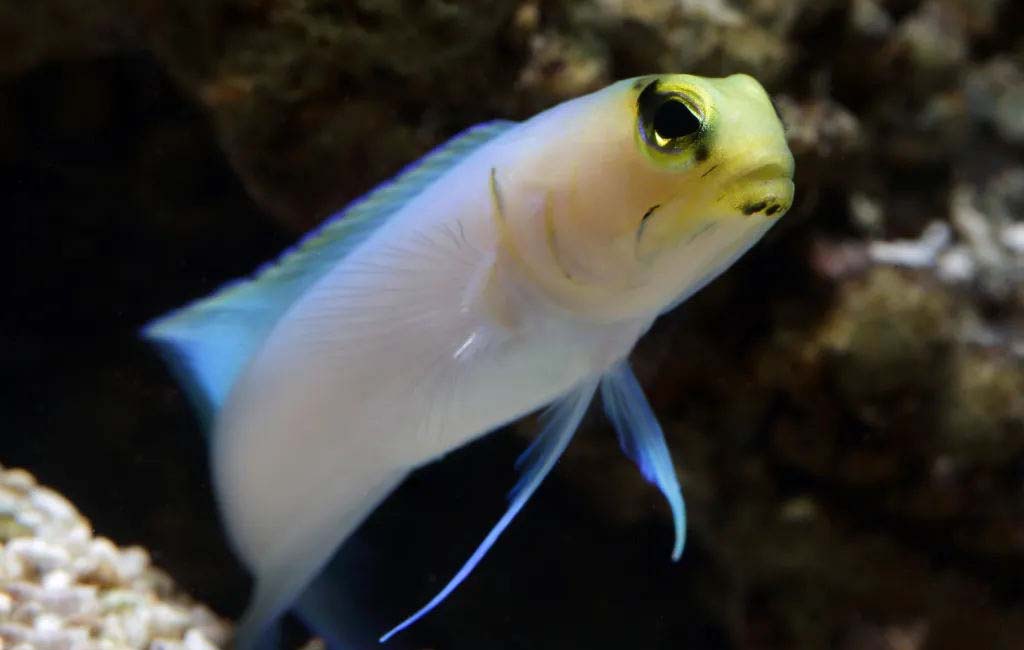
The scientific name of the yellowhead jawfish is Opistognathus aurifrons. It is one of the most popular saltwater fish species, especially in the US. As the name suggests, they have bright yellow heads and pale blue white bodies. They grow up to 4 inches in length. Like other jawfish species, they are peaceful with a territorial nature toward other jawfish. They are always curious about their surroundings. They are burrowers, so you need to keep them in a tank with at least a 4 to 6-inch sandy substrate.
Blue Spotted Jawfish
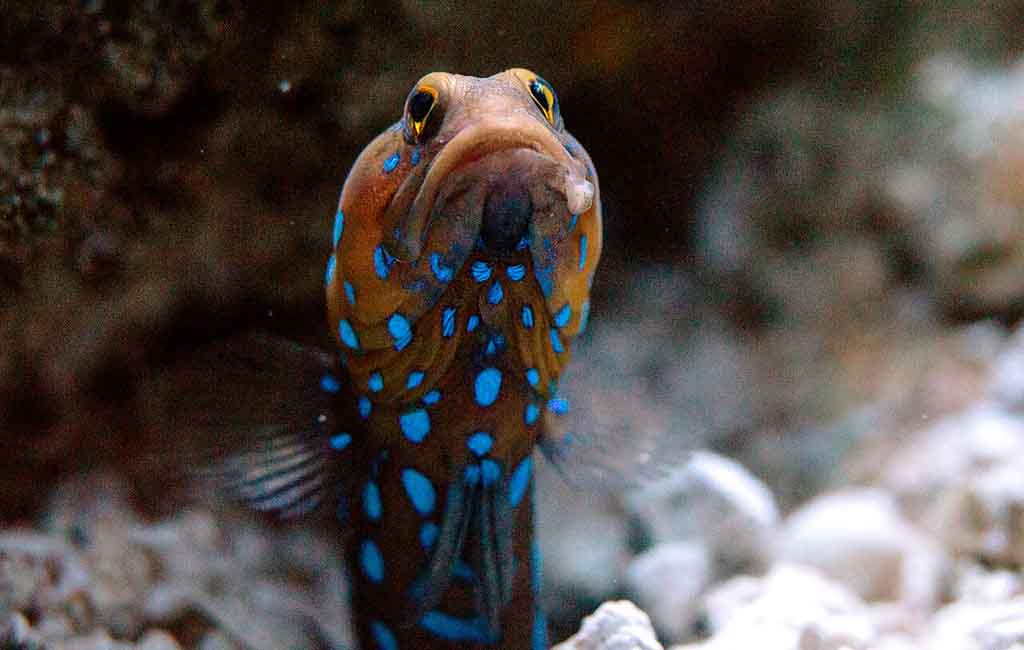
The scientific name of the blue-spotted jawfish is Opistognathus rosenblatti. These are among the most beautiful jawfish species. They have striking electric blue spots on their tan bodies. Unlike yellowhead jawfish, they love to spend their life alone. However, they require similar tank conditions, i.e., a 4 to 6-inch-thick sand substrate in the tank. Moreover, they also grow up to 4 inches long.
Quick Comparison
| Feature | Yellowhead Jawfish | Blue Spotted Jawfish |
| Scientific name | O. aurifrons | O. rosenblatti |
| Max size | ~4 inches | ~4 inches |
| Temperament | Very peaceful, schooling, active | Peaceful, reclusive |
| Origin | Caribbean | Mexico, the Sea of Cortez |
| Temperatures | Tropical | Cooler |
| Sand substrate depth | 4 – 6 inches | 4 – 6 inches |
| Difficulty | Easier due to hardy nature | Moderate due to sensitive nature |
| Availability | Common | Rare |
| Minimum tank size | 20 to 30 gallons | 30+ gallons |
The Special Breeding Way of Jawfish
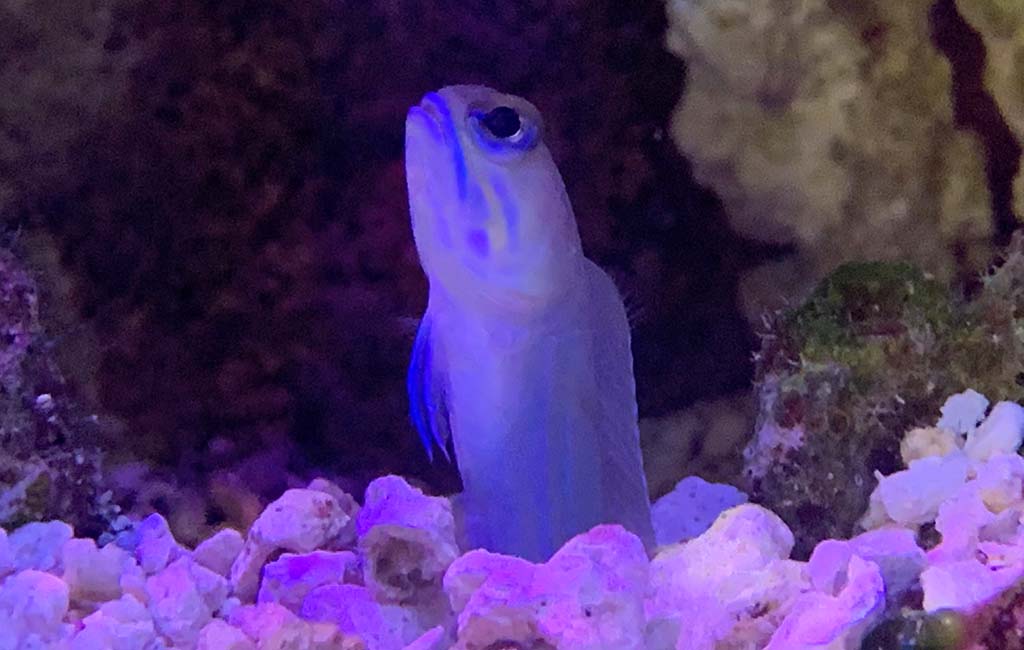
Jawfish are mouthbrooders, i.e., they carry the eggs in their mouth. When fish lay eggs, and they are fertilized, instead of scattering or putting them into a bubble nest, male partners scoop these eggs into their mouths. Eggs take 7 to 9 days to hatch. Until then, males rarely eat. They roll the eggs in their mouth for cleaning. Sometimes, the male scoops eggs out and then scoops these eggs after cleaning. After 7 to 9 days, you can see the larvae. Here are some important points about breeding.
- Captive breeding is hard to achieve. However, only advanced breeders can achieve it.
- Established pairs often mate.
- Larvae need a specialized tank environment for optimal growth.
Special Breeding Way of Jawfish
Jawfish in Saltwater Community Aquarium
As mentioned, they are peaceful with some territorial behavior. So you can keep them in a community fish tank. They are compatible with all of the reef fish species. However, you need to avoid the following types of species as they might trigger fear or territorial behavior in jawfish species.
- Avoid large and aggressive fish, as they can eat jawfish. It includes lionfish, groupers, or triggers.
- Fast and nipping species can harass them.
- Other burrowing species can compete with them for territory.
Compatible Fish Species
- Clownfish (Amphiprioninae spp.)
- Royal grammas (Gramma loreto)
- Firefish (Nemateleotris magnifica)
- Cardinalfish (Apogon spp.)
- Chromis damselfish (Chromis viridis)
- Cleaner shrimp
- Peppermint shrimp
- Soft and hard corals
yellowhead jawfish
The Keeping Precautions of Jawfish
Although jawfish are easy to keep in a saltwater tank. However, you need to follow some precautions as they have peculiar behavior and nature. Here is a list of precautions that will help you ease your jawfish-keeping journey.
- Use a lid, as they are escape artists.
- Use the fine sand with rubble at the top. It will help to fulfil their browsing demand. Keep the thickness between 4 and 6 inches.
- They reinforce their burrow with shells and small rocks. So don’t forget to add shells and small rocks.
- They are carnivores. Feed them 2 to 3 times daily. Mysis shrimp, brine shrimp, and chopped seafood are some of the optimal feeding options.
- Always maintain a stable water condition. Use a protein skimmer to reinforce the water quality. Moreover, test the water parameter weekly.
- Acclimate them properly before adding to the community or specialized jawfish tank. Drip acclimation is the best acclimation option.
- Introduce all jawfish at one time. A similar entry helps to avoid territorial disputes, as every fish establishes its territory.
Keeping Precautions of Jawfish
Water Parameters
Water parameter is another cautionary aspect that you never have to compromise. Here are the optimal water parameters for the jawfish tank.
| Parameter | Optimal Level |
| Ammonia | 0 ppm |
| Nitrite | 0 ppm |
| Nitrate | Less than 10 ppm (reef) |
| Less than 30 ppm (FOWLR) | |
| Phosphate | Less than 0.05 ppm |
| Calcium | 380–420 ppm (for reef tanks) |
Is This the Fish You Want?
If you are looking forward to some small, beautiful, and always entertaining fish species, the jawfish is the best option. Moreover, this saltwater species can reside in your tropical reef tank and live in communities with peaceful, similar-sized, and behavior fish species.
Feed them meaty food and enjoy the burrowing. If all of these things that you can do and want to enjoy in reward, start with the yellowhead jawfish, as it is easy to keep. If you already have this one, upgrading to a blue spotted jawfish will be amazing. In either case, you will enjoy their presence in the tank.
Related Products



Leave a comment