
A failing air pump rarely gives a warning. One moment, the tank hums along quietly, and the next, oxygen levels drop while fish gasp at the surface. This is exactly where a USB-rechargeable air pump earns its place in any aquarist’s toolkit. Choosing the right one, though, requires more than picking the cheapest option on a shelf. This article breaks down what actually matters when selecting a USB-rechargeable air pump and reviews one model worth a closer look: the HG199.
Content Table
USB rechargeable air pump
Clarify Your Air Pump Needs
Before comparing specifications, define the actual job the pump needs to do. A USB-rechargeable air pump bought for one purpose often underperforms at another.
Consider the following scenarios:
- Daily aquarium oxygenation. Tanks with dense stocking, live plants competing for oxygen at night, or poor surface agitation need steady, adjustable airflow.
- Emergency power outage backup. An emergency air pump must switch on automatically or activate within seconds, since fish in an oxygen-deprived tank can show stress within an hour.
- Small cylinders or isolation tanks. Quarantine setups and breeding cylinders often need lower, gentler flow rather than maximum output.
- Temporary transportation. Moving fish between tanks, shops, or shows calls for a compact unit that survives jostling and works without a wall outlet.
Matching the pump to the scenario narrows the field considerably. A unit built for emergency backup duty, for example, prioritizes battery runtime and automatic switching over raw power, while a transportation pump prioritizes size and durability over adjustable flow range.
emergency air pump
Is the USB Rechargeable Air Pump Worth Choosing
Traditional plug-in air pumps work fine until the power cuts out. A USB rechargeable air pump solves that single point of failure by storing energy in an internal battery, ready to take over the moment grid power disappears.
The appeal goes beyond outage protection. A USB rechargeable air pump charges from a power bank, laptop, or car charger, which means it travels well for fishing trips, livestock transport, or weekend trips away from the main tank. Most models also run on USB Type-C now, so one cable can charge a phone, a flashlight, and the pump itself.
Cost has dropped, too. A capable rechargeable unit now sits in a similar price bracket to a standard plug-in pump, so the rechargeable feature comes at little to no added expense for the protection it offers.
The Core Specifications of USB Rechargeable Air Pumps
Specification sheets can look similar at a glance, but small differences in the numbers translate to real performance gaps. Pay attention to these factors.
Flow Rate and Outlet Capacity
Flow rate, usually listed in liters per minute, determines how much oxygen reaches the water. Single outlet pumps suit smaller tanks under 80 gallons, while dual outlet models distribute air across two air stones, useful for larger tanks or two separate setups running from one unit.
Pressure and Dive Depth
Pressure output matters most when air needs to travel through tubing and reach an air stone sitting at the bottom of a deep tank. Weak pressure shows up as a struggling, sluggish bubble stream rather than a steady flow.
Battery Capacity and Runtime
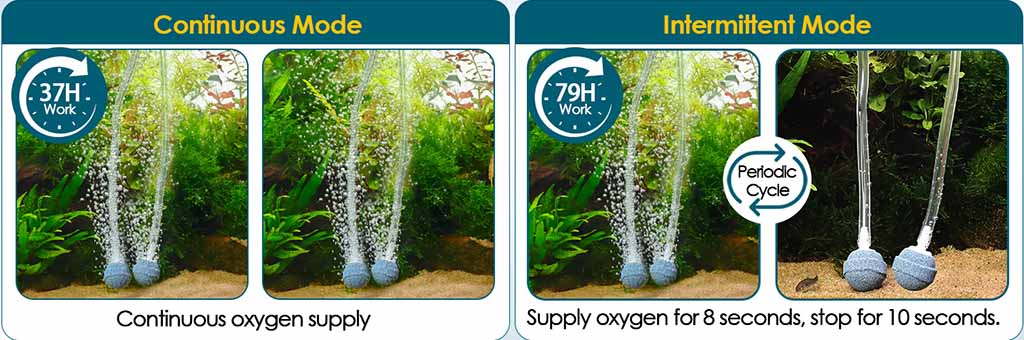
Battery capacity, listed in mAh, dictates runtime. Larger capacity batteries last longer between charges, but runtime also depends heavily on whether the pump runs in continuous or intermittent mode. Intermittent cycling, where the pump pulses on and off, extends total runtime significantly compared to nonstop operation.
Specifications of USB Rechargeable Air Pumps
Charging Method and Convenience
USB Type C charging has become the standard for good reason: faster charging, reversible plug orientation, and compatibility with the same cables used for phones and tablets. Check whether the pump shows a charge level indicator, since a sudden dead battery defeats the purpose of an emergency air pump.
Noise and Vibration
A pump rated under 35 decibels runs quietly enough for a bedroom or living room tank. Rubber feet and a thickened housing reduce vibration that would otherwise transmit through a stand or shelf.
Air Interfaces and Accessories
Check what comes bundled: air stones, check valves, and tubing length all affect setup cost and convenience. A check valve in particular prevents water from siphoning back into the pump when it sits below water level, a detail that protects the motor from damage.
Consider Safety and Reliability
A pump failure during a power outage defeats its entire purpose, so reliability deserves close attention before purchase.
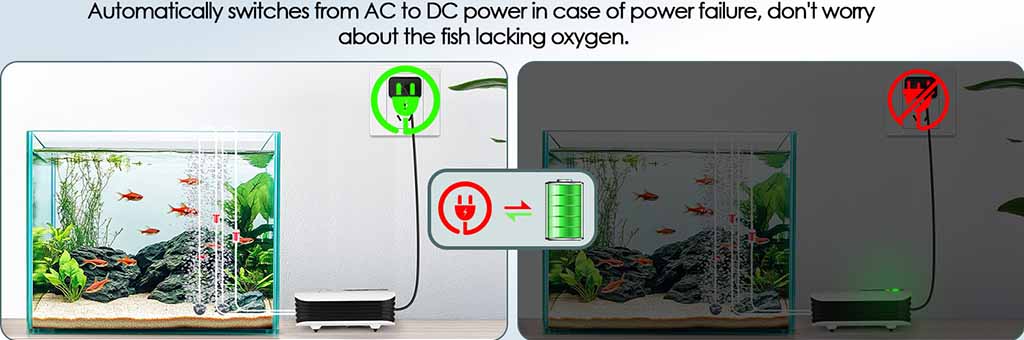
Look for an automatic AC to DC switch. This feature detects power loss and shifts to battery power within moments, without needing a manual switch flip during a stressful moment. Also, check the water resistance rating. An IPX4 rating, for instance, blocks light splashes and rain but does not tolerate submersion, which matters for anyone using the pump near a sump or in damp outdoor conditions.
Motor construction affects long-term reliability, too. A pure copper motor tends to run cooler and last longer than the cheaper alternatives found in some budget pumps. Avoid units with no clear warranty terms, since a short or vague warranty often signals lower build confidence from the manufacturer.

How to choose a USB rechargeable air pump
USB Rechargeable Air Pump Selection Suggestions
Different use cases call for different priorities. The suggestions below match common scenarios to the features that matter most.
- Emergency power outage backup: prioritize automatic AC/DC switching, a battery rated for at least 24 hours of intermittent runtime, and a charge level indicator.
- Isolation or transportation use: prioritize compact size, a sturdy clip or mount, and IPX4 or higher splash resistance.
- Daily oxygenation: prioritize adjustable flow levels and quiet operation, since this pump runs for extended stretches near living spaces.
- Deepwater or complex pipelines: prioritize higher pressure output and dual outlet capacity to maintain consistent flow across longer tubing runs.
Buyers managing more than one tank often find that a dual outlet, higher wattage pump handles daily duty while doubling as backup, removing the need for two separate devices.
HG199 USB Rechargeable Air Pump Review
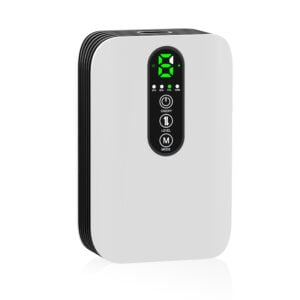
The HG199 from hygger is a battery-powered, USB-rechargeable air pump built around exactly the scenarios covered above: power outages, fishing trips, bait buckets, and tanks ranging from 5 to 120 gallons. This HG199 review looks at how the specifications hold up against real use.
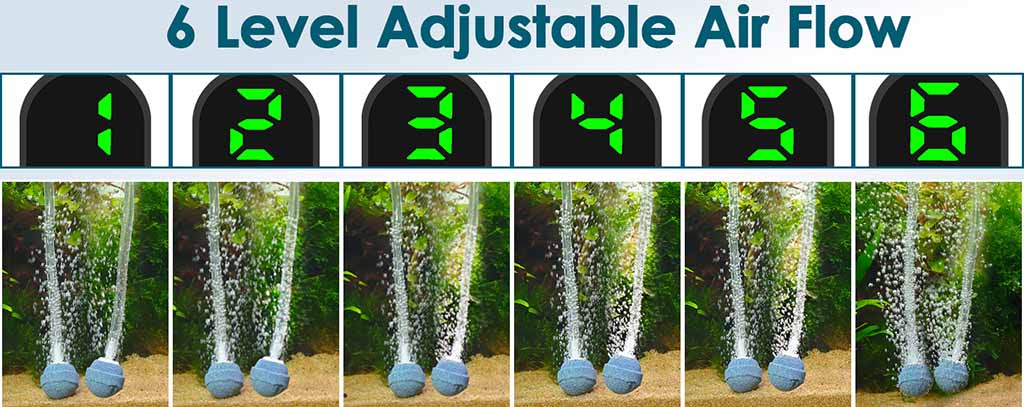
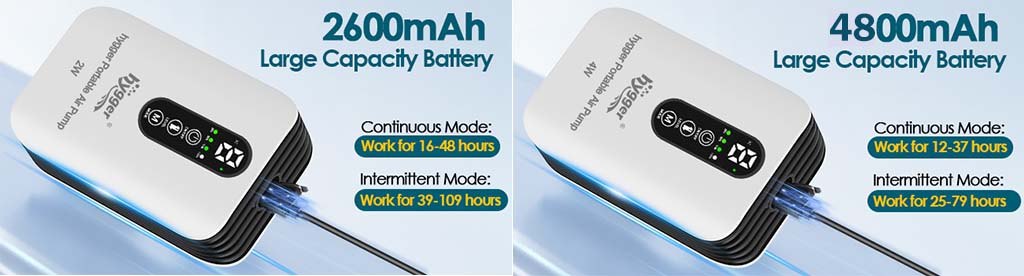
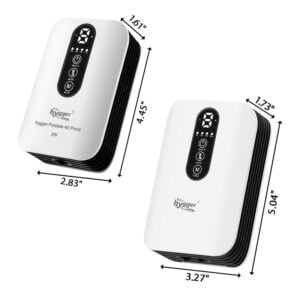
The pump ships in two configurations. The 2W version runs a single outlet with a 2600mAh battery, suited to tanks up to 80 gallons. The 4W version runs dual outlets with a 4800mAh battery, suited to tanks up to 120 gallons or two smaller setups at once. Both versions offer six airflow levels and two operating modes, continuous and intermittent, giving a wide working range between gentle aeration and stronger output.
Battery runtime stands out as a strength in this HG199 review. The 2W model runs up to 48 hours continuously at minimum flow, or as long as 109 hours in intermittent mode. The 4W model runs up to 37 hours continuously, stretching to 79 hours intermittently. That range covers an extended outage without anyone needing to recharge mid-emergency.
Strengths:
- Automatic AC to DC switching activates the battery the instant grid power fails.
- USB Type-C charging works from a power bank, wall charger, or laptop.
- Quiet operation under 35 decibels, helped by a copper motor and rubber feet.
- Compact, palm-sized build with a metal clip, useful for bait buckets and fishing trips.
- Bundled accessories include an air stone, check valve, tubing, and charging cable.
Weaknesses:
- IPX4 resistance handles light splashes only, not submersion or heavy rain exposure.
- A check valve is required for use below the water level, an extra step some buyers may overlook.
Overall, this HG199 review finds a pump that performs well across its intended use cases, particularly as an emergency air pump for households prone to outages.
HG199 review
How Not to Choose
A few common assumptions lead buyers toward the wrong pump.
More bubbles do not automatically mean better performance. A pump pushing a dense bubble stream at maximum flow may simply drain its battery faster without meaningfully improving oxygen exchange, particularly in a tank that already has good surface agitation. Matching flow rate to tank size and bioload matters more than chasing the highest setting available.
Higher rated power also does not guarantee the oxygen output a specific tank needs. A heavily planted, lightly stocked tank may need far less aeration than a densely stocked tank half its size. Buying based on wattage alone, without checking tank requirements first, often results in either an underpowered pump or unnecessary battery drain.
In short, the right USB rechargeable air pump comes down to matching real tank conditions and intended use against the specifications that matter, rather than chasing the biggest numbers on the box.
FAQs of USB Rechargeable Air Pump
Will replacing the air stone with a larger one affect the gas supply?
Yes. A larger air stone creates more resistance and finer bubbles, which can reduce overall flow if the pump lacks sufficient pressure to push air through it efficiently. Match the air stone size to the pump’s rated output rather than assuming bigger is always better.
When should someone upgrade to a larger pump?
Signs include consistently weak bubble flow at maximum setting, a tank that has grown in stock or size since the original purchase, or a need to run multiple air stones from a single unit. If a current pump struggles to maintain adequate surface agitation, particularly overnight when oxygen demand peaks, it is time to step up to higher wattage or a dual outlet model.
Related Products


Leave a comment