
Filtration is the key to a successful and happy fish tank. Therefore, it should be optimal. Single-flow filters have various problems, e.g., it stops working if the intake is clogged. To address this and various other issues, aquarium dual-flow filters were developed. If you don’t know about them, the following article will help you learn about them.
Content Table
You will learn about what a dual-flow filter, traffic flow, and traffic path are, and their importance. There is a discussion about how a dual-flow filter works, pros and cons., and a quick comparison between single and dual-flow filters. HG283 review and setup will help you select and install a state-of-the-art dual-flow filter in your tank. In conclusion, you will also learn about the filter flow adjustment that is crucial.
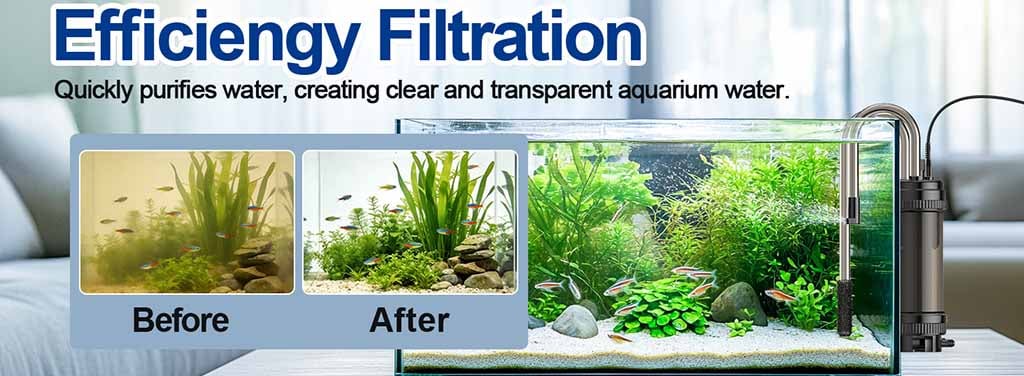
aquarium dual-flow filter
What Is an Aquarium Dual-Flow Filter
It is a specialized filtration system that pulls the water from a tank through 2 separate intake pipes. One intake pipe sucks the water from the water surface, and the other from the bottom side of the tank. Both intake pipes intake water simultaneously.
- It helps in removing oils and proteins from the water surface.
- Two intakes ensure that there is no stagnant zone and proper water circulation throughout the tank.
- Two intakes make sure that the filter never stops due to clogging. If one intake is clogged, the other will keep the pump running properly.
Why Is Traffic Flow More Important Than You Think in Aquariums?
Filter materials are important, but the other most important things are traffic flow and the flow path developed through the filter. If the traffic flow is inadequate and debris or filtering material does not optimally reach the filter intakes, the filter becomes useless. Before going into why flow path and flow traffic matter, here is the difference between the two.
Flow Traffic
In short, this is the pattern in which water moves in the tank. Flow traffic helps to avoid dead zones in the tank. The common flow traffic types are as follows.
- Circular / Loop (Gyre): This pattern helps to keep the water flow at one side, across the top, across the bottom, and down the other side. It helps to keep the water column clean.
- Chaotic / Turbulent: It replicates the natural and unpredictable ocean or river current in the tank. When multiple pumps or wave makers are placed in opposite directions, this happens.
- Linear: It is one of the simplest forms, i.e., water pushes from one side to the other side in a straight line.
Flow Path
In short, you can call the flow path routes. It is mapped according to the direction of the filter output nozzle, powerheads, and air stone.
Here are some reasons why flow matters a lot.
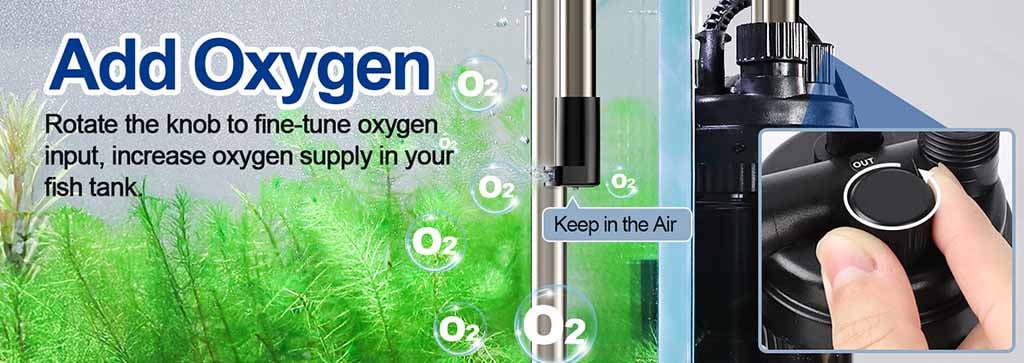
filter flow add oxygen
Why Does Traffic Flow Matter A Lot?
Improved Oxygenation
Flow traffic continuously breaks the surface tension in the tank. This continuous motion helps in entering oxygen into the tank and also allows carbon dioxide to leave the tank.
No Dead Spots
An optimal flow path ensures that water is moving around the tank and there are no dead zones. Elimination of these spots helps avoid ammonia and nitrite buildup in the tank.
Optima Filtration Efficiency
Flow traffic helps to keep the water in a suspended condition in the water column. After that, the flow path helps to sweep the debris and waste toward the dual-flow filter intake. This combination optimizes the filter efficiency in the tank.
Optimal Heat And Nutrient Distribution
When there is a problem with the flow of traffic, it causes a stagnant condition in the tank. The hot water remains at the top, and the cold water remains at the bottom. Optimal flow traffic helps to maintain the uniform temperature throughout the tank. Moreover, live plants have a fair and continuous nutrient supply.
Optimize Fish Health
Numerous fish come from rivers, streams, and coral reefs, where they are used to certain environments. With correct flow traffic, fish experience the home-like conditions. It helps to reduce stress. Moreover, swimming against the flow helps to exercise them and improve the fish’s health.
How Dual-Flow Filters Work?
A dual-flow filter works on a two-stream circulation principle. It has two intake pipes that sucks the water from the different tank surfaces and process it through various processes. After that, water returns to the tank through the exhaust pipe. This dual-flow aquarium helps to improve flow-traffic and flow-pattern in the tank.
Here is the breakdown of the system.
Dual-Intake Suction
A dual-intake filter has a single motor. This motor creates the pressure difference between the tank and filter. The water is drawn from two different places, the top and bottom, toward the filter.
Top Intake
The top intake sucks water from the top layer and removes the following, along with improving gaseous exchange.
- Organic protein films
- Floating oils
- Dust
Bottom Intake
This intake sucks the water from the bottom of the tank. Mainly, this intake helps to remove
- Heavier suspended detritus
- Fish waste
- Leftover food
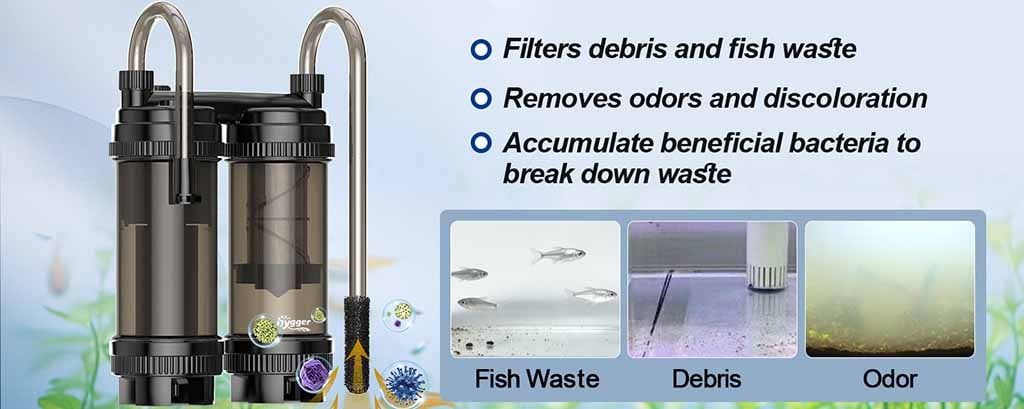
How dual-flow filters work
Internal Filtration
Once the water enters the filtration chamber, it is passed through various filter media.
Mechanical Stage
Water passes through poly pads or filter sponges. This stage helps to remove visible particles from the water. During this stage, water is passed through at a higher speed.
Chemical Stage
Water passes through the activated carbon or specialized chemical resins. This stage helps to remove odors, medication, and dissolved toxins. During this stage, water is passed through at a speed higher than the regular speed.
Biological Stage
During this stage, water slowly passes through a high-surface-area of ceramic rings or bio-foams. These areas have beneficial nitrifying bacteria that break down the ammonia and nitrites into nitrates. In this stage, water is allowed to stay so that bacteria have more contact time.
Pros and Cons of Aquarium Dual-Flow Filter
| Pros | Cons |
| It offers even water circulation that helps to eliminate the dead zones. | The initial cost is higher than single flow filter |
| It offers a gentle flow that helps to reduce stress among fish. This setup is a suitable option for goldfish, White Cloud Mountain Minnow, Stiphodon, and shrimps. | It takes a bit of extra time in setting. |
| It improves the oxygenation in the tank as it offers surface agitation. | |
| It offers flexibility to adjust the outlet angle. | |
| It helps to save space. |
Core Strengths
- It is suitable for all types of tanks starting from 20 gallons. However, some advanced filters like HG283 are even suitable for small tanks, i.e., 5 to 20-gallon tanks.
- It is suitable for delicate fish species, fancy goldfish, panda eel, and nano shrimps.
- It improves oxygenation in the tank by breaking surface tension. It improves the gaseous exchange.
- It reduces the algae bloom problem in the tank.
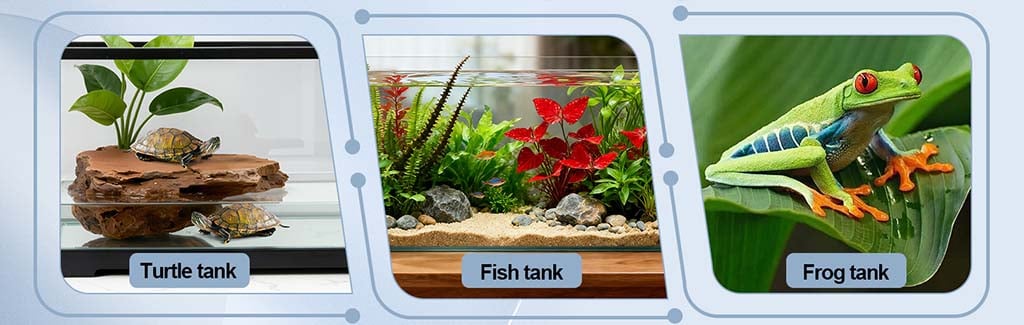
Dual-Flow Filter vs Single-Flow Filter
Dual-Flow Filter vs Single-Flow Filter
Here is a quick comparison between single-flow filters and dual-flow filters. This comparison table will help you in selecting the suitable option for your tank.
| Category | Single-Flow Filter | Dual-Flow Filter |
| Water outlets | 1 nozzle | 2 nozzles |
| Coverage area | Limited — one side | Wide — whole tank |
| Flow strength | Can be too strong in one spot | Balanced and gentle |
| Best tank size | Under 20 gallons | 20 gallons and up |
| Best for fish type | Stronger swimmers | Delicate or slow swimmers |
| Dead zones | Common in corners | Greatly reduced |
| Price range | $10 – $30 | $25 – $60 |
| Setup difficulty | Very easy | Easy to moderate |
HG283 Dual-Flow Aquarium Filter Setup & Placement Tips
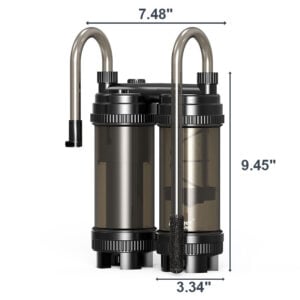
The HG283 dual-flow aquarium filter is one of the best filter options. It helps to clean a 5 to 20-gallon tank. It improves water circulation and removes waste from upper and lower levels of the tank and establishes stable filtration. Like the other dual-flow aquarium filters, it removes floating dust, oils, and protein film from the top and fish waste, leftover food, and heavier debris from the bottom.
Features
High-Efficiency Water Circulation
The HG283 filter has an 8.5W motor and a 120 GPH flow rate. Moreover, it is easy to maintain and suitable for freshwater and saltwater tanks.
Space-Saving Hob Filter
It offers a compact design and an easy installation. You can install it on the outer tank wall of the tank. Moreover, it is easy to remove from the wall and clean. It has a sponge at the inlet. This helps to avoid accidental suction of fry and shrimp.
Quiet Operation and Adjustable Oxygenation
The HG283 aquarium filter features a brushless motor and a low-friction rotor. It operates quietly, making it ideal for shrimp or small fish. The air intake knob helps mix air with water and increase dissolved oxygen in the tank.
Easy replacement
The HG283 aquarium dual flow filter comes with 2 bio-sponges and 1 PP filter media for fine filtration. The filter media can be added or replaced as needed.
HG283 review
How to Set up?
Unpack the Filter
Take out all parts from the box and ensure the following items are there.
- Filter cup
- Inlet pipe
- Outlet pipe
- Funnel
- Drainage pipe
- Spare sponges
Inspect All Components
Inspect all of the components, and ensure everything is fine.
Place the Filter on the Aquarium Wall.
Firmly installed the filter outside the aquarium. The suitable thickness of the glass wall is up to 1.4 inches or 3.5 cm.
Install the Inlet Pipe.
Insert the inlet pipe into the water inlet section and tighten the plastic nut properly.
Install the Outlet Pipe.
Insert the outlet pipe into the water outlet section and tighten the screw.
Prime the Filter With Water
Ensure that the inlet area is properly filled with water before starting the filter. If the power stops later, refill the filter with water before restarting.
Check the water level.
Make sure the inlet area is properly filled with water before starting the filter. If the power stops later, refill the filter with water before restarting.
Plug In the Filter
Connect the power plug to activate the filter. Use a safe socket and keep the power supply away from water.
Adjust the Airflow Control Knob.
Turn the airflow control knob to increase oxygen input. You should see small bubbles in the transparent outlet pipe and more bubbles coming from the outlet.
Adjust Outlet Direction
Set the outlet nozzle direction according to your aquarium’s needs. Keep the flow gentle for small fish, fry, shrimp, or betta fish.
Use the Drainage Pipe When Needed
Turn off the power first. Insert the drainage pipe into the drain outlet and place a cup or bucket below it.
Drain Collected Waste
Push the drainage outlet to release dirty water from the waste chamber. Release it to stop the drainage.
Observe the Filter Operation.
Make sure water is flowing properly, bubbles are coming from the outlet, and the filter is securely installed.
Do regular maintenance
Clean the filter sponge every 2–3 weeks. Replace the white PP sponge if it becomes heavily dirty. The black sponge can be reused after cleaning.

Flow Adjustment & Safety Tips
Flow Adjustment & Safety Tips
Maximum flow is not always an optimal setting. If you think so, you are on the wrong side. It can cause various harms to fish, plants, and the overall tank ecosystem.
Why Maximum Flow Is Not A Better Setting?
- Maximum flow means the powerful currents. Powerful currents cause stress among slow swimmers, like bettas or fancy goldfish.
- High flow can also uproot the delicate plants in the tank.
- High flow also disturbs the beneficial bacterial colony in the substrate.
- Higher flow results in a higher surface agitation. This higher surface agitation causes the CO2 to leak from the tank, which is not optimal for planted tanks.
- Higher flow rates affect the fry and shrimps. It can cause them to suck them into the filter.
- A higher flow rate in the filter media results in reduced contact time between bacteria and water. This reduces the biological filtration efficiency.
Flow Adjustment Rule
The simple rule of thumb for flow adjustment is that the flow rate should be 4 to 10 times per hour of the tank’s total volume. Beyond 10 times per hour is not recommended. A 20-gallon tank should have a flow rate between 80 and 200 GPH. Here is the optimal flow rate for various fish species.
| Fish Type | Ideal Flow Rate (x tank volume/hr) | Outlet Direction |
| Betta Fish | 3–4× (very gentle) | Along glass walls instead of fish |
| Goldfish | 4–6× | Mid-tank and toward the water surface |
| Tropical Community | 5–8× | One outlet up and one across the bottom |
| Cichlids / Larger Fish | 8–10× | Strong cross-tank flow is recommended |
| Planted Tank | 4–5× (avoid surface break) | Below the surface and side-to-side |
Safety Tips
- Always cover the intake with a pre-sponge filter. It will help to avoid accidental suction of fry and shrimps.
- Never run the filter when the water level is lower than the recommended surface. Otherwise, dry running will ruin the pump.
- Use old tank water to clean the filter media. It will help to maintain the bacterial colony in the filter media.
- Once you have adjusted the flow rate, keep an eye on fish behavior for 24 to 48 hours. If they are comfortable, go with that flow rate; otherwise, adjust to please them.
Summary&Selection Suggestions
Until now, you have understood completely that if you want to avoid dead zones and optimal filtration, aquarium dual-flow filters are one of the best options. It will improve the flow of traffic and the flow path. The top intake pipe will keep the surface oil-free, and the bottom will clean the substrate. The HG283 filter will provide you with the optimal filtration in even 5 to 20-gallon tanks, which is otherwise only available for 20+ gallon tanks. Now follow a step-by-step setup procedure, and optimally adjust the flow rate to enjoy with happy fish in your tank.
Related Products

Leave a comment