
Peppermint angelfish are one of the most expensive and rarest aquarium fish species. Mostly, aquarists love to know about them; it is the only thing that they can do. It is due to their rarity. Here, you’ll learn about their habitat, why they are expensive, the peppermint angelfish price, and some peppermint angelfish anecdotes. Moreover, a list of expensive fish species is also worth knowing at the end of the article. So, scroll down and enjoy the anecdote.
Content Table

peppermint angelfish
A Rare Resident of Deep, Mesophotic Reefs
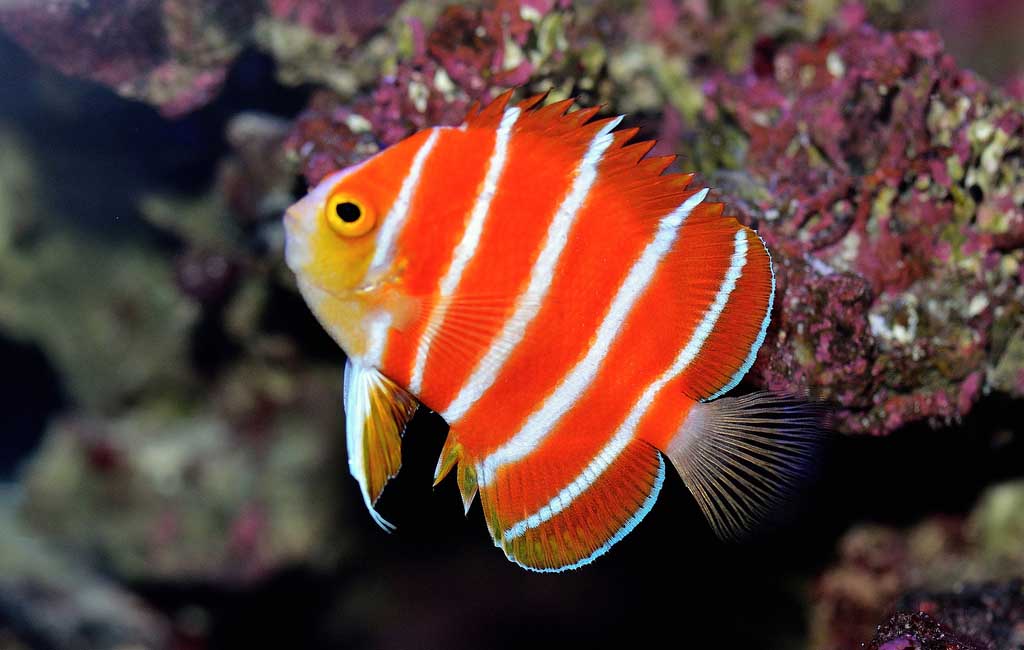
Peppermint angelfish are small, red-orange striped, beautiful marine fish. Their appearance and rarity make them among the most demanding fish. Aquarists want to keep them in their aquarium. Here is a profile of peppermint angelfish.
| Feature | Details |
| Scientific name | Centropyge boylei |
| Common name | Peppermint angelfish |
| Family | Pomacanthidae |
| Size | Up to 2.75 inches long |
| Coloration | Bright red-orange |
| Strips | Colorful vertical strips on the body |
| Distribution | Mainly in the Cook Islands (South Pacific) |
| Living depth | 55 to 120 meters in water |
| habitat | Deep coral reef, i.e., reef slopes and caves |
| Temperament | Shy |
| Diet | Omnivorous |
Living Habits
They live in deep, rocky environments. Peppermint angelfish are present on the outer slopes of reefs. They live in small groups, usually in pairs. This behavior shows their social behavior. They consume various diets from their habitat, i.e., worms, crustaceans, sponges, tunicates, and detritus. Moreover, they also consume organic matter from their surroundings.
They are distributed from 55 to 120 meters deep, i.e., adapted to low light. Their higher cost is also due to their deep living environment, as it is hard to capture and acclimate them in shallow waters. Usually, they are considered reef-safe fish. However, they can nip the corals, i.e., sponges, LPS corals, and clam mantles.
Why Are Peppermint Angelfish So Expensive?
Usually, the value of an object depends on its supply and demand. Peppermint angelfish is highly demanded among aquarists. However, compared to demand, they are present in smaller quantities. It raises their price. Here are several other reasons to explain why they are so expensive.
Rarity
They are present only in the Cook Islands, on deep and mesophotic reefs. This geographical restriction increases their rarity.
Deep water Presence
They are present at 50 to 120 meters in the water. Therefore, it is hard to catch them from that environment.
peppermint angelfish price
Difficulties in Harvesting
It is hard to catch a peppermint angelfish; there is a high chance of escape to the rocks in their area. Here are some difficulties,
- High depth
- Water pressure
- Difficult train
- Small size
- Low light
- Shyness
Acclimation Problems
Once, you even succeeded in capturing or buying a peppermint angelfish. It is hard to acclimate to a new environment and decompress in shallow water.
High Demand
Due to their unique physique and other properties, they are a highly demanded species among aquarists. While their supply is extremely limited. Moreover, they are considered the “Holy Grail” of marine angelfish, which further increases their price.
Breeding
Although it is challenging to breed in shallow-depth environments, some have managed to do so. This process is difficult and costly. Therefore, their price has skyrocketed.

peppermint angelfish anecdote
How Many Peppermint Angelfish Are Left Now?
The exact number of Peppermint angelfish is unknown. However, according to the 2009 IUCN list, they are labeled as least concerned. In 2019, it was reported that there was only 1 specimen globally available for public display. However, there is a concern about their population. In the future, they may experience a decline in population due to declining habitat, i.e., coral degradation and environmental change issues.
A Short History of Peppermint Angelfish
The peppermint angelfish is among the most recently discovered fish species. In 1990, their first presence was noted. Initially, this discovery was limited to researchers and divers. In 1992, John Ernest Randall and Richard Pyle popularized this discovery. The peppermint angelfish was named Centropyge boylei after Chuck Boyle, a deep-reef collector.
Aquarium fish trade divers randomly tried to collect them between 1990 and 2000. In 2000, 1 peppermint angelfish was available for public display in Hawaii. In 2009, the IUCN categorized them as the “least concerned” species. In 2010, they were labeled as the Holy Grail in the aquarist community.
In 2019, it was reported that only one specimen was available for public display. Some divers have made their videos and pictures of deep-sea corals available.
History Timeline
| Year | Event |
| 1990 | Discovered in the Cook Islands, but remains limited to a few researchers and divers. |
| 1992 | Publicly announced by Richard Pyle and John Randall.
Named Centropyge boylei after Chuck Boyle. |
| 2000s | Successfully collected one specimen and made it available at the Waikiki Aquarium in Hawaii. |
| 2009 | ICUN categorized it as a least concerned species. |
| 2010s | Labeled as “Holy Grail”
Priced at $30,000 |
| 2019 | Still, only publicly available species. |
| 2015 to 2020 | Only a few videos are available due to deep-sea divers. |
Some Most Expensive Pet Fish You Can Buy
Platinum Arowana
| Feature | Value |
| Scientific name | Osteoglossum bicirrhosum |
| Common Name | Dragon Fish |
| Lifespan | Average in Wild: 20 to 40 years
Average captivity: up to 20 |
| Conservation Status | Endangered |
| Coloration | Almost white and metallic platinum |
| Size | 4 feet |
| Average cost | $400,000 |
Freshwater Polka Dot Stingray
| Feature | Value |
| Scientific name | Potamotrygon leopoldi |
| Common Name | Xingu River ray
White-blotched river stingray Polka-dot stingray |
| Lifespan | Average in Wild: unknown
Average captivity: between 5 and 10 years |
| Conservation Status | Not categorized due to lack of data |
| Coloration | Black and brown, covered with white spots |
| Size | 18 inches in diameter |
| Average cost | $100,000 |
Peppermint Angelfish
| Feature | Value |
| Scientific name | Centropyge boylei |
| Common Name | Centropyge boylei
Peppermint angelfish |
| Lifespan | Average captivity: 10–15 years |
| Conservation Status | Least Concerned |
| Coloration | Striking red with vertical white strips |
| Size | 2.8 in |
| Average cost | $30,000 |
Masked Angelfish
| Feature | Value |
| Scientific name | Genicanthus personatus |
| Common Name | Genicanthus personatus
Masked angelfish |
| Lifespan | Average captivity: 10–12 years |
| Conservation Status | Not endangered |
| Coloration | White with black coloration |
| Size | 8.3 in |
| Average cost | $16,000 |
Bladefin Basslet
| Feature | Value |
| Scientific name | Jeboehlkia gladifer |
| Common Name | Bladefin Basslet
Long spine Sea Bass |
| Lifespan | Average captivity: 2 – 4 years |
| Conservation Status | Least concerned |
| Coloration | White, pink, or red with the head and back of the neck red |
| Size | 3 inches |
| Average cost | $10,000 |
Golden Basslet
| Feature | Value |
| Scientific name | Gramma dejongi |
| Common Name | Golden fairy basslet |
| Lifespan | Up to 15 years |
| Conservation Status | Least concern |
| Coloration | Vivid golden yellow |
| Size | 3 Inches |
| Average cost | $8,000 |
Neptune Grouper
| Feature | Value |
| Scientific name | Cephalopholis igarashiensis |
| Common Name | Garish hind
Neptune grouper Goldbar grouper Japanese cod |
| Lifespan | 30–50 years |
| Conservation Status | Least concern |
| Coloration | Reddish-orange |
| Size | Usually 10 in |
| Average cost | $6,000 |
Australian Flathead Perch
| Feature | Value |
| Scientific name | Rainfordia opercularis |
| Common Name | Flathead perch
Rainford’s perch |
| Lifespan | 15–20 years |
| Conservation Status | Least concern |
| Coloration | Dark orange with strips |
| Size | Between 5–7 inches |
| Average cost | Between $1,000 – $5,000 |
Wrought Iron Butterflyfish
| Feature | Value |
| Scientific name | Chaetodon daedalma |
| Common Name | Barberfish |
| Lifespan | Up to 10 years |
| Conservation Status | Least concern |
| Coloration | Black coloration |
| Size | Up to 6 in |
| Average cost | $2,700 |
Clarion Angelfish
| Feature | Value |
| Scientific name | Holacanthus clarionensis |
| Common Name | Clarion angelfish |
| Lifespan | 10–12 years |
| Conservation Status | Vulnerable |
| Coloration | Brownish orange with dark brown head |
| Size | Up to 7.9 in |
| Average cost | Between $2500 $3000 |
Lasting Impressions
The peppermint angelfish is a beautiful, small, and rare fish species. They are present in the Cook Islands at coral reef slopes at a higher depth. They are expensive due to their rarity, the “holy grail” title, high demand, and breeding difficulties, among other factors. Although they are bound to a specific geography, the IUCN lists them as the least concerned species.
These are some of the most recently discovered species with a little-known history. According to available details, you can dream about having a Peppermint angelfish or owning one in your tank. However, if you are interested in other expensive species, we have already discussed a list with features.
Related Products



Leave a comment