
Running a reef aquarium without proper water movement is like having a living room with no ventilation. Things start going wrong quietly, and most of the time, the fish and coral pay the price before anything becomes obvious. A large wave maker is one of those pieces of equipment that goes completely unnoticed when it works well and becomes painfully clear when it is missing.
Content Table
This post covers what strong water flow actually does for tank health, how the HG295 performs across different setups, and practical water flow adjustment tips that make a real difference.
large wave maker
Why Strong Water Flow Actually Is Healthier in Fish Tanks
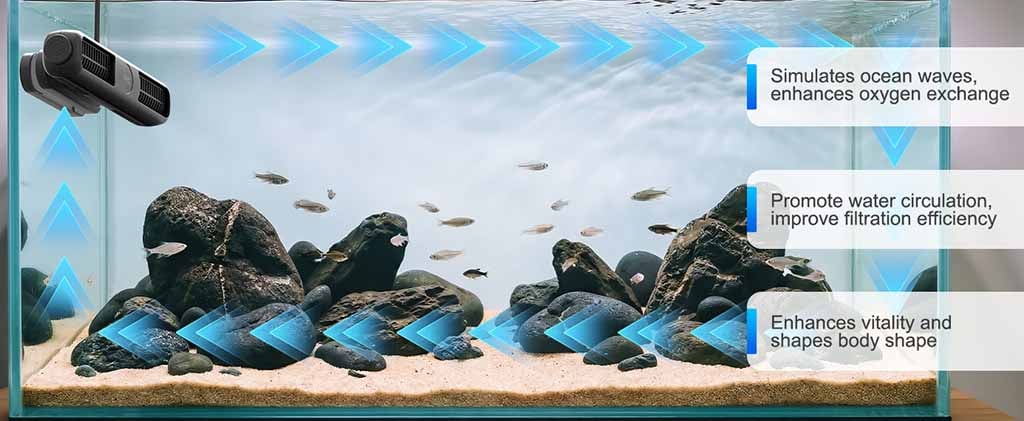
Most fishkeepers know that fish need clean water, but fewer think about the role movement plays in that equation. Still water is not neutral. It allows waste to settle, nutrients to concentrate in specific corners, and oxygen levels to drop near the substrate. Strong water flow breaks that cycle entirely.
In the wild, fish live in rivers, tidal zones, or the open ocean, where water is never completely still. Their bodies adapt to those currents over generations. Fins grow stronger. Metabolism functions more efficiently. Coral polyps extend fully in moving water because it brings food particles directly to them while carrying waste away from their surfaces.
Here is what consistent, well-distributed strong water flow does for fish health, specifically:
- Keeps fish physically active, which builds muscle tone and supports better organ function over time
- Reduces the risk of fin rot and bacterial infections that thrive in stagnant water pockets near the substrate
- Encourages more natural feeding behavior by distributing food evenly through the entire water column
- Supports respiratory efficiency, since fish absorb oxygen through their gills more effectively when the surrounding water is properly aerated and moving
The assumption that calm water is peaceful water does not hold up under scrutiny. Peaceful for the eye, perhaps. Not always beneficial for the biology happening inside the glass.
strong water flow
How Water Flow Affects Aquarium Water Quality
Water quality in a reef tank is not just about chemical readings. It is also about the physical movement of water through filtration systems, across tank surfaces, and around everything living inside.
Dead zones form wherever flow does not reach consistently. Detritus builds up in those corners, ammonia spikes, and the biological filter cannot process waste it cannot access. A large wave maker eliminates these zones by pushing water steadily across the entire tank floor and surface without leaving pockets untouched.
There is also the matter of gas exchange. Carbon dioxide needs to leave the water column, and oxygen needs to enter. This process happens most efficiently at the water surface, and surface agitation driven by strong water flow speeds up that exchange significantly. Tanks with poor surface movement often show lower dissolved oxygen levels, which stresses fish, slows coral growth, and weakens the beneficial bacteria colonies that keep the nitrogen cycle stable.
The connection between flow and filtration efficiency is direct. More movement means more water passes through the filter media per hour. Waste gets processed faster, and parameters stay stable longer between water changes.
What a Large Wave Maker Does
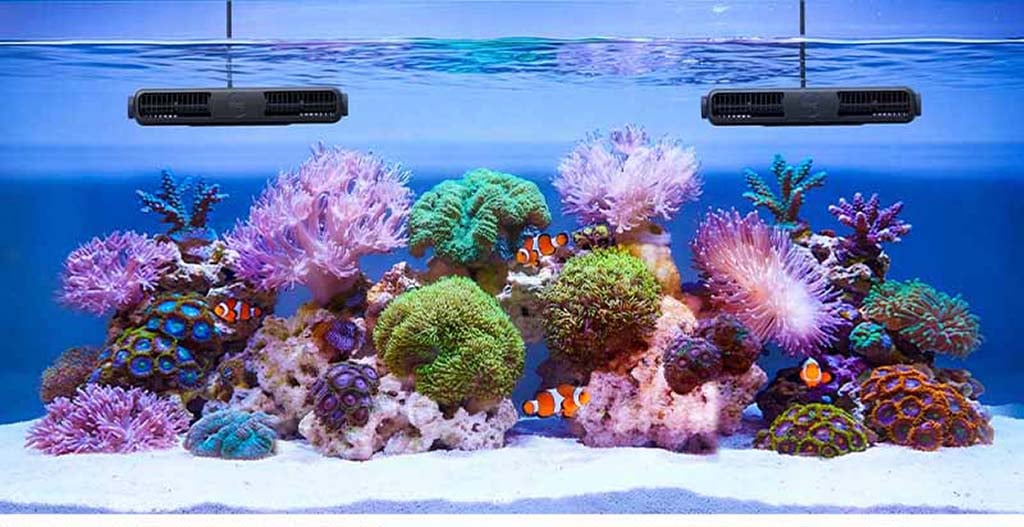
Big wave makers don’t just push water in one direction. Modern units simulate the irregular, multi-directional patterns found in actual ocean environments, which is meaningfully different from a standard powerhead that produces a single directional stream and leaves most of the tank relatively undisturbed.
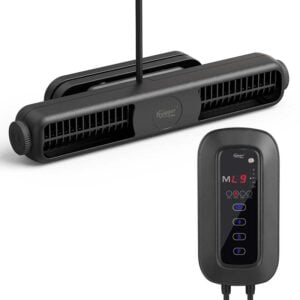
The HG295 uses a wide crossflow outlet design with two rotatable outlets that can be adjusted to direct flow at different angles across the tank. This crossflow pattern distributes water far more evenly than a traditional pump, which tends to produce narrow, point-based turbulence rather than broad coverage.
Large Wave Maker Placement
The unit supports five distinct wave modes:
- Constant mode delivers a steady, uninterrupted flow at whatever speed level is set
- Classic mode introduces gradual flow variation that loosely mimics tidal movement
- Synced reverse mode alternates flow direction, creating a genuine cross-current effect
- Sine wave mode produces smooth, rhythmic pulses that closely replicate natural wave action
- Random mode generates unpredictable variation that keeps fish alert and corals fully extended
Each mode suits different tank types. Coral and reef tanks generally respond best to sine wave or synced reverse modes. Fish-only tanks do well with classic or constant mode at moderate speed settings. The right mode depends on the specific livestock combination, not a universal recommendation.
Large Wave Maker Placement Guide
Placement determines everything about how effective a large wave maker is in a running tank.
General placement principles:
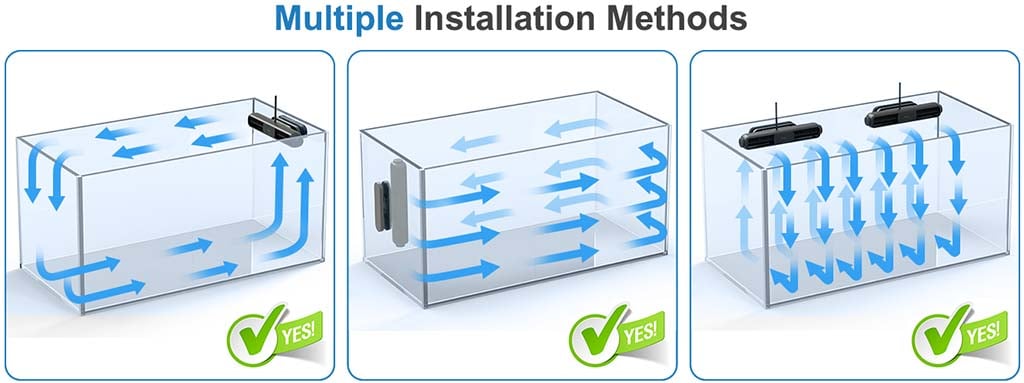
- Mount the unit near the top of the tank, angled slightly downward, so flow moves through the full water column rather than only across the surface.
- Position it opposite the return pump or skimmer intake to create a circular current that covers the back corners.
- Avoid aiming the outlets directly at coral frags or delicate invertebrates. Indirect flow almost always outperforms direct pressure for reef inhabitants.
- In tanks longer than 48 inches, placing the unit on the short-side wall allows the crossflow to cover the full length more effectively.
On horizontal versus vertical mounting
The HG295 magnetic base supports both orientations, giving real flexibility depending on the tank shape. Horizontal placement works well in shallow, long tanks where coverage across the length is the priority. Vertical mounting suits taller, narrower setups where top-to-bottom circulation matters more. The magnetic base holds securely on glass up to 12mm thick, which covers most standard home aquariums without additional hardware.
HG295 review
HG295 Large DC Wave Maker Review
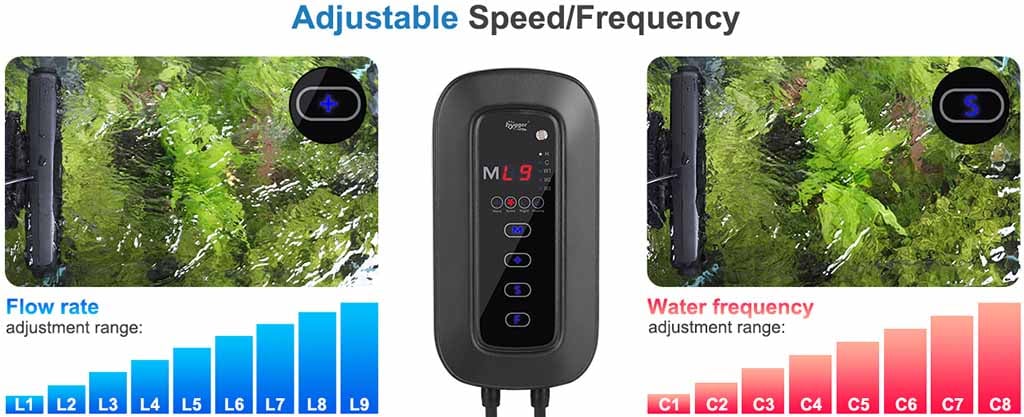
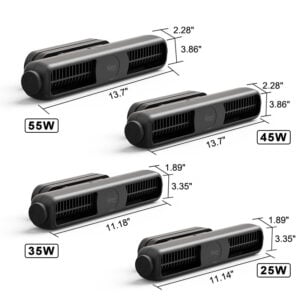
The HG295 wave maker review starts with capacity because that is where most purchasing decisions begin. This pump handles tanks from 55 to 4126 gallons, making it a genuinely versatile option for both home setups and larger display tanks. Flow rate runs across nine levels (L1 to L9), and frequency adjusts across eight settings (C1 to C8). That range of control is not common at this price point, and it gives enough precision to fine-tune the environment for different species combinations.
1. Noise Performance
Noise performance is one of the stronger points in this HG295 review. The motor runs quietly during operation, and the included cotton pad absorbs vibration between the pump body and the glass. Even at higher speed levels, the unit stays unobtrusive, which matters considerably in living spaces where equipment noise becomes a daily presence.
2. Light Sensor
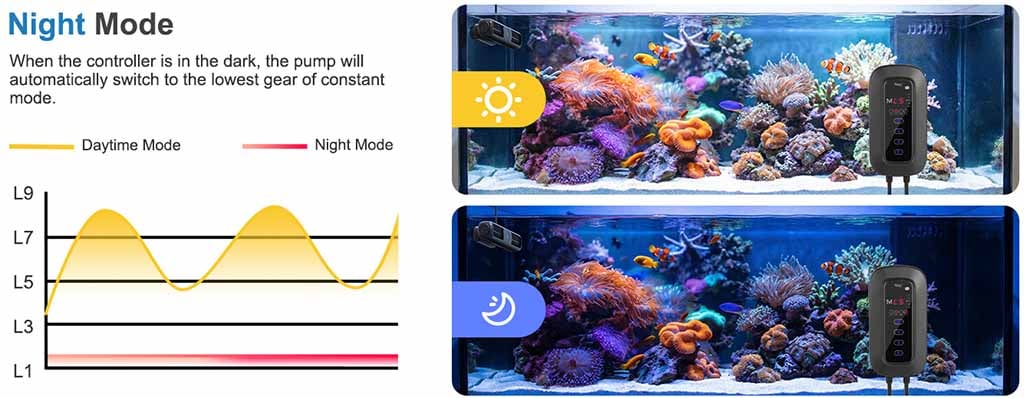
The light sensor feature adds genuine convenience. When the room darkens at night, the controller automatically drops the pump to the lowest constant mode setting without any manual input. The tank continues receiving gentle circulation through the night without the owner needing to adjust anything.
3. Feeding Mode
The feeding mode handles another common frustration well. The pump pauses for a selected duration (10, 20, 30, or 60 minutes) and resumes automatically afterward. Food stays near the surface and distributes more naturally without being pulled into the filter before slower fish have a chance to eat.
4. Ceramic Shaft
The ceramic shaft is corrosion-resistant, which extends operational lifespan in saltwater tanks where mineral deposits and salt creep are ongoing maintenance concerns.
water flow adjustment tips
Water Flow Adjustment Tips
Getting the most from the HG295 requires some patience in the first few weeks, particularly after adding new livestock or rearranging the aquascape.
Practical water flow adjustment tips to start with:
- Begin at L3 or L4 and observe fish behavior for 24 to 48 hours before increasing the speed. Hiding, rapid gill movement, or erratic swimming usually indicates the current is too strong for that particular species.
- Switch to random mode or sine wave mode if the coral is not opening fully. Steady, predictable flow sometimes causes corals to retract, while irregular patterns encourage full polyp extension.
- Use the feeding mode timer to drop flow during meals. This keeps food suspended long enough for slower or more timid feeders to compete.
- Adjust the outlet direction before changing speed levels. Repositioning the outlets often resolves circulation problems without increasing power at all.
- At night, the controller automatically switches to the lowest constant mode when the room is dark, so additional adjustment is unnecessary unless a specific nighttime flow level is preferred.
These water flow adjustment tips apply broadly across most wave pump brands, but the nine-level control on the HG295 gives enough range to actually implement them with precision rather than approximation.
Aquarium large wave maker equipment
Key Points
A large wave maker is not optional equipment in a serious reef or mixed aquarium. It directly affects oxygen exchange, filtration efficiency, fish physical health, and coral behavior in ways that no amount of chemical dosing can fully compensate for.
The HG295 review covers a pump that earns its place in large tank setups through flexible speed and frequency control, quiet operation, five programmable wave modes, and a light sensor that removes the need for nightly manual adjustments.
Strong water flow, properly distributed across the full tank volume, is one of the most reliable ways to stabilize an aquarium long term. The water flow adjustment tips outlined above provide a useful starting point, but real optimization comes from watching how specific fish and coral respond over time and making small changes accordingly.
Related Products

Leave a comment