
Good lighting and proper filtration are not enough to create an atmosphere of health and activity in your aquarium. Water movement is one of the most important. Yet, most neglected parts of a successful fresh or saltwater tank are. This is where wave pumps for aquariums are used.
Content Table
Why use a wave pump in a tank? Wave pumps mimic the natural flow created by wave action in oceans and rivers, solving water quality problems, eliminating dead zones, and enhancing oxygenation. However, not every wave pump is like the other. Selecting an appropriate wave pump to suit the size of your tank and the aquatic environment can actually have tremendous effects on the health, appearance, and performance of your aquarium.
In this hygger blog, we will be considering the benefits of wave pumps. When you know you need one on your tank and how to choose between 2 of the most highly performing models: the hygger HG070 Cross-Flow Wave Pump and the hygger HG119 Circulation Wave Maker Pump. Including a size chart of tanks, from 60 gallons to 300 gallons.

wave pump for aquarium
The Benefits of Wave Pump for Freshwater and Saltwater Tanks
They are very useful in freshwater and saltwater aquariums. They help to maintain a biological balance in the tank, to upgrade its water quality, and make it look much better. They also exist to fulfil various vital functions according to the water environment:
For Freshwater Tanks:
- Prevents Stagnant Water: In low flows, dead zones may end up containing harmful bacteria, uneaten food, and waste. Wave pumps maintain the movement of the water. Such that debris may be kept longer, so that the filters can pick it up.
- Supports Plant Growth: Most freshwater aquariums have living plants that require an adequate supply of nutrients. The soft turbulence promotes equal distribution of CO2and fertilizers to avoid algae accumulation and enhance the vitality of the plants.
- Improves Oxygen Exchange: When the surfaces are stirred adequately, the oxygen gets into the water and also encourages the escape of unwanted gases such as CO2. This provides better living conditions for fish, shrimp, and helpful bacteria.
- Reduces Algae Growth: A good flow prevents algae from settling down in certain corners and limits the biofilm formation on the glass and ornaments.
For Saltwater Tanks
- Provide Natural Ocean Currents: Corals and invertebrates at sea are used to constantly changing stream conditions. These natural flows are reproduced in wave pumps and provide their nutrients, food, and respiration.
- Removes Waste and Debris: Within a reef tank, waste materials usually build up behind some rocks or corals. Powerful and alternating flows produced by wave pumps leave the wastes in suspension and push them to the filtration system.
- Promotes Even Heat Distribution: The heat usually collects on the heaters. This energy is dispersed evenly by circulating pumps and avoids the formation of a hot or cold spot in large tanks.
- Supports Coral Feeding and Growth: Corals rely on the food that floats in the water, such as plankton. These are, in turn, being evenly distributed through the tank by wave pumps. It allows polyps to gain proper nutrition, keeping corals in a healthy state.
- Enhances Filtration Efficiency: Improved circulation leads to greater water coverage of the tank, and the filters and protein skimmers can do their job better and remove more organic waste.

Why use a wave pump in a tank
Does My Fish Tank Need a Wave Pump?
Do you want to know whether you need a wave pump in your aquarium? These are some of the indications and circumstances that will mean you need one in your tank. If you checked off one or more of these, it’s time to invest in a wave pump.
- You have dead spots where debris and waste accumulate.
- Oxygen levels are low, causing fish to gasp at the surface.
- You own a reef tank with corals that need constant water movement.
- You’re experiencing uneven water temperatures.
- Plant growth is slow in your freshwater setup due to poor nutrient circulation.
- Your tank has a high bioload, requiring better circulation to distribute waste for filtration.
Cross-Flow Wave Pump: hygger HG070
Overview
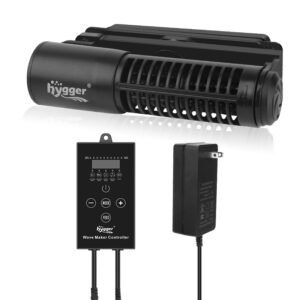
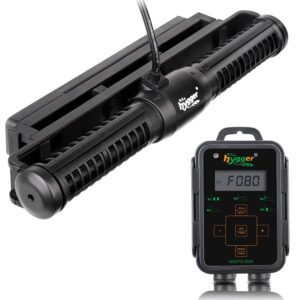
hygger HG070 Cross-Flow Wave pump fits medium and large tanks (60-265 gallons), and fits freshwater tanks in addition to marine.
Key Features:
- 360° Cross-Flow Technology: Provides a natural, ocean-like flow with uniformly distributed soft waves. Eradicates dead spaces and encourages circulation in a full tank.
- Ultra-Quiet Operation: Runs silently with its 24V DC motor that has sine wave control and can be used in bedrooms or offices.
- Multi-Position Mounting:
- Top: Creates surface waves that add visual appeal.
- Middle: Delivers mid-water flow, mimicking natural environments.
- Bottom: Dislodges debris and supports substrate cleaning.
- Smart LCD Controller: Adjust speed, mode, and power output easily with a user-friendly interface.
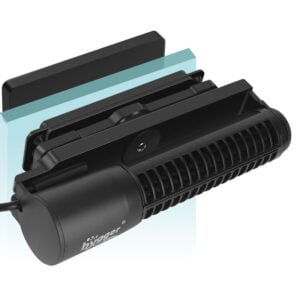
- Strong Magnetic Base: Secure installation on glass up to ½ inch thick.
Usage Tutorial
Installation and proper maintenance of your wave pump are critical in ensuring maximum functionality and the successful appearance of an aquarium. These are some instructions on how to operate the pump in different positions and maintain it in the best possible state:
1. Top Position
The installation of the pump close to the water surface creates attractive surface turbulence. This increases oxygen exchange and aids in the breaking of surface film. Making it very appropriate in tanks with fish that need high amounts of oxygen. It also provides motion and glitter to your fish tank lighting.
2. Middle Position
Placement of the pump at the midpoint of the tank imitates the dynamical flow patterns of natural rivers or reefs. It generates a steady, homogenous current using microbubbles. These are ideal for replicating natural water conditions. This arrangement is good for both freshwater and reef tanks as it distributes food particles and nutrients.
3. Bottom Position
To clean deep and have better circulation, put the pump towards the bottom of the tank. This will enable the pump to aerate settled debris, avoid dead zones on the back side of rocks and decorations, and encourage effective filtration. It fits well in tanks that have a large bioload or those with a difficult aquascape.
Why Choose HG070?
It is ideal for aquarists who want an extremely quiet pump, low-energy-consuming, and can be mounted in a variety of positions. The HG070 makes the living environment of your tropical fish or delicate corals better, whether you are keeping them in a house or not.

HG070 cross flow
Circulation Wave Maker Pump: hygger HG119
Overview
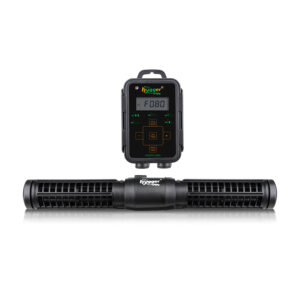
The hygger HG119 Circulating pump is a very strong multipurpose wave pump with 2 versions, 35W and 50W, which is intended to work with large tanks (up to 300 gallons). It is a combination of high-end cross-flow technology and intelligent control.
Key Features
- Cross-Flow Technology: Creates full-tank movement with 360-degree flow. Ideal for simulating ocean conditions and promoting even filtration.
- Two Power Options:
- 35W: Best for 85–160 gallon tanks.
- 50W: Best for 100–300 gallon tanks.
- Multifunctional LED Controller:
- 4 Wave Modes: Constant, gradient, classic, and random.
- Memory Function: Remember your previous settings after a power outage.
- Feeding Mode: Temporarily pauses wave action for 10/20/30 minutes.
- Adjustable Speed & Flow: Customizable from level 1 (30%) to level 10 (100%).
- Dry-Running Protection: High-tech chip prevents damage from rotor lock or running without water.
- Shock-Absorbing Silent Base: Features six silicone struts that minimize noise and vibration.
Usage Tutorial HG119
The hygger 119 wave pump is fashioned as a rotatable structure and a flexible pump head. It can be installed in a flexible way with the ability to direct the water flow in a specific direction. Installation on varying levels in the tank has special effects, which increase not only utility but also the aesthetics.
1. Top Position
Installation of the pump on the top of the tank provides visible agitation of the surface, facilitating oxygen exchange and the destruction of film. This arrangement also improves the lighting shimmers so that your aquarium appears more vigorous and lively.
2. Middle Position
Mid-installation of the pump simulates the natural ocean currents to generate smooth and dynamic waves containing microbubbles. This would suit fish and corals, which grow well in the water with low circulation. It enhances the nutrient dispersion as well as the feeding of corals in reef tanks.
3. Bottom Position
Locating the pump at the bottom will stir up the detritus and remove stagnant water, and maintain the substrate clean. The arrangement is particularly useful in tanks with either complex aquascapes or high bioloads because wastes are less likely to build up in difficult-to-reach regions.
Why Choose HG119?
Select HG119 when you require a high-performance and smart-controlled wave maker with a large flow customizability, such as coral tanks, large community setups, and tanks with a high bioload.
| Feature | hygger HG070 | hygger HG119 |
| Type | Cross-Flow Wave Pump | Circulation Wave Maker |
| Tank Capacity | 60–265 Gallons | 85–300 Gallons |
| Power Options | 12W, 18W and 25W Options (24V DC) | 35W and 50W Options |
| Noise Level | Ultra-Quiet | Quiet with Silicone Shock Absorbers |
| Controller | LCD Display | LED Touch Controller |
| Wave Modes | 5 Wave Modes+ Feeding Timer | 4 Wave Modes + Feeding Timer |
| Positioning | Top, Mid, Bottom Mounting | Adjustable Mounting with Wave Effects |
| Suitable For | Coral tanks, planted tanks | Reef tanks, large community tanks |
HG070 vs. HG119 Wave Pump: Which Is Right for You?
How to Choose
- Choose HG070 if you want a minimalist, simple-to-operate, quiet cross-flow pump for tanks up to 265 gallons.
- Opt for HG119 if you prefer more control, wave customization, and higher tank capacity supporting up to 300 gallons.
What Size Wavemaker for a 60–300 Gallon Tank?
Choosing the right size wave pump ensures effective circulation without overwhelming your fish or disturbing your aquascaping.
Wave Pump Size Chart for 60–300 Gallons:
| Tank Size (Gallons) | Recommended Pump | Model | Wattage |
| 60 | HG070 | 12W Cross-Flow | 24V |
| 60–135 | HG070 | 18W Cross-Flow | 24V |
| 100–160 | HG119 | 35W Circulation | 35W |
| 160–265 | HG070 | 25W Cross-Flow | 24V |
| 200–300 | HG119 | 50W Circulation | 50W |
Tips for Choosing Size
- Consider bioload: Tanks with more fish or corals need stronger circulation.
- Account for tank shape: Long tanks benefit from cross-flow; deep tanks may need vertical circulation.
- Match with the filtration and heater to support consistent water quality and temperature.
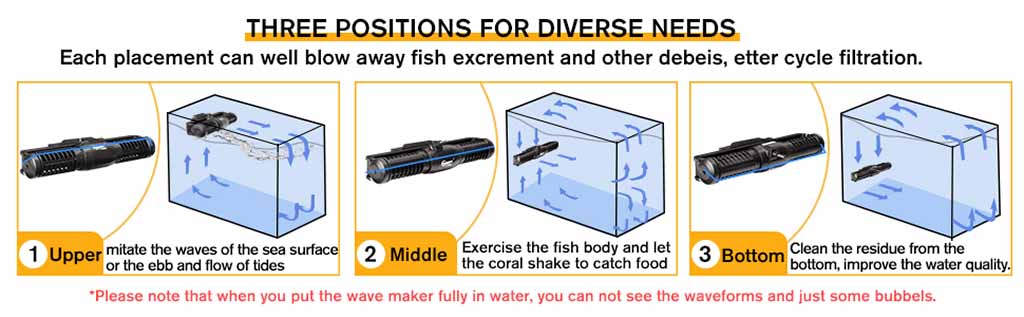
Where to place the wavemaker pump
Wrapping Up
Wave pumps are not accessories, but rather essential tools in promoting a thriving aquarium ecosystem. No matter what type of system you have, whether it is a freshwater system or a marine reef tank. The proper wave maker can make a tremendous difference both in the clarity of the water, the health of the fish and corals, and the overall beauty of the tank.
The hygger HG070 Cross-Flow Wave Pump provides smooth, silent, and gentle natural flow., It is highly flexible to mount, which suits those aquarists who want an easy and effective pump.
In the meantime, the hygger HG119 Circulation Wave Maker offers more advanced functions, including multi-mode wave control, feeding timers, and speed settings to enthusiasts seeking to have precise control.
Whether your tank is as small as 60 gallons or a system larger than 300 gallons, the hygger wave pump is ideal for your system. Choose the correct decision today and give your aquarium the sound of natural waves.
Related Products

Leave a comment