
The Elephant Nose Fish has quite an interesting shape and attributes. This African native shows interesting behavior in community tanks. If you are an experienced aquarist and looking for something new, the elephant nose fish is one of the best choices. For that, you need to learn about their profile, temperament, diet, size, life stages, and factors that really affect them. In the following, you’ll find these points along with many more. Scroll down, read it, and go for your challenge.
Content Table
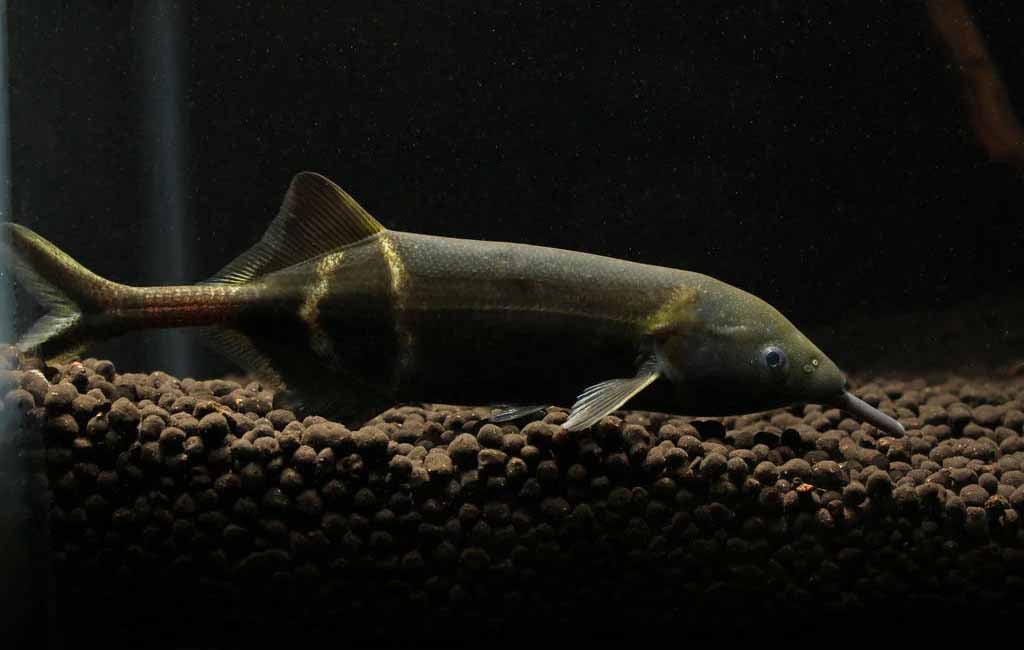
elephant nose fish
Fish with Elephant Nose
It is a unique-shaped fish that has a long, trunk-like snout. In fact, this long snout is an extended mouth. Due to this unique shape, mimicking an elephant’s snout, named the elephant-nose fish. They use this extended mouth for various purposes.
- Communication in dark and muddy water
- Foraging
- Navigating through water
- Acts like a sonar to detect the surroundings and catch the prey, i.e., worms and insects
Here is a profile of this fish with an elephant nose.
Profile
| Category | Details |
| Common Name | Elephant Nose Fish |
| Scientific Name | Gnathonemus petersii |
| Family | Mormyridae |
| Origin / Distribution | Slow-moving rivers of West & Central Africa (Nigeria, Cameroon, Congo Basin) |
| Species | 200+ |
| Adult Size | Average 6 to 9 inches |
| Lifespan | 6–10 years |
| Temperament | Peaceful but territorial toward the same species |
| Activity Level | Nocturnal; active at night or in low light |
| Swimming Zone | Bottom–mid area |
| Electric Organ | Yes, for navigation and communication |
| Water Temperature | 22–28°C |
| pH Range | 6.5–7.2 (soft to moderately hard water) |
| Water Hardness | 5–12 dKH |
| Diet Type | Carnivore |
| Preferred Food | Live/frozen bloodworms
Blackworms brine shrimp Tubifex Mosquito larvae |
| Feeding Behavior | Slow eater |
| Special Behavior | Uses its long “trunk” to find food using electric pulses (electrolocation) |
| Sensitivity Level | Very sensitive to water quality, medication, strong light, and nitrates |
Are Elephant Nose Fish Aggressive?
Elephant-nose fish are mildly aggressive. However, they are only aggressive toward their own species. They are equipped with electric organs that they use as a weapon. Their aggression is not physically damaged but mildly electrified. In concise
- Aggressive toward their species
- Aggressive around the hiding spots due to their territorial nature
- Not physical damage, but electrical
- Mildly violent
Are Fish With Elephant Noses Hard to Keep?
In a single word, yes. They are only suitable for advanced-level aquarists. Why are they hard to keep? Here are a few reasons.
- Sensitive to water quality, especially to ammonia, nitrite, and higher nitrates.
- They require a soft bottom as they have a delicate trunk.
- They require a low-light environment, which is usually not suitable for beginners, as they want to see the fish activity.
- It is hard to keep the community tank as they are slow eater and other fish can outcompete them while feeding.
- They prefer live or frozen food, not dry.
- It is hard to treat them with medication as they are sensitive to copper and many other elements.
- High light and sunlight put them under high stress.
Temprament
Peaceful except toward their own species.
Characteristics
Here are some characteristics of the elephant-nose fish.
- They appear slender and dark brown to black with two pale white bands on the fins.
- They have a distinctive and flexible nose.
- Elephant-nose fish have an electric organ. They use it for communication, locating their food, and navigating through the dark.
- They are nocturnal.
- They live in dark and slow-moving rivers with muddy bottoms in Africa.
- Peaceful only towards other fish species, not toward the similar ones.
- They live in large schools in the wild.
- They are hard to breed in tanks.

fish with elephant nose
What Do Elephant-Nose Fish Eat?
The elephant-nose fish’s diet is mainly small live creatures in mud and leaf litter, as they are carnivores. They prey on soft-bodied creatures. If you want to understand the food chain of this unique fish, look at the following.
Food Chain
| Level | Organisms | 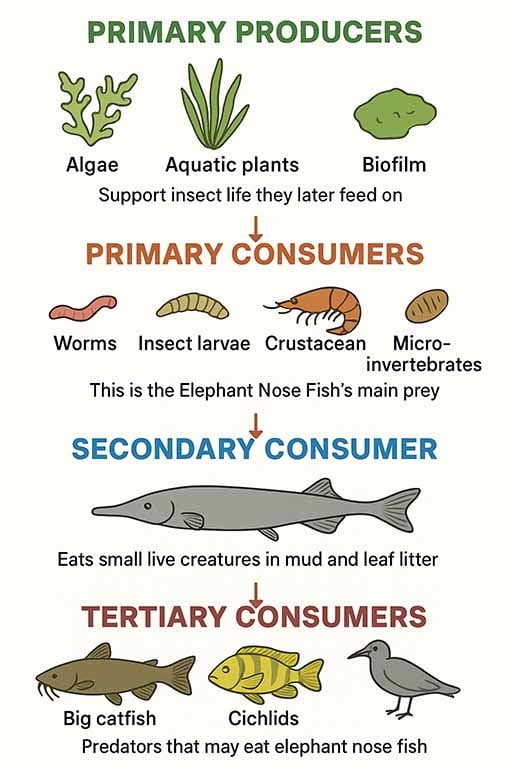
|
| Primary Producers | Algae, aquatic plants, biofilm | |
| Primary Consumers | Worms, insect larvae, crustaceans, micro-invertebrates | |
| Secondary Consumer | Elephant Nose Fish | |
| Tertiary Consumers | Big catfish, cichlids, birds |
What is the Elephant-Nose Fish Diet in the Wild?
- Worms
- Aquatic insect larvae
- Micro-crustaceans
- Zooplankton
- Small benthic invertibrates
What is the Elephant-Nose Fish Diet in an Aquarium?
They eat different food in captivity.
- Live/frozen foods
- Dry food, but only for the trained once
- Occasional food options
Here are the details of these food types.
Live or Frozen Diet
- Bloodworms
- Blackworms
- Tubifex worms
- Daphnia
- Mosquito larvae
- Brine shrimp
Dry food, but only for the trained once
- Carnivores special sinking micro-pellets
- High-protein soft pellets
- Sinking wafers
Occasional diet options
- Chopped earthworms
- Sinking frozen mix cubes for carnivores
- Live grinded worms
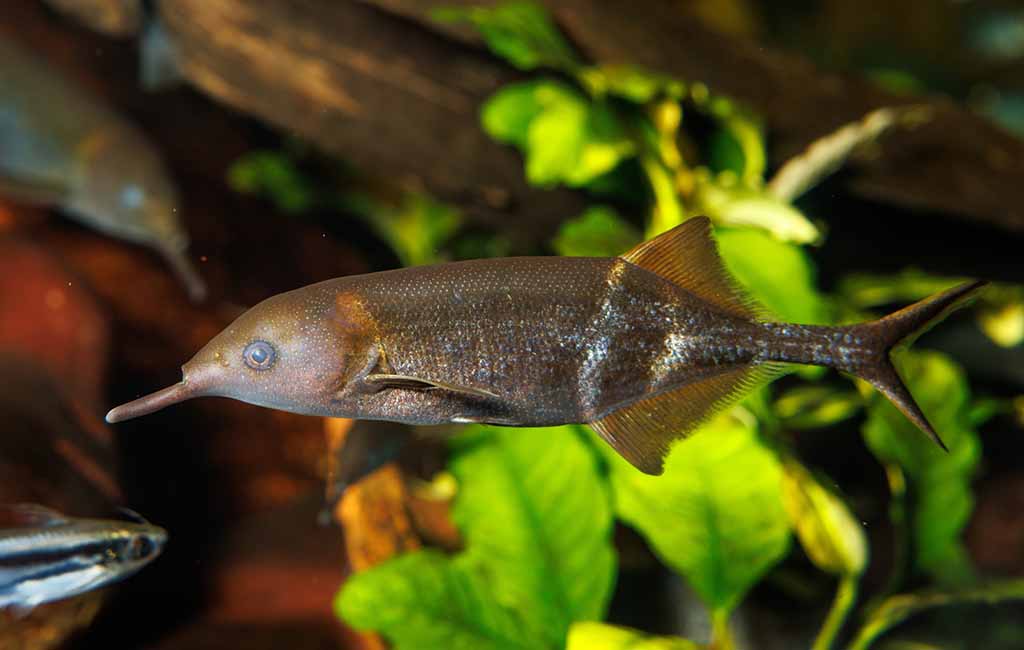
elephant nose fish diet
How Big Do Elephant Nose Fish Get?
The elephant-nose fish size is different in the wild and in captivity. They remain small in aquariums for various reasons, like small space, limited diet, and other stress factors. Here is the average and maximum size of elephant-nose fish.
Average Size
An adult fish grows between 6 and 9 inches. The lower limit is more frequent for aquariums.
Maximum Size
Some elephant-nose fish grow up to 14 inches. However, this is uncommon and mainly happens in the wild.
Growth Stages of Elephant Nose Fish
A typical elephant nose fish goes through 5 growth stages. Each stage has a distinct size and other attributes. Here are the different growth stages, sizes, and specifications of that stage.
Fry Stage
This is the beginning stage. It lasts up to 4 weeks. During this period, the fry reach up to 5 mm, are transparent, and are extremely delicate. Moreover, their electrification ability is very low, as nothing has been developed. It is almost impossible to see this stage of elephant nose fish in your tank, as they don’t breed in tanks.
Juvenile Stage
At this stage, elephant nose fish size reaches up to 2 inches. Mostly market-available fish are juveniles. At this stage, they begin to use their trunk and look like an elephant’s nose fish due to their trunk growth. During this period, they show higher growth and require a small live diet. Usually, this stage lasts up to 4 months.
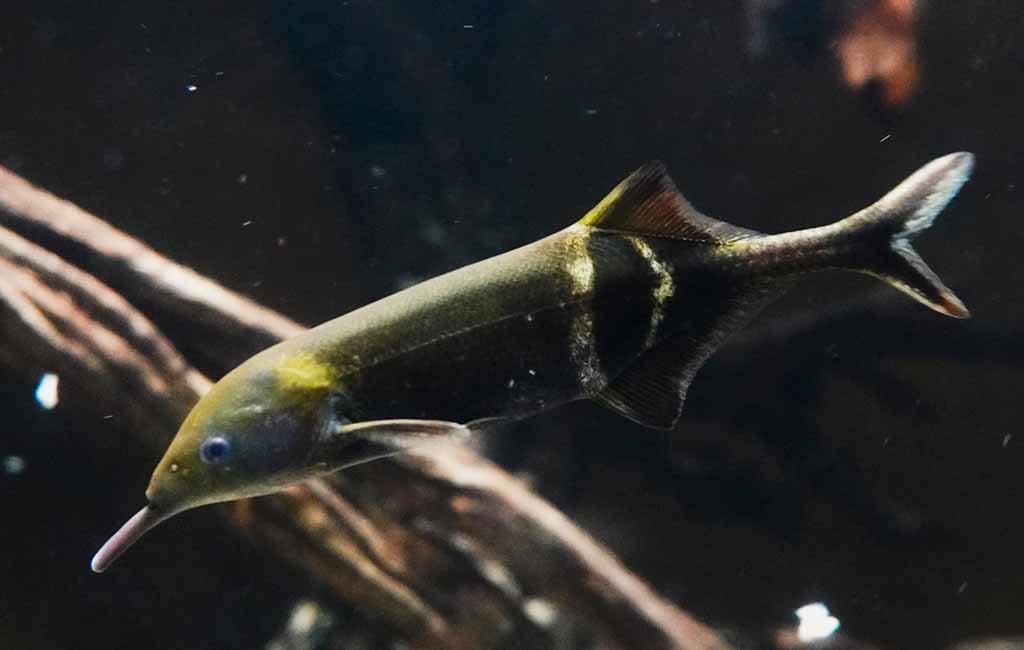
elephant nose fish size
Sub-Adult Stage
After 4 months, it enters a sub-adult stage. This stage lasts up to 12 months. During this stage, they can grow up to 5 inches. However, if you keep them with some fast-moving or active species, their growth becomes slow. Moreover, at this stage, their electric organ becomes fully active.
Adult Stage
At this stage, they reach up to 6 to 8 inches long. Their confidence is more visible, and they actively use their strong electrical field for navigation and prey. Moreover, at this stage, they become territorial and aggressive toward other elephant-nose species. Usually, this stage lasts up to 3 years.
Fully Grown Stage
At this stage, elephant-nose fish size reaches up to 9 inches on average and 12 inches in rare cases. They need at least a 55-gallon tank, optimal water parameters, and a high-quality diet. Their head and trunk become thicker and more muscular.
Factors Affecting the Elephant Nose Fish Size
- Tank size
- Food quality
- Tank mates
- Substrate
- Water quality
- Lighting Quality
Characteristics of a Fully Grown Elephant Nose Fish
At this stage, you can see the following attributes in your fish
- Muscular body
- Long and sensitive trunk
- Deep black coloration
- Pale white band on the fins
- Beautiful swimming pattern
- Strong electrical signaling
- Highly territorial
Breeding Elephant Nose Fish
It is almost impossible to breed an elephant-nose fish in the tank. Here are the reasons.
- Require soft, muddy river bank conditions.
- Completely relaxing environment
- No disturbance
- Specific electric mating signal
- Specific water condition
- Micro-live food and pristine water conditions for eggs and newborns.
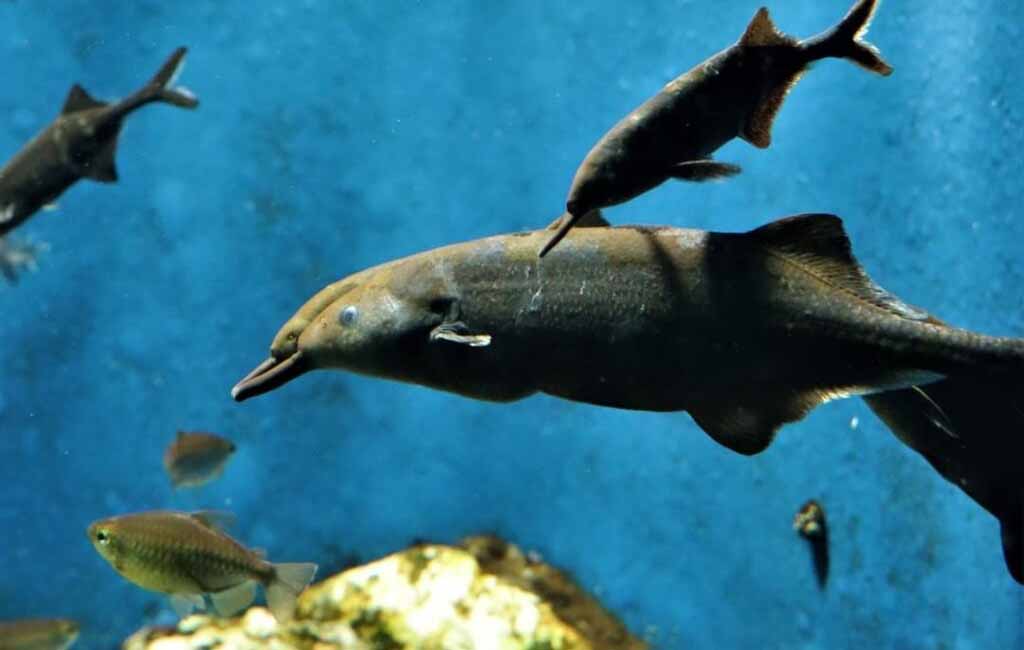
Breeding Elephant Nose Fish
A Quiet but Territorial Fish Species
Elephant-nose fish is quite interesting, but only for experienced aquarists. Their appearance, eclectic organs, and interesting swimming patterns make them interesting. However, this quiet but territorial creature loves to eat live or frozen food and can grow up to 9 inches. If you are experienced, able to provide them the desired environment, go with them, and enjoy up to 12 years of gentle swimming and beauty.
Related Products



Leave a comment