
HOB filters are one of the best options for small to medium-sized home aquariums. They improve oxygenation and maintain optimal water parameters. How they improve oxygenation, working principle, working hours, cleaning, and maintenance of HOB filters for aquariums are worth knowing aspects.
Content Table
You should also know about bilateral HOB filters and how they work. Comparing HOB and canister filters will also help you minimize any confusion about which is the best filter for your tank. All of these aspects are covered below.
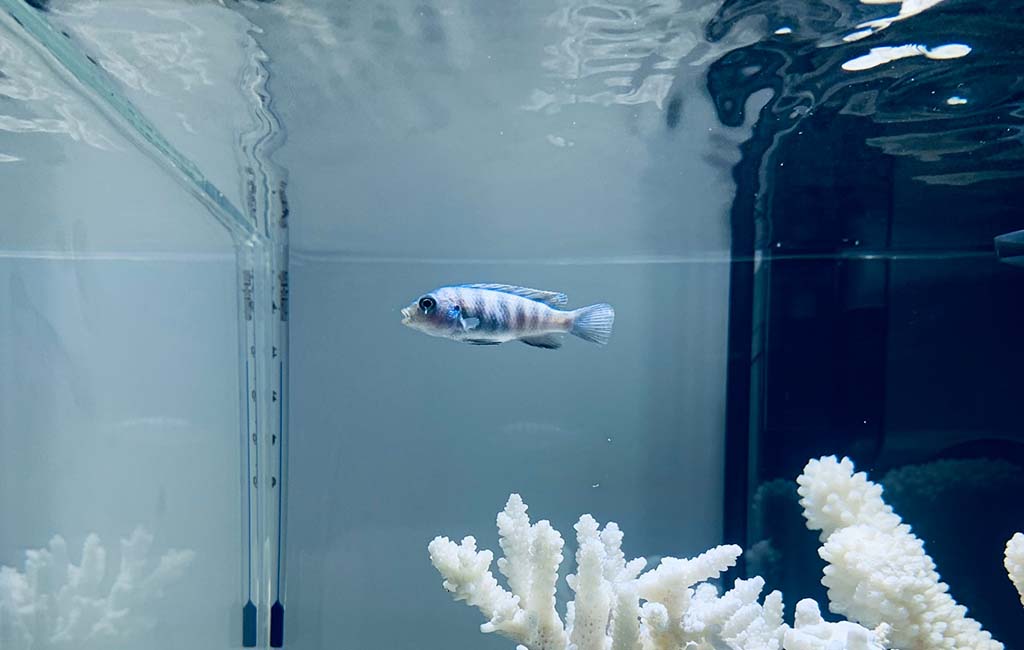
HOB filter for aquarium
Does a HOB Filter Provide Oxygen?
Yes, HOB or hang-on-back filters provide oxygen in a fish tank due to surface agitation. They provide enough oxygen for moderately stocked tanks. However, if your tank is heavily stocked, you can meet the requirements by installing air stones or other aeration equipment.
Brief Working Principle
A HOB filter intakes the water from the tank through a pipe or siphon. Water passes through various filters, i.e., chemical, mechanical, and biological. After that, the filter returns the water to the tank through a spillway or waterfall. While water re-enters, there is a gas exchange that results in improved oxygenation.
Detailed Working
Water Intake via Siphon Action
An extended tube from the HOB filter opens in the tank. The HOB filter intakes the water with the help of an internal pump from the inlet pump, and the siphon action starts. Water moves to the filter chamber.
Mechanical Filtration
Mechanical filtration is the first step in filtration. It is done earlier to avoid biological and chemical filter media clogging. Usually, a sponge or filter pad performs mechanical filtration. It removes leftover food, fish waste, and plant waste.
Chemical Filtration
Chemical filtration helps to treat odor, coloration, chlorine, and heavy metal issues. Activated carbon media help with chemical filtration. However, activated carbon requires monthly replacement, and it is not reusable.
Biological Filtration
Biological filtration helps in the nitrogen cycle, which is crucial for fish health and the tank ecosystem. It converts the ammonia into nitrite and further into nitrate. Biological filter media contain bio-foam, ceramic rings, and bio-balls.
Water Return
After completion of filtration, it’s time to reintroduce the water into the tank. Treated water re-enters the tank via spillway or waterfall-style. This re-entry improves the overall tank oxygenation due to surface agitation. Moreover, it enhances the water circulation and distribution through the entire tank.
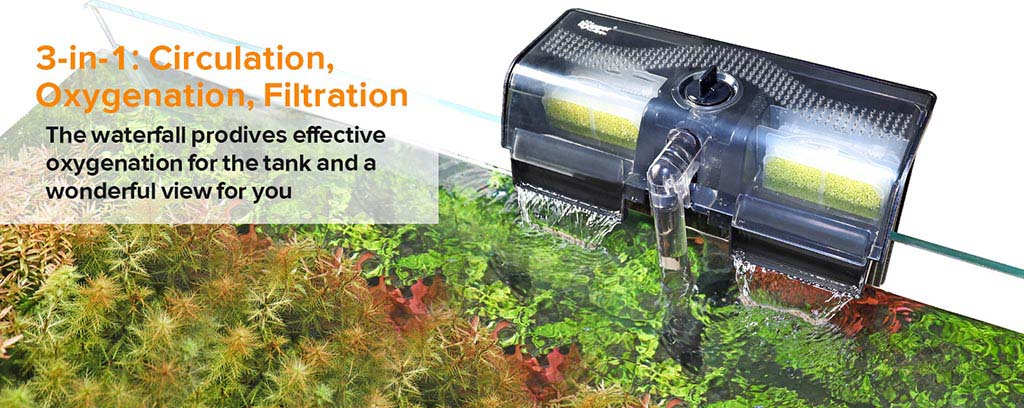
hob aquarium filter
The Working Time of a HOB Filter in Aquariums
The HOB filter has no on/off switch. They are designed to run continuously 24/7. If you turn off for a longer period, it can cause various problems in the tank environment.
- Destabilization in water parameters.
- Disruption in beneficial bacteria growth in the tank.
- It’ll disrupt the nutrient and oxygen distribution in the tank.
- If it’s turned off for a long time, i.e., 40 to 60 minutes, it can cause a rise in toxicity in the tank.
How Often to Clean the HOB Filter?
An HOB filter should be lightly cleaned every two weeks. In case of heavy stocking, monthly deep cleaning is necessary for optimal working. If you have a balanced or low stocking, clean it after every two months. However, the exact duration depends on the visible tank condition. Here is the procedure for cleaning an HOB filter.
How to Clean the HOB Filter?
Gather all the necessary equipment. Here is a list of such items.
- A bucket for water collection
- A small filter brush
- Soft sponge or cloth
- Replace the filter media if it has worn off.
- Towel to catch the drips
- In case of reinstalling the filter media, have dechlorinated water.
Cleaning Method
- Switch off the filter and carefully remove the filter from the tank.
- Open the filter media compartment and take out all the filter media. However, keep the biological filter media dipped into water for bacterial preservation.
- Use a sponge or toothbrush to scrub the filter media chamber. Clean the inside walls and remove slime, algae, and any other waste.
- Rinse the filter media chamber with aquarium water. Tap water can cause the problem. Only replace when it is worn out.
- Activated carbon, i.e., chemical filter media, should be changed monthly.
- Pull out the intake tube and propeller, and clean them with a brush. Remove gunk, slime, or algae. After cleaning, rinse it with the tank water.
- Reassemble the filter media in the following order. Mechanical, chemical, and biological. Reattach the intake tube and impeller.
- If your filter requires priming for smooth running, prime it.
- Reinstall the HOB filter, plug it, and observe whether it is working optimally. Ensure there are no air-lock or flow issues with the water.
Maintenance Tips
- Never clean all the filter media at once, as it affects the tank environment. Always schedule the filter media cleaning.
- Never use soap or detergent, as they are harmful to fish.
- Try to preserve as many bacterial colonies as possible on biological filters.
- Schedule cleaning after or during water change.
HG137
Bilateral HOB Filter
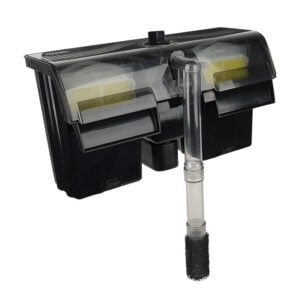
A bilateral HOB filter does filtration from both sides. It takes the water from the tank with two inlet pipes and filters it into two separate filter media holding compartments. Each compartment contains all three filter media types and works in parallel. You’ll better understand bilateral HOB filters with the help of an example, i.e., hygger HG137 bilateral HOB filter.
hygger HG137 Bilateral Hob Filter
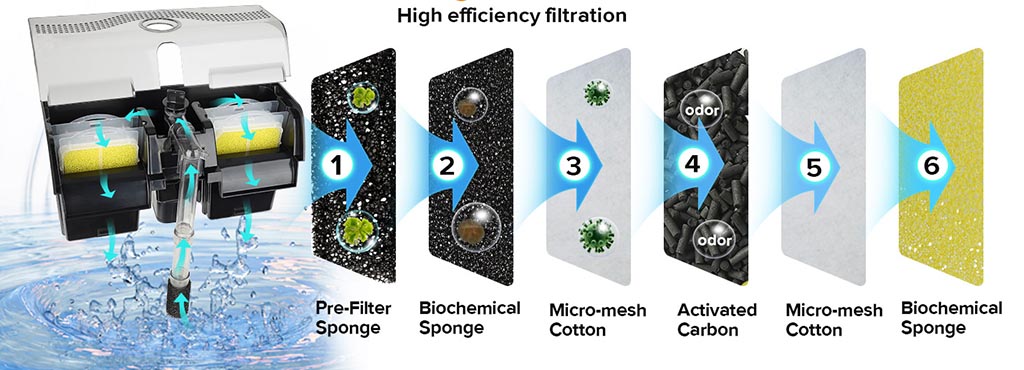
The HG137 filter has dual-sided cartridge filters. Each side contains separate filter media layers, and these layers work simultaneously.
Design
It has two filtration compartments, i.e., left and right. Each filter compartment contains the following filter media.
- Biochemical sponge
- Microporous cotton
- Activated carbon
Filtration Stages
HG137, an easy-to-hide bilateral HOB filter, performs filtration in 6 stages. Here are the stages.
| Stage | Function | Media | Media Location |
| 1 | Mechanical filtration | Biochemical sponge | Both sides |
| 2 | Fine filtration | Micro-mesh cotton | Both sides |
| 3 | Chemical filtration | Activated carbon | Both sides |
| 4 | Biological filtration | Sponge + surface area | Both sides |
| 5 | Water circulation | Pump+waterfall outlet | Central |
| 6 | Surface skimming | Surface intake slits | Top of filter |
Features
- It offers adjustable flow rates, i.e., 132 or 264 gallons per hour, and operates quietly, i.e., under 30 dB sound level.
- It has a compact and universal fit design, i.e., works on glass or acrylic tank wall with 1.1”
- Requiring low power to perform filtration operation, i.e, 5W to 10W.
- It is easy to maintain the HOB filter due to the sliding cartridge.
- It works well for both saltwater and freshwater tanks.
Benefits
- Both cartridges work independently and simultaneously to make it faster.
- It is highly efficient as both sides remove large and fine particles, supporting stronger nitrogen stability due to the double surface area for beneficial bacteria.
- It offers greater oxygenation in the tank as water from both sides merges into the wide waterfall. This merging creates higher surface agitation that enhances the oxygenation in the tank.
- If one side is clogged or slows down, the other side operates continuously to help maintain the water quality in the tank.
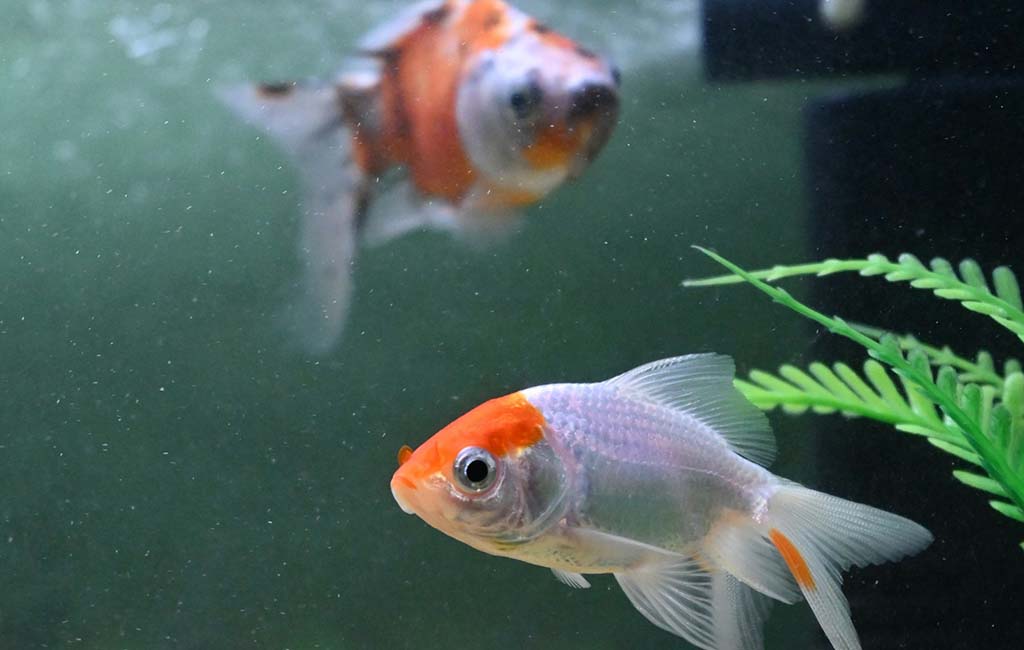
How to clean a hob filter
Which is better: Canister or HOB Filter?
HOB and Canister filters are both good. However, they have certain limitations. Here is a comparison between Canister and HOB filters.
| Comparison Criteria | HOB filter | Canister Filter |
| Filtration Power | Moderate | Strong |
| Tank size | Small to medium, i.e., up to 70-gallons | Medium to large, i.e., 40 to 200 gallons |
| Filtration types | Mechanical, chemical, and biological. It works in 3 to 6 stages. | Advanced multi-stage. It’s customizable according to the tank size. |
| Installation | Hangs on the back of the aquarium
Very easy |
Sits under or side of the tank and is difficult to install |
| Maintenance | Very easy | More complex. However, it requires less frequent maintenance. |
| Flow rate | Gentle to moderate | High flow rate |
| Aesthetic impact | Visible from the back | Hidden |
| Noise level | Very low | Extremely quiet due to sealed design |
| Oxygenation | Higher | Require surface agitation |
| Cost | Budget friendly | Expensive |
| Customization | Limited | Higher customization |
Concluding Remarks
Hang-on-back or HOB filters are excellent options for small to medium-sized tanks. They improve the tank’s oxygenation due to surface agitation on water re-entry in the tank. It intakes water from the water inlet pipe through a siphon process. Pass through this water from mechanical, chemical, and biological filter media that are packed in a compartment. After processing, it re-enters the tank.
HOB filter cleaning is easy. HG137 bilateral HOB filter is one of the best ways to understand bilateral HOB filters. It produces low noise and improved oxygenation. Canister filters are best for large setups.
Related Products



Leave a comment