
Salvinia cucullata is not very common among hobbyists, although it carries several benefits. If you are interested in this plant, it is a great option. It is beneficial for fish and for tank water. However, they require proper care for optimal growth in the tank. In the following, you will learn why it is an interesting option, its care, profile, and peculiarities. Moreover, you’ll also learn about the Slavinia plant, i.e., the parent family of Salvinia cucullata. If you scroll down to the end of the article, you’ll learn about an interesting comparison. Now scroll down to learn more about this plant.
Content Table
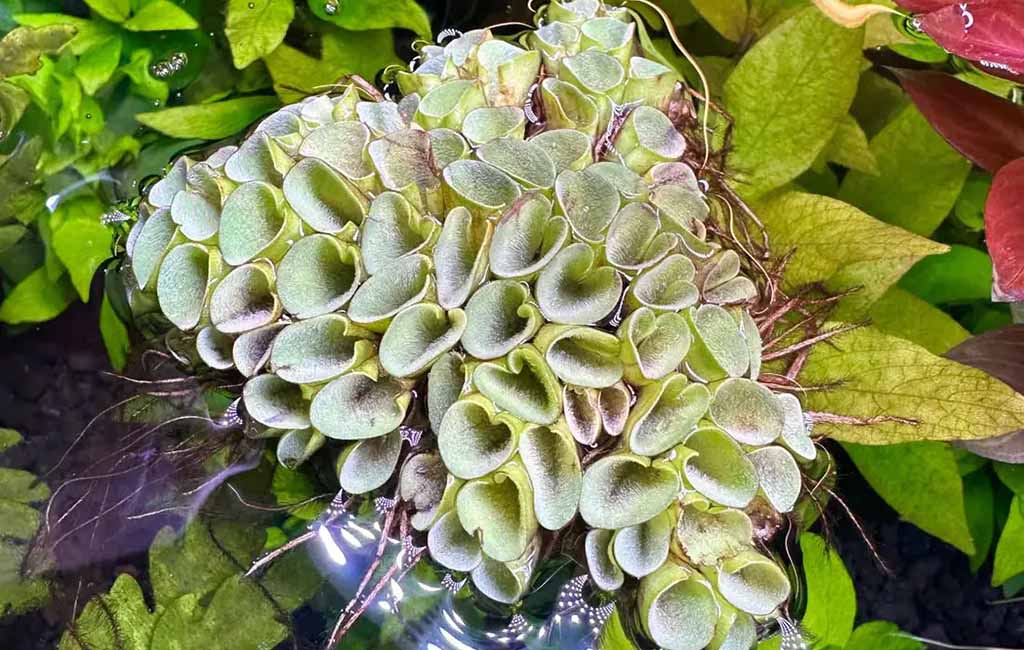
Salvinia cucullata
What Is Salvinia Cucullata?
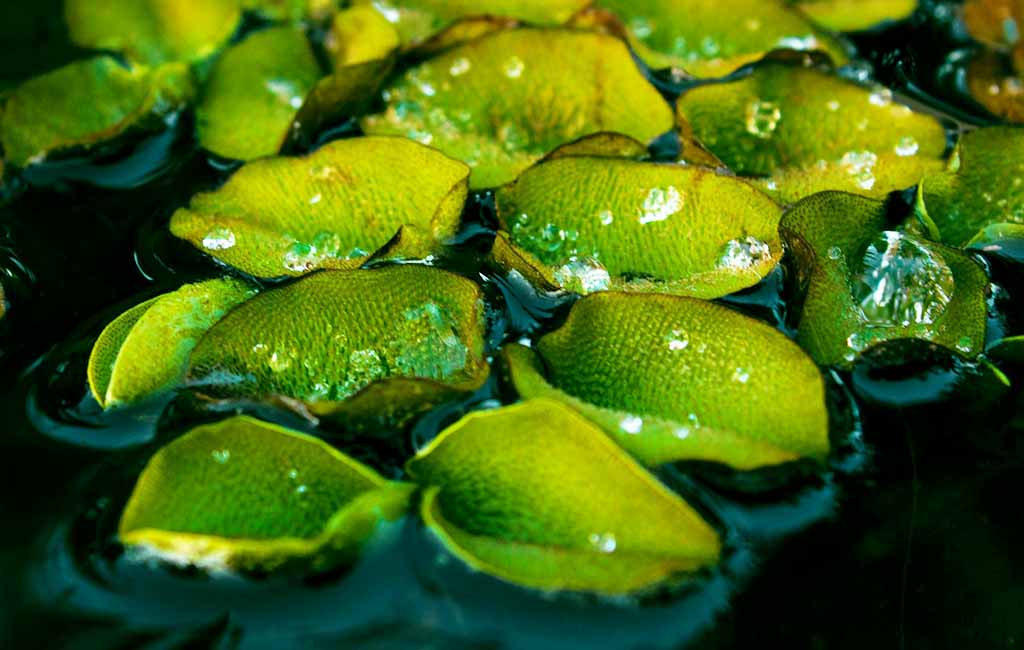
Salvinia cucullata, or hooded watermoss, is one of the unique and less spoken of floating plants. It is a fast-growing native aquatic fern of South and Southeast Asia. They freely float at the surface. It has a unique folded cup-shaped green leaf. Here are some peculiarities of salvinia plants.
Peculiarities
- These plants have unique cup-shaped leaves.
- The top leaf surface has a water-repellent layer of papillae. This layer helps the leaves to remain dry even under extreme water turbulence.
- Salvinia plants lack true roots, unlike the other floating plants. They have a floating leaf underside that helps them to anchor. Moreover, this anchoring leaf also helps the plant to absorb nutrients from the water.
- It is a fast-growing plant.
- It is suitable for nitrogen and ammonia-rich tanks.
- Salvinia cucullata shows high multiplication due to vegetative fragmentation, as it produces fewer sporocarps.
- They help in sewage water treatment.
- Salvinia plant is one of the best options for fish fry tanks.
- Engineers have researched its structure and used the findings in waterproof structures, clothing, etc.
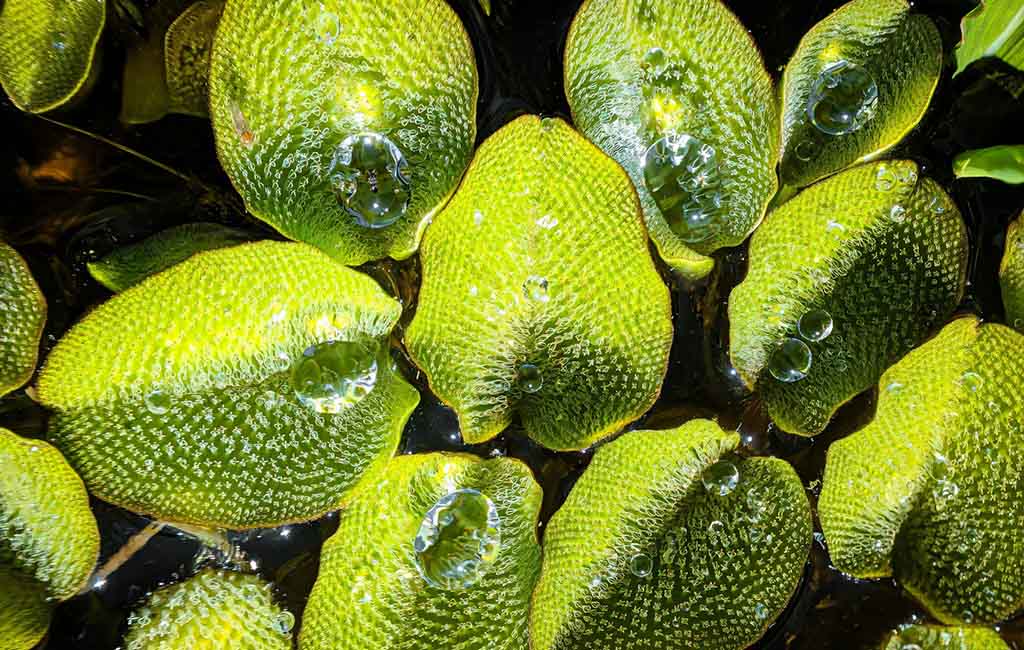
hooded watermoss
Profile
| Feature | Detail |
| Scientific Name | Salvinia cucullata Roxb. ex Bory |
| Common Name | Pouch Salvinia, Hooded Watermoss |
| Family | Salviniaceae |
| Origin | South and Southeast Asia (India, Thailand, Myanmar) |
| Plant Type | Free-floating aquatic fern |
| Average Leaf Size | 0.5 to 1.5 cm wide |
| Growth Rate | Moderate to fast |
| Light Need | Low to High |
| CO₂ | Not required |
| Conservation Status | Least Concern (IUCN) |
| Optimal Temperature | 72–82°F |
| Optimal pH | 6.0–7.5 |
| Water Hardness | 2–15 dGH |
Salvinia Plant
The salvinia plants are part of the Salviniaceae family. Salvinia has 12 species, along with Salvinia cucullata. All of the species are evolved to live at the top of the water surface, and none of the species have flowers.
All 12 species reproduce at a greater rate. And for this reason, they are considered invasive plant species. Due to their invasive nature, they are present outside of their native regions. Some species, like Salvinia molesta, are listed as federal noxious weeds in the USA. All of these species lack a true root system. They have a leaf-like root structure that helps in uptaking nutrients from the water.
Out of 12 species, there are about 5 species that are widely known.
- Salvinia molesta
- Salvinia minima
- Salvinia natans
- Salvinia cucullata
- Salvinia auriculata
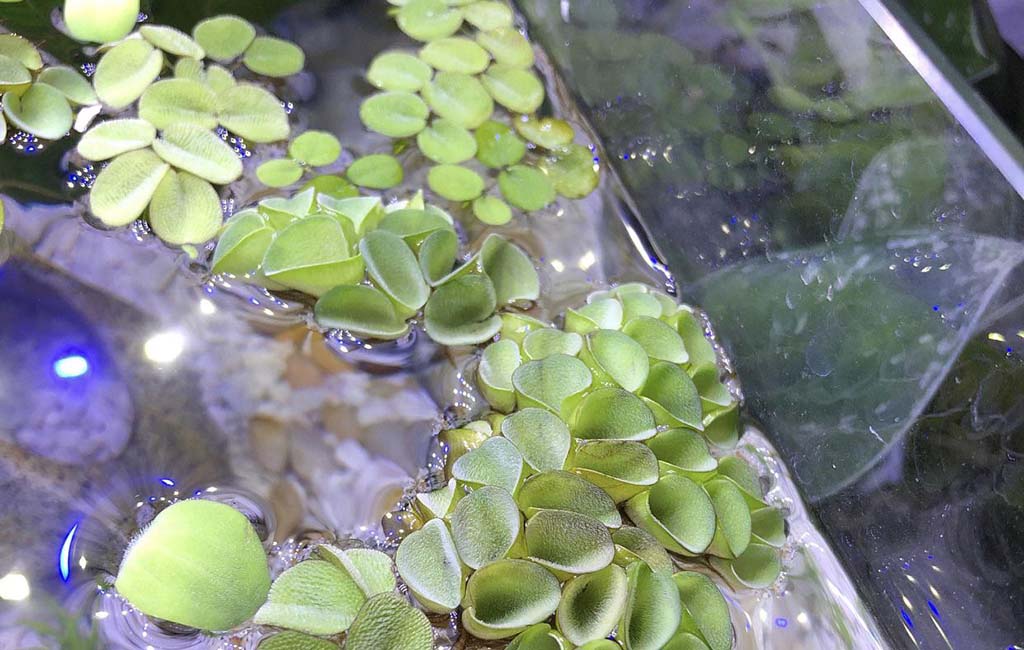
salvinia plant
What Is Salvinia Cucullata Used for?
Salvinia cucullata is not quite popular among hobbyists. However, it has various other uses. Here are some such use cases.
Aquarium Coverage
- It provides shade to fish.
- It reduces algae growth in the tank.
- It provides dimmer conditions for shy or nocturnal fish species.
Breeding Habitat
Salvinia cucullata’s root is the best anchor point to build breeding nests for bettas and gouramis.
Water Purification
It uptakes excessive nitrogen, phosphorus, and other heavy metals. This uptake improves plant growth and also purifies the water.
Rice Paddy Management
Southeast Asian farmers have used this plant as a natural mulch and nitrogen source in rice fields.
Fish and Poultry Feed
In Thailand and Vietnam, Salvinia cucullata is a feeding option. Although it is not a common priority. However, it is used. It is not confined to fish and poultry. Many other animals enjoy feeding on Salvinia cucullata.
Research
Scientists and researchers have studied this plant to design the water-replant materials.
Does Salvinia Oxygenate Water?
Yes, but it is limited. You might think it is a plant, and plants produce oxygen through photosynthesis, and how this is limited. It is a surface plant, and most of the oxygen goes to the atmosphere instead of dissolving into water. However, at night, like other plants, salvinia plants use the dissolved oxygen if there is no aeration near the tank. Therefore, add an air stone to improve the oxygenation in the tank, especially if you have sensitive fish species in the tank.
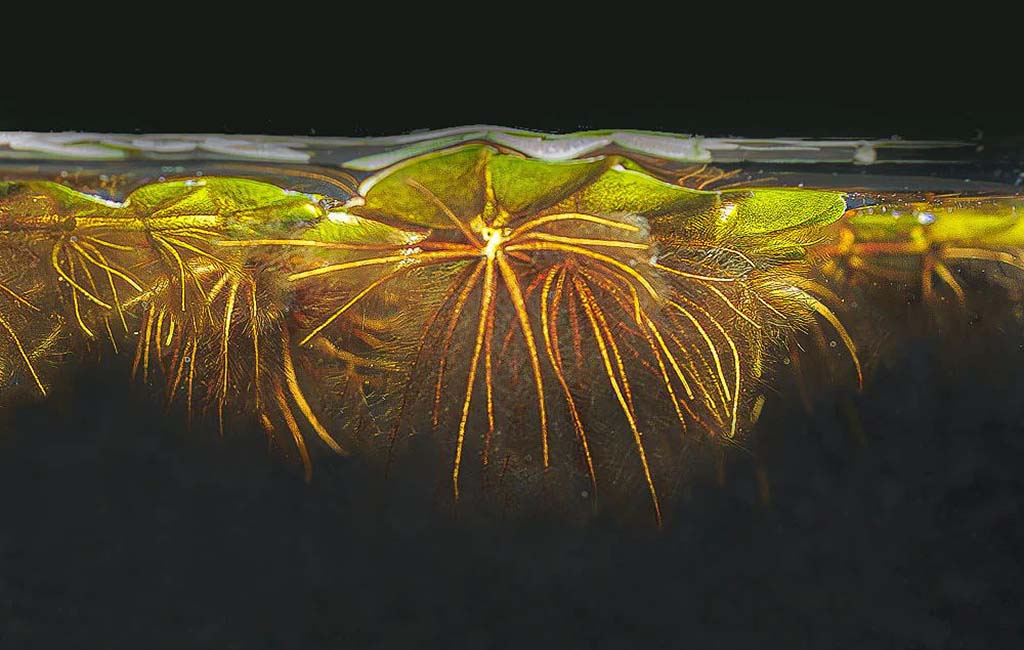
Salvinia cucullata aquarium
Salvinia Cucullata Aquarium
Here are some important roles that Salvinia cucullata plays in aquariums.
- They reduce algal growth in the tank by blocking the light.
- They take up the ammonia and nitrates from the water. In this way, they help to maintain a balance in the tank.
- They provide shade to fish.
- They provide safety to fish from predators.
- They provide a low-stress environment in the tank.
- They help to recreate a native environment for southeastern and South American fish species.
- Their anchor surface helps to breed the betta fish with ease.
Take Good Care of Salvinia Cucullata
Maintaining the following parameters in a tank greatly helps in caring for Salvinia cucullata growth.
Salvinia cucullata care
Salvinia Cucullata Care Parameters
| Parameter | Ideal Range |
| Temperature | 72–82°F (22–28°C) |
| pH | 6.0–7.5 |
| Water Hardness | 2–15 dGH |
| Lighting | Low to High |
| CO₂ | Not needed |
| Fertilizer | Optional (liquid fertilizer) |
| Water Flow | Low |
| Humidity | High preferred |
Care Tips
- Trim the plants so that they cover only 30 – 50% of the tank surface. They double their mass within a week.
- Use a glass lid on the tank top to maintain high humidity, as these plants grow optimally in high-humidity conditions. If you are living in a dry region, it is necessary.
- Rinse the plant with dechlorinated water to avoid any future problems.
- Don’t add copper, as they are sensitive to copper. Moreover, if you need to use copper-based fish medication, transfer the fish to another tank.
- If you are observing yellowish leaves, use the liquid fertilizer.
Salvinia cucullata vs. Salvinia minima
Salvinia cucullata vs. Salvinia minima
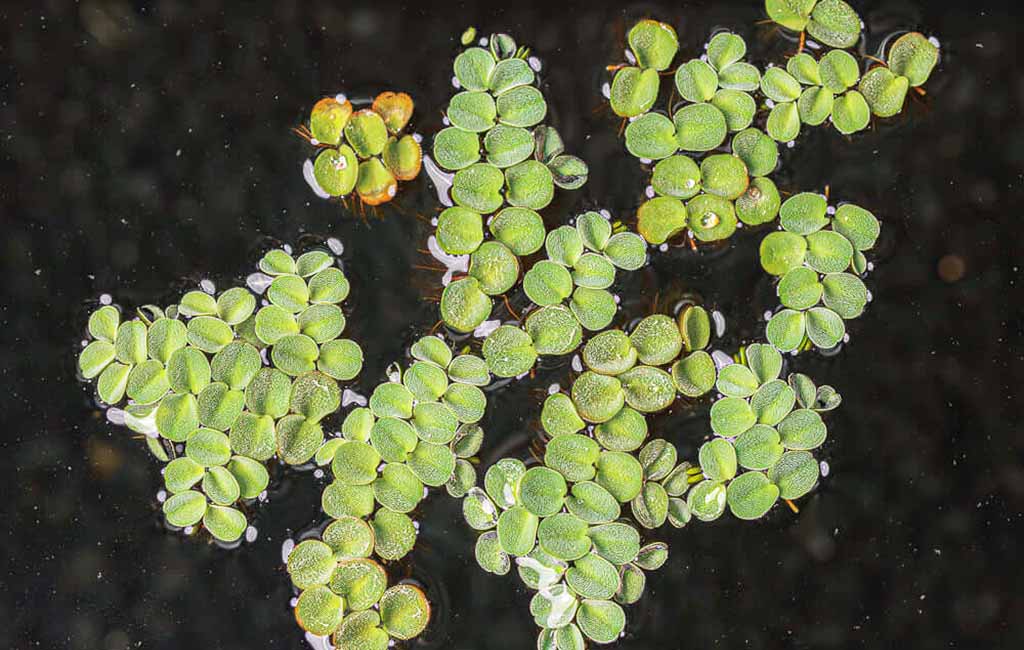
| Feature | Salvinia Cucullata | Salvinia Minima |
| Origin | Southeast Asia | Central & South America |
| Leaf Shape | Cup-shaped / folded (pouch) | Flat/oval |
| Leaf Size | 0.5–1.5 cm | 0.5–2 cm |
| Invasive Status (USA) | Not listed as invasive | Invasive in southern states |
| Water Repellency | Very high (strong Salvinia effect) | Moderate |
| Growth Rate | Moderate to fast | Fast to very fast |
| Light Requirement | Low to high (flexible) | Moderate to high |
| Availability in the USA | Rare (specialty sellers) | Very common (pet stores) |
| Best For | Shrimp tanks, betta tanks, biotope setups | General community tanks, ponds |
To Sum up, the Key Points Are Above
- Salvinia cucullata belongs to the salvinia plant family, which has 12 species. Slovenia cucullata originally belongs to the southeastern regions.
- They have cup-shaped leaves and have no true roots. They used the leaf-like root to uptake nutrients from the water surface.
- They are used for mulching, water purification, research, and in animal feed.
- They oxygenate the tank water, but at a limited rate. Not suitable for a sensitive fish species tank if it doesn’t have an air filter.
- Optimal temperature, pH, trimming, and other care aspects make it suitable for aquariums. Salvinia cucullata is not common among hobbyists.
- Salvinia Minima differs from Salvinia cucullata in many aspects, e.g., leaf shape, size, etc.
Related Products


Leave a comment