
A 10-gallon fish tank is the most popular choice for beginners. Why did they choose it? It requires some details. Optimal 10-gallon fish tank dimensions, how to clean it, and how to change the water are also discussed. This article addresses all of these questions and discussions.
Content Table
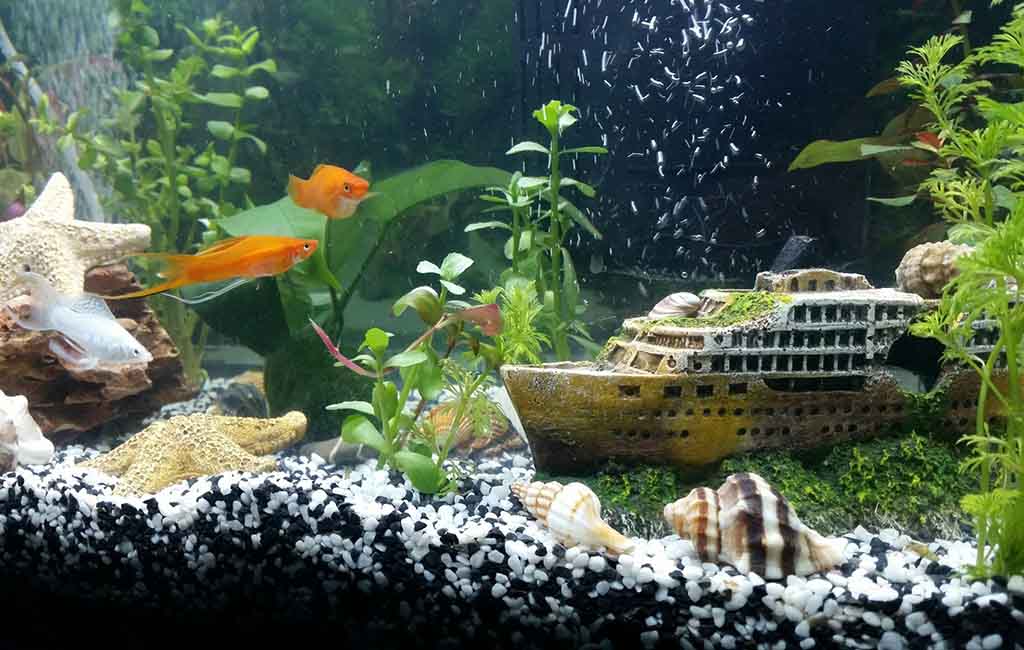
10-gallon fish tank
How Big Is a 10-Gallon Fish Tank
A 10-gallon fish tank is a small aquarium. It is a common choice for beginners due to easy management, cost-effectiveness, an easy learning curve, etc. How big is it? You can understand it with its dimensions.
Various Dimensions
Standard or Rectangular
Dimensions: 20″ L × 10″ W × 12″ H
Material: Glass or Acrylic
Long Tank
Dimensions: 24″ L × 8″ W × 12″ H
Pros: It is suitable for active fish as it offers open swimming space.
Tall Tank
Dimensions: 16″ L × 10″ W × 18″ H
Pros
- Suitable for bettas.
- A better option for tall aquascapes.
Calculation of 10-Gallon Fish Tank Dimensions
If all dimensions are in inches, here is the formula to calculate the volume and dimensions.
Gallons = (Length × Width × Height) / 231
Whereas 1 gallon is equal to 231 cubic inches.
Suitable Fish for a 10-Gallon Tank
| Betta Fish | Dwarf pufferfish | Kuhli loach |
| Corydoras | Endler’s livebearer | Scissortail Rasbora |
| Neon tetra | Guppies | Apistogramma |
| Celestial Pearl Danio | Harlequin rasbora | Cardinal tetra |
| Dwarf gourami | Cherry barb | Ember tetra |
| White Cloud Mountain minnow | Platy | Least Killifish |
| Zebra danio | Boraras brigittae | Pencilfish |
| Fancy Guppy | Green neon tetra | Kuhli loach |
Calculate the Water Volume of the Small Fish Tank
Calculation of tank dimensions matters a lot when you are trying to build a DIY tank.
Dimension Calculation (Inches)
Here is the basic formula to calculate the dimensions.
Gallons = (Length × Width × Height) ÷ 231
All dimensions, i.e., length, width, and height, are in inches.
If you have a tank with 20″ L× 10″ W × 12″ H dimensions. The volume of the tank will be.
Gallons = (20 × 10 × 12) ÷ 231
= 2400 ÷ 231
≈ 10.4 gallons
You can label it with a 10-US-gallon tank. Similarly, you can use this formula to calculate the dimensions of your tank. However, you must know the volume and the dimensions of the two sides. Usually, a single dimension decides whether your tank will be tall, horizontal, or standard.
Volume Conversion
1 US gallon = 3.785 liters
1 liter = 0.264 gallons
Standard Dimensions For Various Sizes of Tanks
Here are the standard dimensions for various types of tanks.
| Volume (US gallons) | Length (inches) | Width (inches) | Height (inches) |
| 5 | 16″ | 8″ | 10″ |
| 10 | 20″ | 10″ | 12″ |
| 15 | 24″ | 12″ | 12″ |
| 20 | 24″ | 12″ | 16″ |
10 gallon fish tank dimensions
How Often to Change the Water in a Small 10-Gallon Fish Tank
The answer depends on various aspects. However, before answering, let’s see why we have to change the tank water.
Why Do We Need to Change It?
Whether your tank has optimal filtration, it requires frequent water changes.
- Waste and food leftover removal
- Maintain the minerals, e.g., calcium, salts, etc., in the tank.
- Maintain the optimal water parameters.
- To avoid an ammonia spike in the tank
- To prevent your fish from diseases.
Water Change Frequency
The frequency of water change mainly depends on the stocking level. Here are the major categories.
- Lightly stocked+filtration
- Heavily stocked/ aggressive fish species
- Tank without filtration
- New tank
Let’s break them down according to water change frequency and how much volume should change each time.
| Category | Frequency | Volume change |
| With filters lightly stocked | After 1 or 2 weeks | 25 to 30% |
| Heavily stocked / messy fish species | After each week | 30 to 50% |
| Tank without a filter | Twice a week | 30 to 50% |
| New tank | After 2 to 3 days | 10 to 20% |
Replenishing volume is in a range. Change the volume according to your requirements.
Cleaning the Fish Tank When Changing the Water
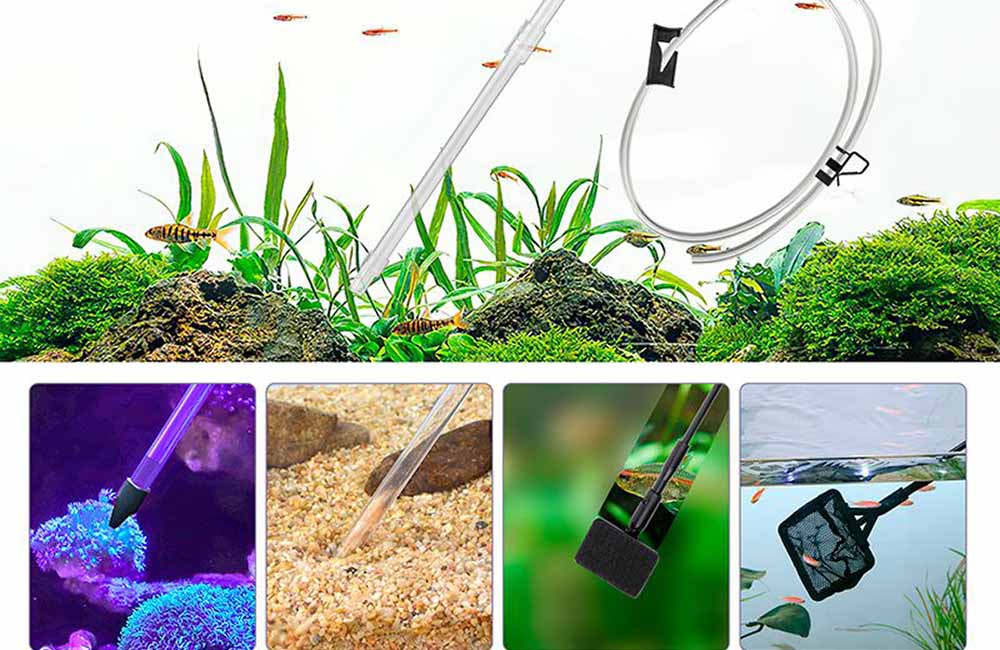
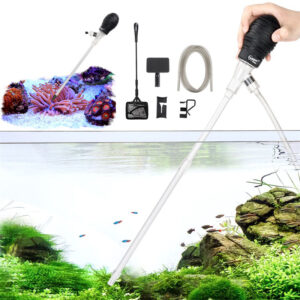
Small tanks require frequent cleaning. You can do it with your hygger HG080 aquarium cleaner while changing the water.
- Press the air ball.
- Stir the substrate with the inlet pipe in the tank.
- Stirring will lose all trapped, i.e., waste, fish waste, food leftover, etc.
- This loose waste will siphon into the outlet container.
10 gallon fish tank water change
Replacement Water for Fish Tank Water Change
Water change is crucial in any tank setup. However, its importance becomes more evident when the tank size is small. Unlike the manual method, it’s better to use a handy tool. Here comes the hygger HG080 cleaning kit. It’s an all-in-one tool that helps in various aspects besides water change. Here are some of them.
- Coral feeder
- Substrate cleaner
- Offer to attach a net.
- A glass scrubber to clean the tank’s glass wall.
Water Preparation
Optimal water preparation is the first step in water change. Here are the steps involved in water partition.
What do You need to see?
- Fish specie
- Optimal water temperature for fish
- No change in chemical composition
Volume to Prepare
Usually, it’s 25 to 30% of the total tank’s volume. It will be 2.5 to 3 gallons for a 10-gallon tank. To measure the volume, use a flask, bucket, or any volume-measuring instrument with visible markings on it.
Water
You can use treated tap water. Otherwise, it’s wise to use RO water.
Water Conditioning
Use a water conditioner to dechlorinate your tap water. Add the mentioned quantity, i.e., drops/volume per liter.
Parameter Stabilization
Let the water parameters stabilize at an optimal temperature. Once everything is fine, it’s time to change the water volume in the main tank.
Change the water in a 10-gallon fish tank
Water Change
Here are the steps to clean your 10-gallon or maximum 12-inch deep tank.
Equipment Preparation
Connect all cleaning and water change parts. It includes
- Air ball
- Handle
- Inlet pipe
- Outlet hose
- Filter basket
- Flow clip
- Hose clip
Connect the inlet pipes to the connector and hand. Insert a filter basket at the end of the hard tube. Use the hose clip to secure the outlet hose to the bucket. Ensure that every piece of equipment is in its place and fully secure.
Unplug The Equipment
Unplug all equipment, i.e., filter, heater, and lights. It’ll help you avoid any accidental damage during the process.
Siphoning
It’s time to start the action. Insert the hard tube or inlet into the aquarium. Squeeze the air ball a few times to start the siphoning action. Shortly after, water will flow from the tank to the bucket.
Stop the Siphon
When you see the desired volume is out of the tank, close the flow clip. You can also do it by removing the hard pipe from the tank.
Replenishing and Restart
Gently add water to your tank that you have already prepared with stable water parameters and temperature. Plug in the equipment and restart your system.
Closing Remarks
A 10-gallon tank is the most common option for beginner aquarists due to easy management. You can use a formula to measure the volume or dimensions of the tank. A small tank, e.g., a 10-gallon tank, requires frequent cleaning and water changes. You can streamline your process with the hygger HG080 all-in-one tank cleaner.
Related Products


Leave a comment