
Having fish in a tank is an amazing feeling. However, it is not easy to put any fish in any tank. You need a proper calculation and methodology for fish tank bio-load capacity. One of the crucial aspects is stocking the correct number of fish in any tank, and knowing how to tell if fish are overcrowded. In the following, we break down this problem with details for various tank types and fish numbers.
Content Table
fish numbers
The Rule for Numbers of Fish in the Tank
The simple rule for fish stocking is to stock 1 inch of adult-size fish per gallon of tank. If a fish has 2 inch adult size, stock about 5 fish in a 10-gallon tank. Similarly, 10 fish of 1-inch adult size can be stocked in a 10-gallon tank.
This is a simple and beginner’s rule. However, it varies according to the fish size. Large fish eat more and produce more waste. Therefore, they need a larger space than normal fish. For better understanding, here is a breakdown for different-sized fish, i.e., slim, medium, and large fish.
| Fish type | Stocking Level | Example Species |
| Slim fish | 1 inch per gallon | Tetra, danios, rasboras |
| Medium fish | 1 inch per 2 gallon | Cichlids, gouramis |
| Large fish | 1 inch per 3 to 5 gallon | Oscar, a large catfish, gold fish |
Fish Form a Social Hierarchy
Different fish species behave differently. Some fish live in communities, while some live solo; others can coexist peacefully. Therefore, before stocking, it is necessary to understand the social hierarchy of fish.
Social Fish
If you are looking to stock social or schooling fish species, stock them in groups. If it is stocked at less than optimal group size, they get stressed, resulting in various problems. If you are stocking any of these fish, you need to calculate the space according to their optimal group size. Here are some examples of schooling fish.
| Fish | Optimal group size |
| Neon Tetras | 6 |
| Corydoras Catfish | 6+ |
| Harlequin rasbora | 8 to 10 |
Territorial or Aggressive Fish Species
Similarly, if you are stocking some territorial or aggressive fish species, you need to consider the overall behavior. There should be only one aggressive or superior fish in the tank. Otherwise, it will be complicated because they will fight for territory. In a nutshell, understand the social hierarchy before stocking the fish.
Schooling fish: stock at least in a group of 6 or more. You need a big tank according to group size.
Territorial fish: Only one dominant male per species.
Peaceful fish: You can mix them freely. However, don’t forget to understand the inch-per-gallon rule or your own rule for your fish species.
If Fish Are Overcrowded in a Fish Tank
How to Tell If Fish Are Overcrowded in a Fish Tank?
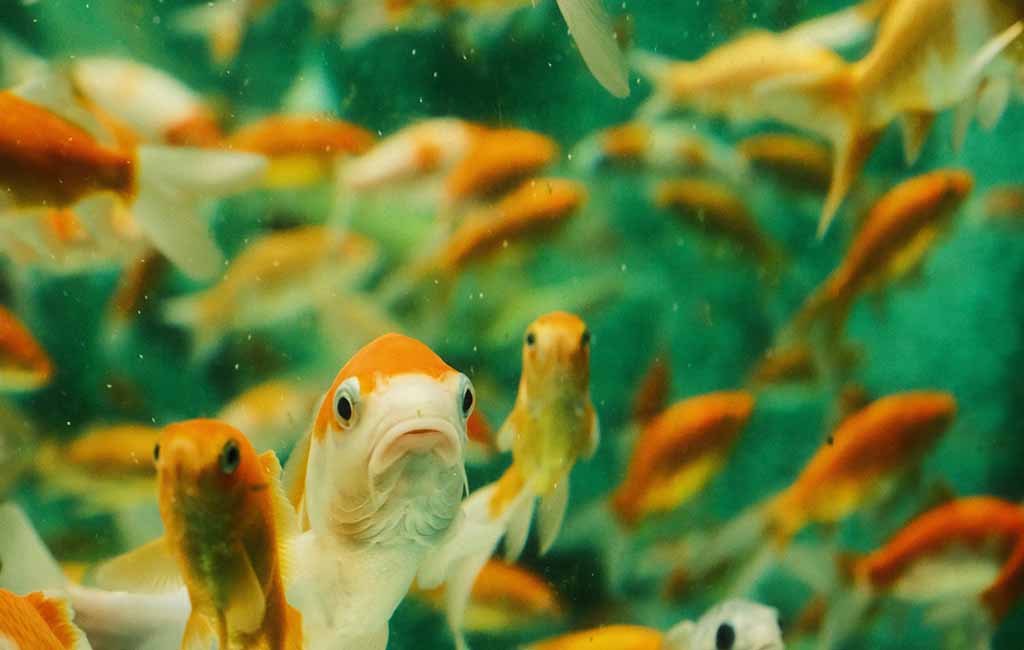
Overcrowding or overstocking is a problem that is sometimes overlooked for various reasons. Like they miss the calculation or don’t clearly understand the fish’s social hierarchy. It leads to various issues. Here are some signs to understand the problem.
- Fish is gasping near the water surface, indicating a reduced DO level.
- You see the milky or foggy water in your tank. It’s due to an ammonia problem.
- Fish are chasing and nipping the fins.
- Fish have frayed or torn fins. It is due to a water-quality problem directly related to the stocking level.
- Fish are cowering behind the decoration more than usual. It is a sign of overpopulation.
- Fish spend more time near the filter outlet in search of oxygen.
- Lose color and appetite.
- Fish swim erratically.
- Fish shows signs of lethargy.
Aquarium Fish Numbers Should Scale with Tank Size
This is the basics of fish stocking. The adult size of the fish and the tank size should complement each other. They should not be stocked based on their juvenile size. If you are stocking according to juvenile size, it’ll be a problem as fish will apparently grow, and your tank size will be inadequate. For better understanding, look at the following example.
Example
You have 10 juvenile oscar fish, each size is about 2 inches in size, and you are stocking them in a 55-gallon tank. Initially, it seems perfect as
Total inches: 10*2 = 20 inches
Total available space = 55 gallon
Required space = 20 gallon
Free space = 55 – 20 = 35 gallon
With a 35-gallon extra space, you will feel comfortable. As time flies, juveniles grow into adults. The adult size is 10 inches per Oscar fish. Now the calculation will look like
Total fish inches = 10*10 = 100 inches
Total available space = 55 gallon
Required space = 100 gallons
Free Space = 55 – 100 = -45 gallon
You are outperforming with a 45-gallon deficiency. This space deficiency will cause problems in the tank.
fish tank bio-load capacity
Stocking Instructions
- Look at the adult size of the desired fish.
- Calculate the tank volume with respect to adult size instead of juvenile.
- Upgrade the tank according to its size. If you do not have a big tank, transfer extra fish to another tank.
- Especially take care of fast-growing species. Check the available space after every 3 to 6 months.
Adult Size and Growth Rate of Popular Fish
| Fish | Adult size (inches) | Growth rate | Tank size (gallon) |
| Common goldfish | 12+ | Fast | 30+ |
| Neon tetra | 1.5 | Slow | 10 |
| Oscar | 12 to 14 | Fast | 75 |
| Betta | 2.5 | Slow | 5 |
| Plecostomus | 15 to 24 | Moderate | 75+ |
| Ember tetra | 0.8 | Slow | 10 |
| Red-tailed Shark | 6 | Moderate | 55 |
Aquarium Water and Bio-Load Capacity
Aquarium water and bio-load capacity have a relationship. It varies among tank types, i.e., freshwater, saltwater, marine, and blackwater. It should be calculated properly. Here is the calculation:
Water Volume
Calculate the total water volume in the tank.
Litters (cm) = (Length × Width × Height) ÷ 1000
Gallons (inches) = (Length × Width × Height) ÷ 231
Example Tank Size
90 × 45 × 45 ÷ 1000=182 L
Actual Water Volume
Previously, there was a total water volume. The tank contains various objects, e.g., decorations, plants, etc. Therefore, you need to calculate the actual water volume by removing the volume of other objects. It varies among different tanks.
| Tank Setup | Water Reduction | Example (182 L Tank) |
| Bare tank | 5–10% | 165–173 L |
| Planted tank | 10–15% | 155–164 L |
| Heavy rocks/wood | 15–25% | 137–155 L |
Basic Rule for Freshwater Tank
Give 1 inch fish size per gallon or 1 cm fish size per 2 liters of freshwater. If we consider a planted tank as an example for a 155-liter freshwater tank, the calculation will be.
Total fish size = 155 ÷ 2 = 77 cm
Bio-Load Based on Waste Production
Fish produce various waste in different sizes. Here is a table to overview the bio-load for various fish types.
| Fish Type | Waste Production | Examples |
| Small schooling fish | Low | Tetras, rasboras |
| Medium fish | Moderate | Gourami, barbs |
| Large cichlids | High | Oscar, Jack Dempsey |
| Heavy waste fish | Very high | Goldfish, plecos |
| Marine predators | High | Lionfish, triggers |
How to tell if fish are overcrowded
Bio-Load Based on Filtration Strength
Once you have bio-load, the next thing is its relationship with filtration strength. Here is a filtration level for various stocking levels.
| Filtration Level | Multiplier |
| Light filtration | Tank volume × 0.5 |
| Standard filtration | Tank volume × 0.75 |
| Heavy filtration | Tank volume × 1.0 |
If we consider the standard filtration, i.e., 0.75, the calculation will be as follows.
Fish Biomass = 155 × 0.75 = 116 g fish biomass
Bio-Load Rules by Aquarium Type
Here comes the difference among the different tank types.
| Aquarium Type | Typical Rule |
| Freshwater community | 1 inch fish per gallon |
| Saltwater fish-only | 1 inch fish per 5 gallons |
| Reef aquarium | 1 inch fish per 6–8 gallons |
| Blackwater tank | 1 inch fish per 1.5 gallons |
Can we increase the bio-load capacity of a tank?
Yes, you can definitely increase the bioload capacity of a tank.
- Install a large filter.
- Introduce additional bio-media to enhance the bio-logical filtration.
- Add live plants
- Improve the aeration
- Do regular water changes
Factors affecting bioload capacity
Here are some factors that affect the bioload capacity.
- Tank size
- Filtration
- Surface area
- Fish diet
- Feeding frequency
- Plants
- Aeration
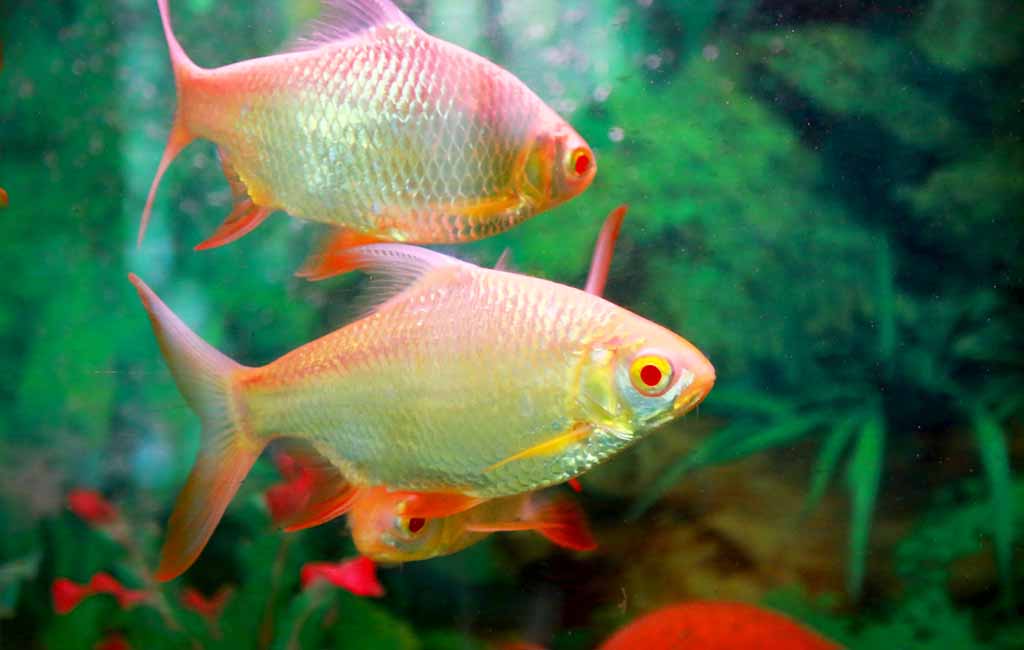
Aquarium Fish Numbers
Final Thoughts
Fish stocking is a very crucial aspect of an aquarium journey. While stocking, consider the fish size, growth rate, and tank size. Generally, it is said that stock 1 inch adult size to one gallon. However, it varies among different tank types as different species generate varying bio-load in the tank. Don’t skip any calculation for optimal results.
Related Products

This is really good information. The 1 inch per gallon is a good start, but the 64 million dollar question is how many fish can I stock. Every situation is different, so this in-depth article is very valuable.
Question: My freshwater tank is a custom built 30x17x17. The stock includes 9 GlowFish Tetras, 8 Cardinal Tetras, 8 Harlequin Rasboras, 5 Sterbai Corydoras, and 2 Otocinclus’. I assigned 1 point to each fish. Is that correct? If so, my total is 32 points, and I am at full capacity. Is that correct?
Yes, please keep an eye on the performance of your tank inhabitants