
Egeria densa is a beautiful and hardy plant. Aquarists love it due to its faster growth, lush green coloration, and other aquascaping opportunities. However, sometimes its fast growth rate can cause problems.
Content Table
In the following, you’ll learn about how to control it before Egeria densa aquarium becomes a problem. Moreover, how to achieve controlled fast growth and Egeria densa care. Sometimes, aquarists can confuse it with some other plants. The identification is also part of this article. Scroll down to learn before your Egeria densa growth becomes out of control.
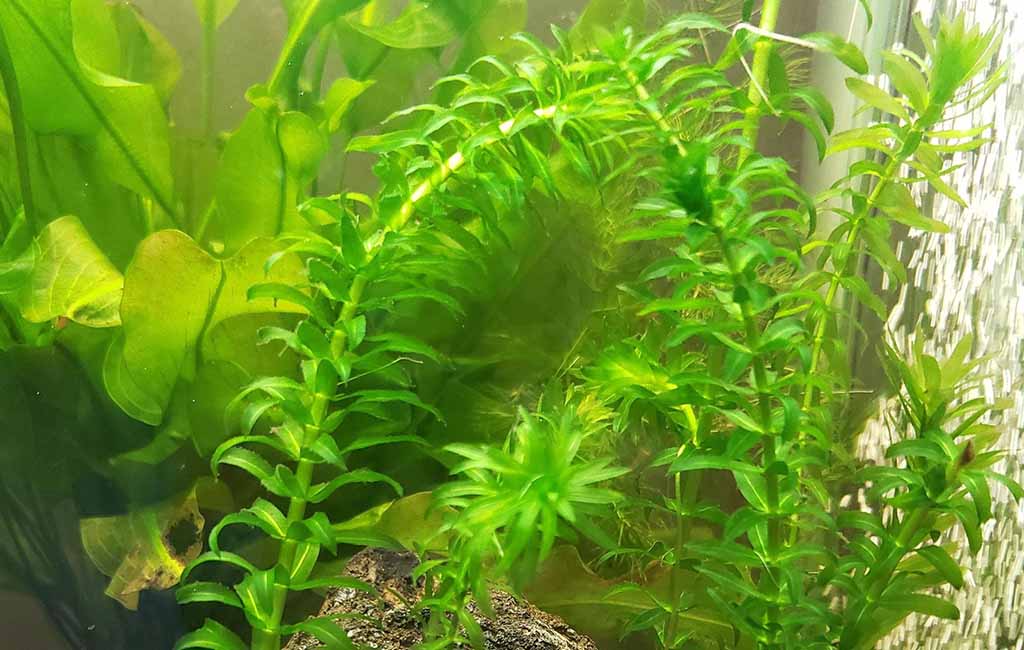
Egeria densa
Egeria Densa Aquatic Plants
Egeria Densa is a perennial aquatic plant. This lush green, bottle-brush-like appearing plant is highly invasive. It survives in a wide temperature range and shows rapid growth. Here is the brief profile of Egeria Densa.
| Category | Details |
| Scientific Name | Egeria densa |
| Synonyms / Former Names | Anacharis densa |
| Elodea densa | |
| Philotria densa | |
| Common Names | Brazilian waterweed |
| Egeria | |
| Oxygen weed | |
| Large-flowered waterweed | |
| Leafy elodea | |
| Dense waterweed | |
| Family | Hydrocharitaceae |
| Origin / Native Range | Brazil |
| Uruguay | |
| Argentina | |
| Global Distribution | North America |
| New Zealand | |
| Australia | |
| Africa | |
| Asia | |
| Europe | |
| Plant Type | Perennial submerged freshwater aquatic plant |
| Typical Size | Stems commonly 30–100 cm in aquaria |
| Wild stems reported up to ~4 m long | |
| Leaf Characteristics | Bright green, narrow leaves in whorls of 3–8 (commonly 4–5). Edges minutely serrated. |
| Flowering | Three petals small white flowers |
| Reproduction | Primarily vegetative via fragmentation |
| Temperature Range (Optimal) | 10–25 °C |
| pH Tolerance (Optimal) | 6.5 to 7.5 |
| Light Requirement | Low to moderate. Thrive under brighter conditions |
| Substrate Needs | In an aquarium, fine gravel, sand |
| In pond settings, loam | |
| Growth Rate | Fast |
| Uses in Aquaria / Ponds | Oxygenates water |
| Algae Control | |
| Absorb nitrates and phosphates | |
| Provides habitat and cover |
Egeria Identification
Egeria Desna belongs to Hydrocharitaceae. This family is also known as the frog-bit family. This family has 18 to 20 genera and about 120 to 135 different species. These species are fully aquatic and cosmopolitan monocotyledonous herbs.
Here is a brief overview of the Egeria family.
| Aspect | Details |
| Genus | Egeria |
| Family | Hydrocharitaceae |
| Order | Alismatales |
| Number of Species | E. najas |
| E. heterostemon | |
| E. densa | |
| Native Range | South America |
| Habitat | Submerged freshwater bodies |
Identification
Here are some features that will help you to identify the Egeria Densa from other species.
| Feature | Characteristics |
| Growth form | Submerged |
| Stems may be rooted or free-floating. | |
| Perennial aquatic herb | |
| long slender stems | |
| Stems | Cylindrical |
| Fragile | |
| Branched | |
| Forming dense mats | |
| Leaf Arrangement | Leaves are whorled around the stem |
| Usually, 4–6 leaves per node. However, it is possible 3 to 8. | |
| Leaf Shape | Linear to strap-like |
| Bright green | |
| Approximately 1–3 cm long | |
| Approximately 2–5 mm | |
| Leaf Edges | Edges have tiny teeth |
| Roots | Adventitious roots at nodes |
| It can regenerate the roots from fragments. Otherwise, they float on the water surface. | |
| Flowers | 3 petals of white flowers. These flowers float at the water surface. |
| Reproduction | Reproduce vegetatively through the stem fragmentation |
Distinction from similar species
There are some plants that you can confuse with Egeria Densa. Hydrilla and Elodea are examples of such plants. Here is the difference between making a complete distinction.
Elodea vs Egeria Densa
| Elodea | Egeria Densa |
| 3 leaves per whorl | 4–6 leaves per whorl |
| Shorter leaves | Longer leaves |
| Crowded whorls |
Hydrilla vs Egeria Densa
| Hydrilla | Egeria Densa |
| It feels rough to touch the underside of the leaf midrib | Smoother underside |
Visual Identification
- Leaves are around the stem.
- Mostly, 4 to 6 leaves in a whorl.
- You can find fine serration on leaf edges.
- 3 petals, white flowers
- Fast vegetative growth.
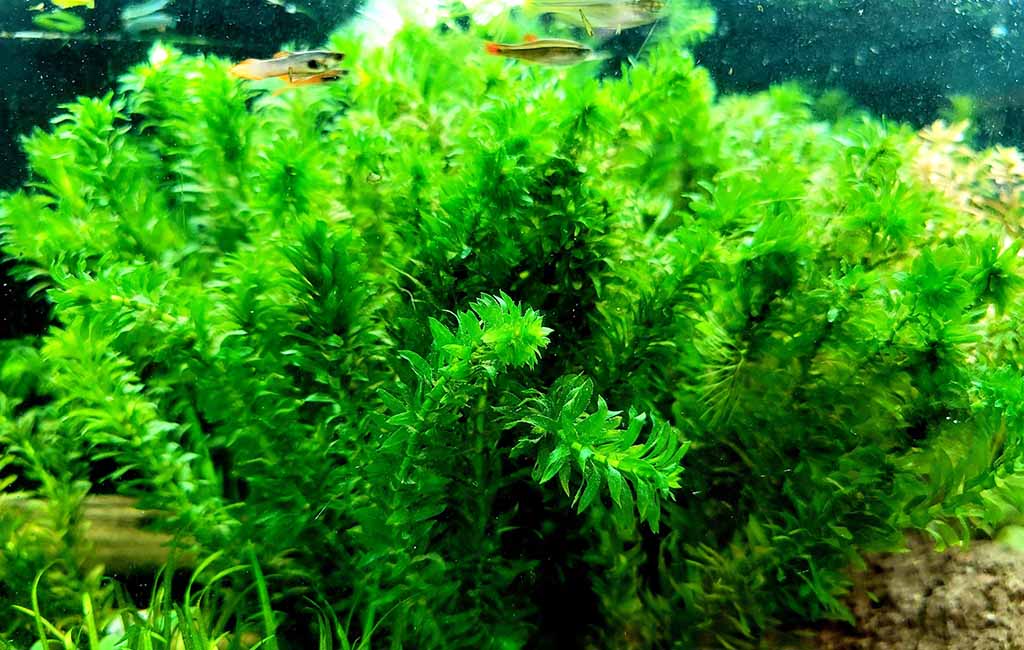
Egeria densa aquarium
Aquarium Egeria Densa
Egeria Densa is a fast-growing plant. It is suitable for freshwater beginner aquariums. If you control its growth rate, it serves for diverse roles in aquariums. Here are some of the roles of Egeria densa and other tank-related aspects.
Advantages
Water Quality
It plays a pivotal role in establishing a new aquarium setup, especially for lightly stocked tanks. It maintains the water chemistry. It helps prevent nutrient buildup by taking up nitrate from the water. It also offers ammonia buffering.
Its faster growth suppresses algae growth. It uses excessive phosphate in water and reduces phosphate. Above all, during photosynthesis, it produces oxygen. This oxygen makes the tank well-oxygenated and improves the fish’s health.
Optimise Fish-Health
It helps to improve the fish’s health in the tank in many ways. It is especially suitable for
- Livebearers
- Tetras
- Barbs
- Danios
- Rasboras
- bettas (in calm zones)
- Shrimp
As mentioned, it helps to improve the fish’s health. Here are the ways in which it helps to optimize fish health.
- It helps to reduce stress by offering a hiding space and cover.
- Its dense growth protects fry from the predators in the tank.
- It helps to regenerate the natural fish habitat.
- It is a spawning ground for egg-scattering species. Therefore, it is suitable for breeding tanks.
Help to Avoid Algae Bloom
Egeria densa helps to avoid algae growth in the tank. Although it does not directly interact with algae, it outcompetes them in growth. Due to this reason, it is a suitable option for a low-tech tank. Here is how it overcomes the algae growth.
- It rapidly absorbs the nutrients.
- It covers the lower area in the tank that is ground for algae growth.
- It uses the light that would otherwise be a fuel for algae growth.
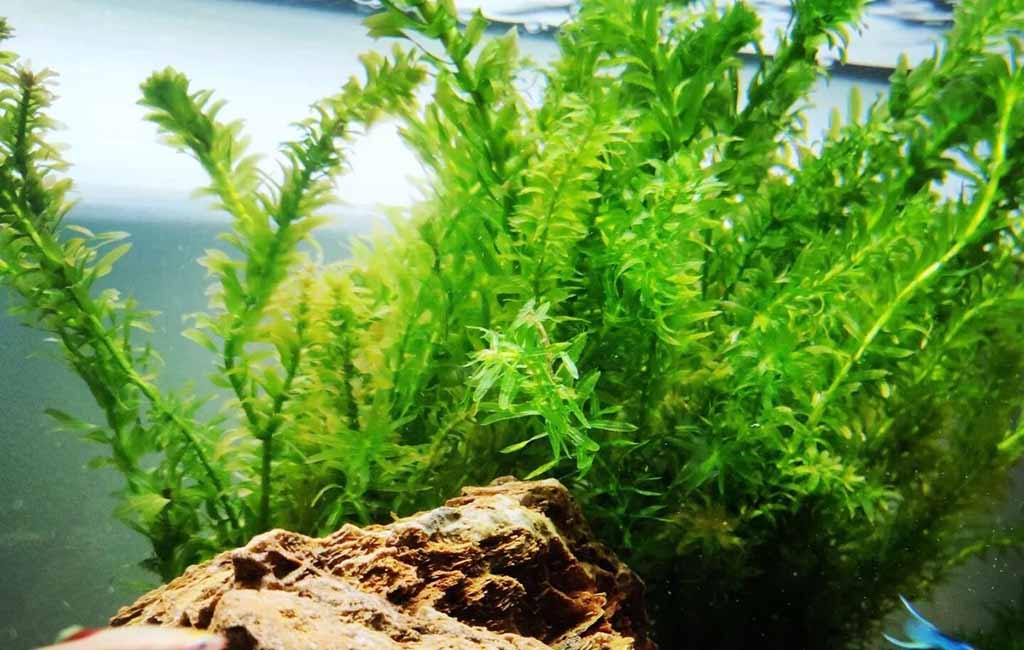
Egeria densa aquascaping
Role in Aquascaping
Visual and Design Function
- Its vertical growth helps to create depth in the background.
- Its bright green color helps to create a contrast in the tank with the hardscape.
- It greatly helps to create a biotope and jungle-style aquascapes.
- It is a suitable option for a filler plant as it shows rapid growth in the tank.
Layout Flexibility
It offers layout flexibility in the tank. You can use them in multiple ways.
- You can grow them as upright plants by growing them in substrate.
- It can float at the surface.
- It helps to hide equipment in tanks. For that, you need to bundle them behind the hardscape in the tank.
Role in Different Aquarium Setups
| Tank Type | Role |
| Beginner tanks | Forgiving plant that tolerates beginner mistakes |
| Low-tech planted tanks | Thrives without CO₂ injection |
| Breeding tanks | Fry shelter and biofilm growth |
| Shrimp tanks | Grazing surface and cover |
| Quarantine tanks | Improves water quality naturally |
Growth Behavior in Tank
- Fast growth rate.
- Faster under bright light.
- It does not require Carbon Dioxide for growth.
- It requires a moderate nutrient supply.
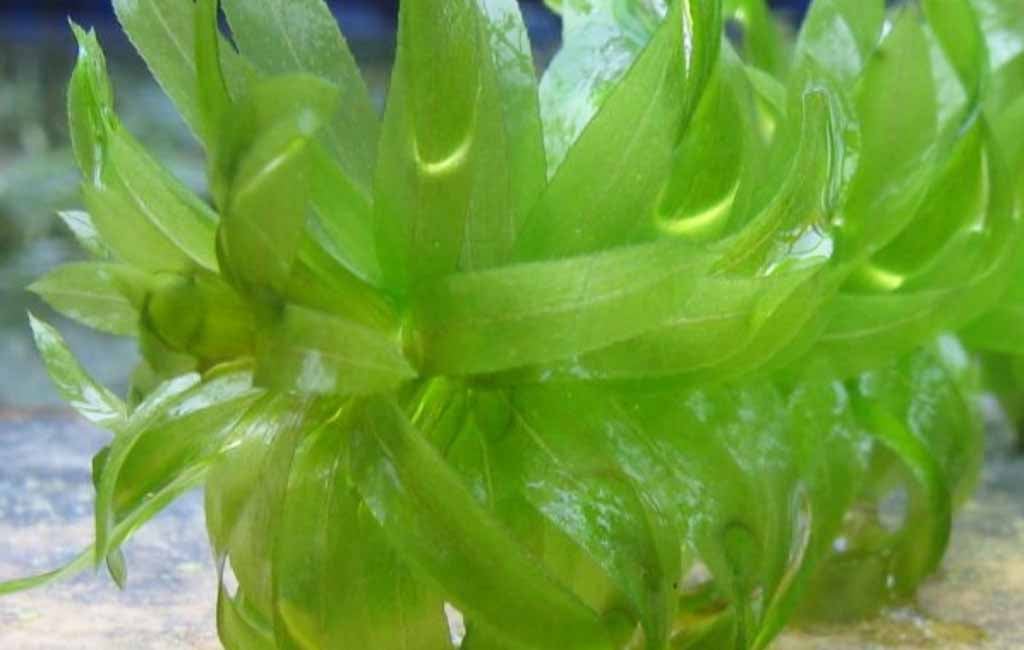
Does Egeria Densa Need CO2
Does Egeria Densa Need CO2
CO2 supply is optional for Egeria densa in a tank. However, if you need faster and healthier growth, supply CO2 in the tank.
How to Make Optimal Growth?
You can observe a rapid growth with and without CO2. However, you need to ensure a few aspects, which are as follows:
- Optimal water quality
- Trimming
- Nutrients in the tank
Water Parameter
| Parameter | Ideal Range |
| Temperature | 18–26 °C (best growth below 26 °C) |
| pH | 6.5–7.5 |
| Hardness | Soft to moderately hard |
| Flow | Gentle to moderate |
Nutrients
It requires optimal nutrients for healthy growth in a tank. Supply the following nutrients in liquid form for more effective results. Nutrients include
- Nitrogen
- Potassium
- Phasphorush
However, the nutrient level varies with the tank type.
| Tank Type | Fertilization Level |
| Fish-heavy tank | Light dosing |
| Planted tank | Regular dosing |
| Shrimp tank | Half dose |
Trimming
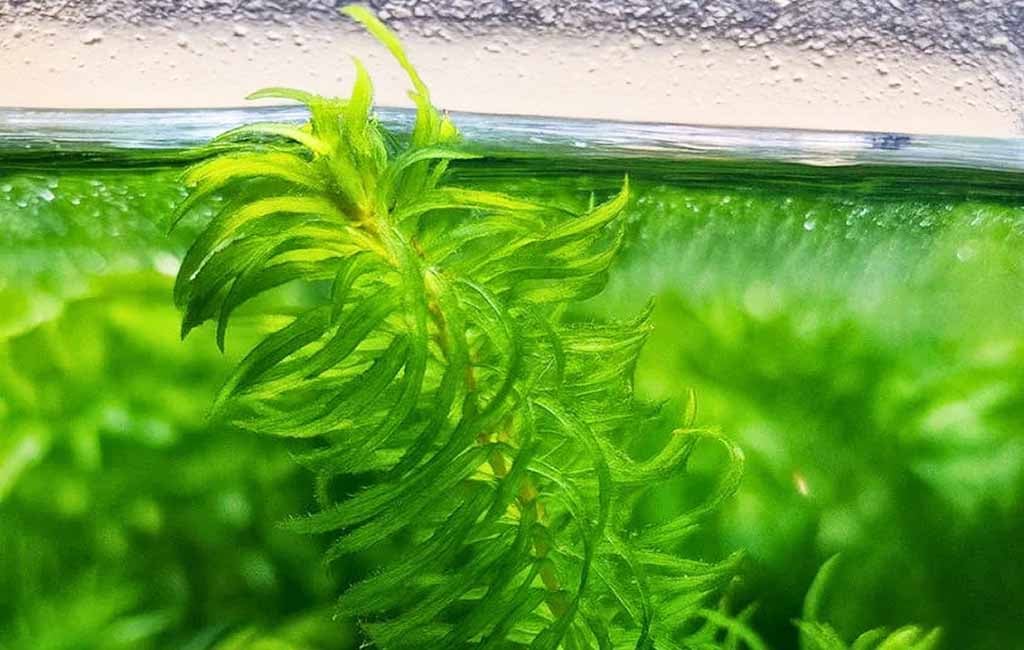
It grows faster when trimming is done properly. For proper trimming, remove 10 to 15 cm from the sides of the plant and replant these cuttings in the tank. It offers the following benefits.
- It encourages the sidewise growth of the plant.
- Preventingshading the lower stems of the tank.
- It helps to make the plant more bushy.
Egeria densa care
Rapid Growth – Without CO2
Once you have satisfied all of the conditions, you can enjoy the plant’s rapid growth. You can do so by increasing the light intensity. Here is the growth behavior at various light intensities.
| Light Level | Result |
| Low light | Slow and thin growth |
| Medium light | Healthy and steady growth |
| High light | Fast and bushy growth |
Rapid Growth – With CO2
CO2 supply is a growth accelerator. A 15–25 ppm CO2 is optimal for faster growth. With the CO2 supply, you can see the following changes in your plant growth.
- Bushier growth.
- Tight leaves whorls.
- Dark green leaves
Egeria densa behaves differently against CO2 types.
| Setup Type | Growth Speed | Plant Health |
| Liquid carbon (Excel-type) | Moderate–Fast | Better |
| Pressurized CO₂ | Fast | Excellent |
How to Control Egeria Densa?
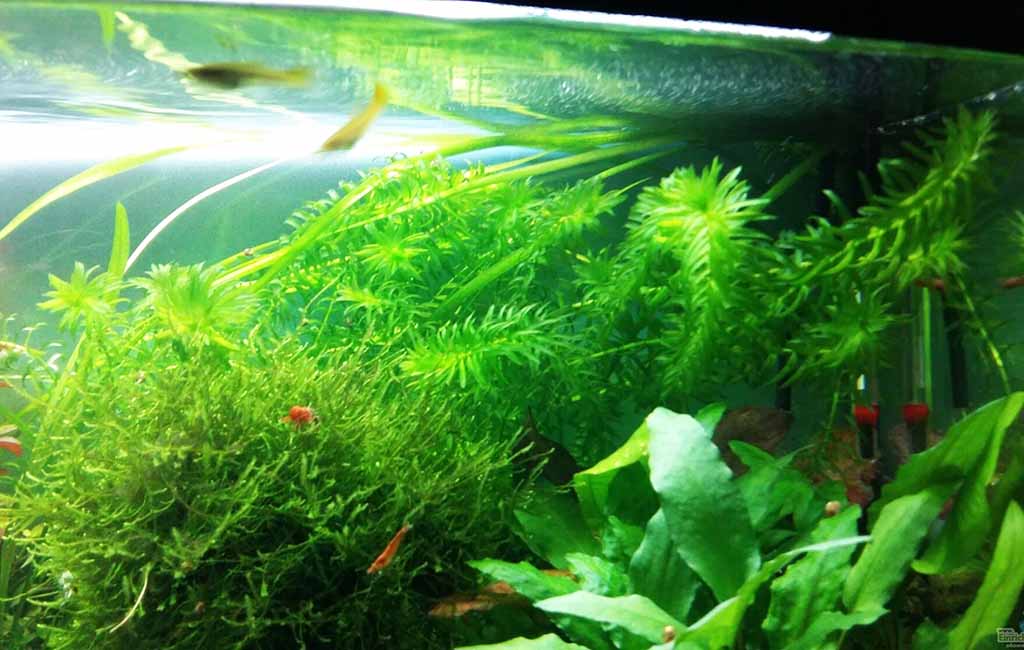
Let’s understand the problem of why Egeria densa floats on the surface.
Reasons
- Fast vertical growth due to a lack of proper trimming.
- Lower stems are weak due to bottom rots or lose grip.
- Plants are not properly rooted in the substrate, and they begin to float due to the loss of anchor.
- Surface light is strong enough for faster plant growth.
How to Control Egeria Densa to Long to Float
Here are some methods to avoid floating.
Early Trimming
Regularly trim the plant. When it is about to reach the surface, cut about 8 to 12 cm from the top. Replant the healthy cuttings and remove the old and weak stems.
Correct Plantation
Make the bottom side 2 to 3 cm of the plant leaves-free. After that, push the plant about 2 to 4 cm into the substrate. Ensure that there is 3 to 5 cm space between stems.
Light Adjustment
Bright light is fuel for growth. Provide low to medium light exposure for 7 – 8 hours daily. It’ll help to control the Egeria densa plant growth.
Bushy Growth
Bushy growth is another way to cope with vertical floating. Frequently trim from the sides, rather than from the top of the plant, to achieve bushy growth.
Gentle Flow
Adjust the flow rate to slow. A high flow rate can weaken the stem, resulting in palnt floating. Reducing the flow rate will reduce the floppy and floating growth.
How to Control Egeria Densa
Take Care of Egeria Densa
Here is a comprehensive care sheet for the Egeria Densa plant.
Lighting
The light affects the plant’s growth rate. It is suitable to use low to medium lighting for controlled growth. Here are other brief details.
| Level | Recommendation |
| Light type | moderate to bright, full-spectrum lighting (5000K–6500K) |
| Best result | Medium light |
| Photoperiod | 7–8 hours/day |
Water Parameters
Control over water parameters also results in optimal growth and allows you to dictate the plant growth.
| Parameter | Ideal Range |
| Temperature | 15 to 26 °C |
| pH | 6.5 to 7.5 |
| Hardness | 4 – 18 dGH |
| Water flow | Low to slow-moving water |
Plantation
Once you are ready, go to the plantation. Here are some planting tips.
- Make about 2 to 3 cm at the bottom side of the plant leaves free.
- After that, push the plant about 2 to 4 cm into the substrate.
- Ensure that there is 3 to 5 cm space between stems.
- Remove the bottom 2–3 cm of leaves
- Grow in small groups.
Nutrition and CO2
| Requirement | Needed? |
| CO₂ injection | No |
| Liquid fertilizer | Yes (Once or twice weekly) |
| Root tabs | No |
Maintenance
- Trim the plant according to growth. It may be weekly or twice a month.
- Trim the top about 8 to 12 cm before it touches the water surface.
- Replant the healthy cuttings.
- Remove the weak or rotten bases.
Parting Thoughts
Egeria densa is a green and rapidly growing plant. This natively belongs to the South American region; however, it is currently present throughout the world. Aquarists love it due to its rapid and bushy growth and other aquascaping benefits. However, it requires proper maintenance, such as lighting, trimming, and water parameters, to control its growth rate.
Related Products


Leave a comment