
Dwarf Hairgrass helps to elevate the look of any freshwater tank with lush green carpet growth. It is easy to grow and maintain. Therefore, beginners and experts love to have it in their tank. In the following, you’ll learn about its general profile, characteristics, and whether it requires CO2 dosage. Moreover, how you can grow it in your tank is worth knowing. Scroll down to start your Dwarf Hairgrass journey.
Content Table
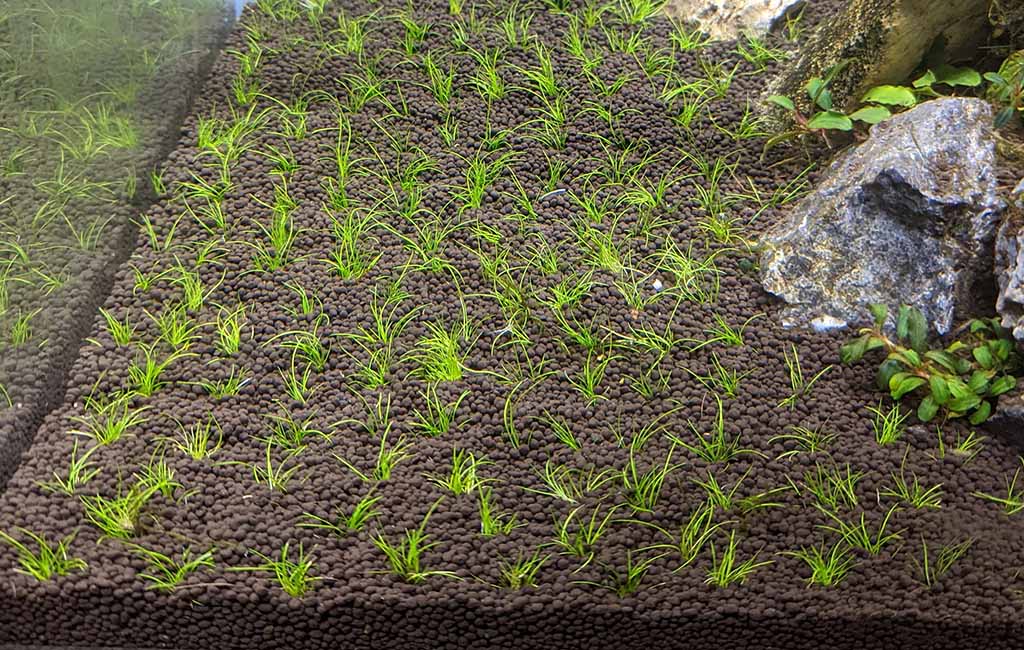
dwarf hairgrass
Dwarf Hairgrass
Dwarf Hairgrass is a freshwater aquatic grass-like plant that grows like a carpet. It grows in bright green hair-like strands. Aquarists use it for aquascaping and tank decor. It is popular among aquarists due to its easy care, providing hidden space to fish and other aquatic pets, and its coloration. Eleocharis parvula and Eleocharis acicularis are popular among aquarists.
General Profile of Dwarf Hairgrass
Here is a general profile of Dwarf Harigrass.
| Attribute | Detail | |
| Common Names | Dwarf Hairgrass | |
| Simply hairgrass | ||
| Small spikerush | ||
| Needle spikerush | ||
| Scientific name | Eleocharis parvula | |
| Family | Cyperaceae | |
| Water type | Freshwater | |
| Origin | E. parvula | North America |
| E. pusilla | Australia | |
| South America | ||
| Asia | ||
| Europe | ||
| North America | ||
| New Zealand | ||
| Type | Rooted, carpeting aquarium plant | |
| Growth Form | Grass-like runners, dense carpet | |
| Placement in Tank | Foreground | |
| Light Requirement | Medium to high | |
| CO2 requirement | Optional | |
| Substrate | Nutrient-rich fine-grain soil | |
| Growth rate | Moderate | |
| Propagation | Through runners or stolons | |
| Trimming duration | Usually, about a week of planting. However, it depends on the aquarist’s choice. | |
| Uses | Create carpet | |
| Shelter for fry and small fish | ||
| Produce oxygen | ||
| Suitable tank | It is suitable for peaceful fish and shrimp. However, avoid growing in the digging Aqua pets tank as they can disrupt the grass. | |
| Suitability | Beginners and experienced | |
| Algae susceptibility | Low to moderate | |
Characteristics
- It appears like grass, and forms a carpet through horizontal growth, and takes a few weeks to form a dense mat.
- Dwarf hairgrass is delicate and has soft leaves, and forms a dense grass mat on CO2 supply and optimal lighting.
- It produces oxygen under intense light during photosynthesis, and it can adapt to a wide range of water parameters.
- According to trimming duration and light intensity, it grows between 2 and 10 cm high.
- Dwarf hairgrass takes nutrients from its roots. It is a strictly rooting plant. Therefore, no floating or emergent leaves.
- It is suitable for peaceful small fish and shrimps, and helps to maintain the nutrient level in the tank.
- It requires frequent maintenance to avoid algae growth threats, as they are prone to it.
- Dwarf hairgrass requires a low to medium flow rate. Higher flow rate can cause uprooting, especially in new plantations.
Does Dwarf Hairgrass Spread
Dwarf Hairgrass spreads and forms a mat at the aquarium bottom. It horizontally spreads through runners, also known as stolons, under the substrate. Dwarf Hairgrass produces daughter shoots throughout the runner length. These daughter shoots help to achieve dense and lush carpet growth in the tank. Aquarists use it for Iwagumi and nature-style aquascapes on the front side of the tank.
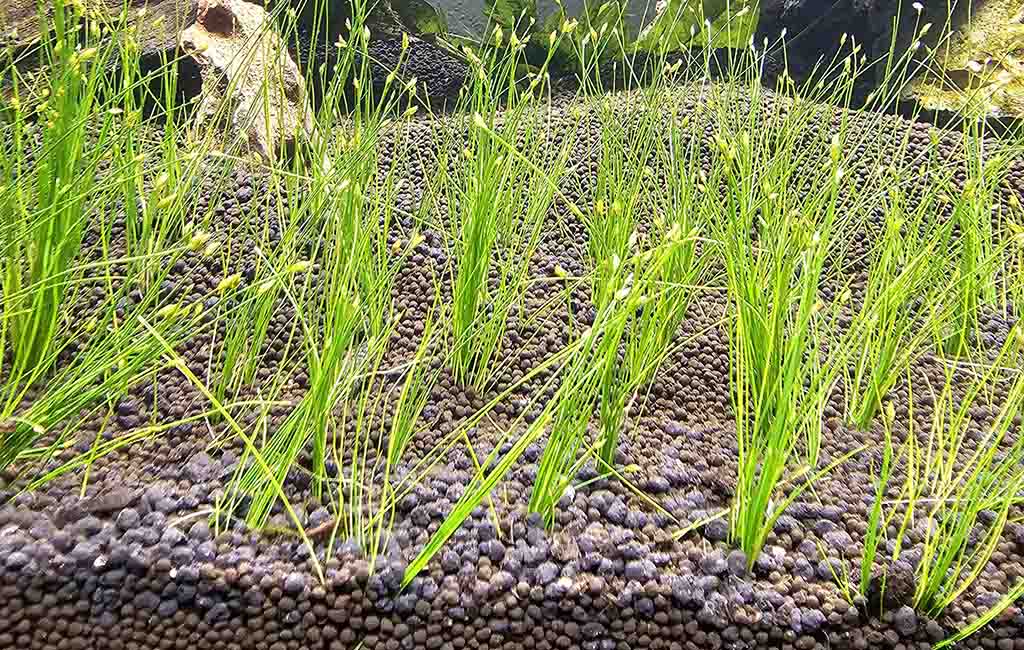
does dwarf hairgrass spread
Growth-Effecting Factors
Its growth greatly depends on several factors.
- CO2 injection
- Lighting intensity
- Nutrient level in the substrate
- Trimming frequency
- Stability of water parameters
- Plantation technique
- Water flow rate
Can It Grow Dwarf Hairgrass Without CO2?
Yes, you can grow dwarf hairgrass without a CO2 supply. By doing so, you can observe a slow growth rate. It’ll grow less tall and less compact. However, if you want to grow without CO2, it will grow due to its ability to adapt.
Here is a growth comparison of Dwarf Hairgrass between with and without CO2.
| With CO2 supply | Without CO2 supply |
| Grow quickly | Grow slowly |
| Spread efficiently | Spread at a slower rate |
| Grass blades remain shorter and thicker | Grass blades tend to grow long and have dense growth. |
| Form vibrant green coloration | Grow in pale green coloration |
| Highly resistant to algae and melting under high lighting conditions | Highly prone to algae and have weak roots |
| Form dense carpet | Form patchy and less dense carpet |
Optimal Dosage Supply and Check
If you want to observe lush green and carpeting growth in the tank, a dosage between 20 and 30 ppm is optimal. Supply the dosage to the tank before 1 to 2 hours of turning on the lighting, and turn the CO2 supply off for almost 1 hour before turning off the lighting.
Supply CO2 with a bubble counter and a solenoid valve. 1 bubble per second per 10 gallons is the best starting dose. Later, maintain CO2 dosage according to the plant, livestock, and drop checker color response. Lime green is considered the safe CO2 level in the tank.
How to Plant Dwarf Hairgrass in Aquariums?
With a proper plantation technique, it is easy to grow and enjoy the optimal growth of Dwarf Hairgrass.
Preparation
Before the Dwarf Hairgrass plantation, prepare several things to enjoy the lush green carpet growth. Here are some preparations.
Substrate
Lay a 1 to 2-inch deep fine-grain, nutrient-rich substrate at the bottom. If you want to lay a sandy substrate, lay an aqua soil layer at the bottom. This aqua soil will act as a pool of rich nutrients, essential for optimal dwarf Hairgrass growth. However, in any condition, don’t use gravel as a substrate.
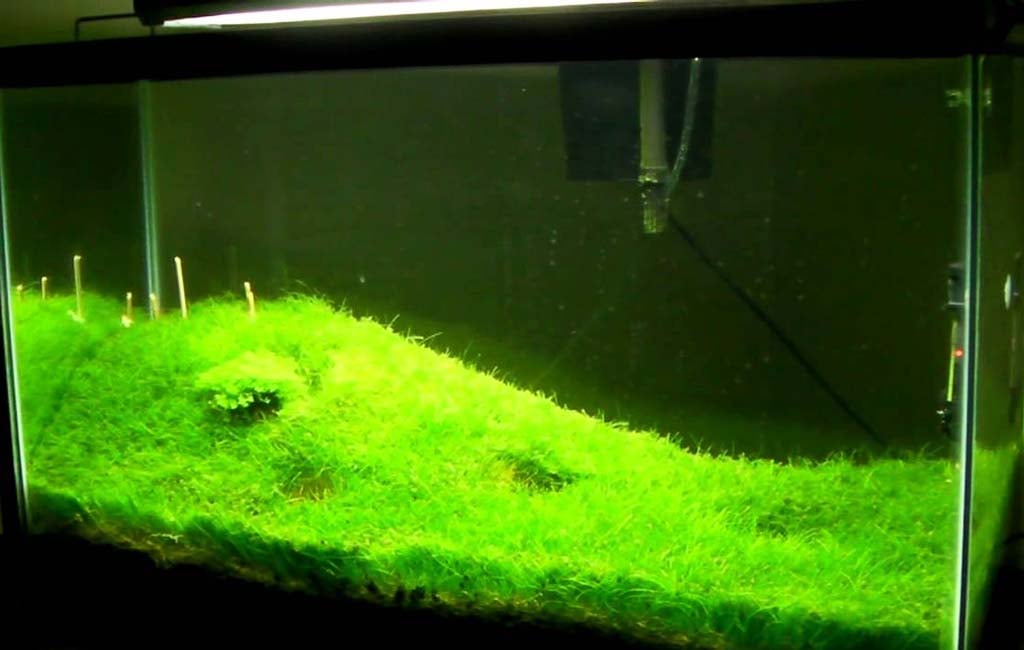
Plant Dwarf Hairgrass in Aquariums
Lighting
Low lighting can cause dull coloration and a slow growth rate of Dwarf Hairgrass. Moreover, bad lighting catalyzes algae growth. However, high light that does not sync with CO2 supply also causes an algae bloom in the tank. Use 3 to 5 watts per gallon light for 8 to 10 hours daily to enjoy lush growth. It will optimize the photosynthesis process and oxygenation of the tank.
CO2 Injection
Prepare a CO2 supply, as it will help you to enjoy fast plant growth and dense mat formation. CO2 injection boosts the coloration, growth rate, and mat formation.
Dwarf Hairgrass Patch Size
They grow best when divided into small patches. Therefore, before plantation, divide them into a patch of 4 blades per patch. It will help you to enjoy even, fast, and lush growth in the tank.
Optimal Water Parameters
| Parameter | Value |
| Temperature | 70°F and 83°F |
| pH | 6.5 to 7.5 |
| KH | 2 and 10 dKH |
| GH | 2 to 10 dGH |
| CO2 | 20 to 30ppm |
| Nitrate | 10 and 25 mg/l |
| Phosphate | 0.1 to 0.5 ppm |
| Iron | 0.5 to 1.0 ppm |
| Flow rate | Medium |
Plantation Guide
Here is a step-by-step procedure for optimal plantation.
- Prepare the substrate.
- Plant the patch in the substrate with the help of tweezers.
- Plant with a 2-inch difference.
- Turn the lights on for 8 to 10 hours.
- Supply the 20 to 30ppm CO2 for faster and lush growth.
- If you are planting in an empty tank, cover the plants with a plastic plate. Fill the tank slowly to avoid disruption and uprooting.
- Weekly, trim the grass minutely to keep its growth under control.
- Catalyze the growth with liquid fertilization and root tabs.
- Always keep an eye on the algae growth. Remove it as soon as possible.
Final Insights
Dwarf Hairgrass is a small, lush, green, and easy-to-grow aquatic plant. It forms a dense mat. Aquarists use it for aquascaping. They are highly adaptable and can grow without a CO2 supply. However, without CO2, it turns pale and patchy. Provide optimal light, nutrient-rich substrate, and maintain optimal water parameters before growing it into the tank. After that, plant a 4-leaf grass patch at a 2cm distance and enjoy the carpet growth with proper care.
Related Products


Leave a comment